
Humanoid Robots Reach Nasdaq. Orders Still Are Not Revenue.
Published November 8, 2026
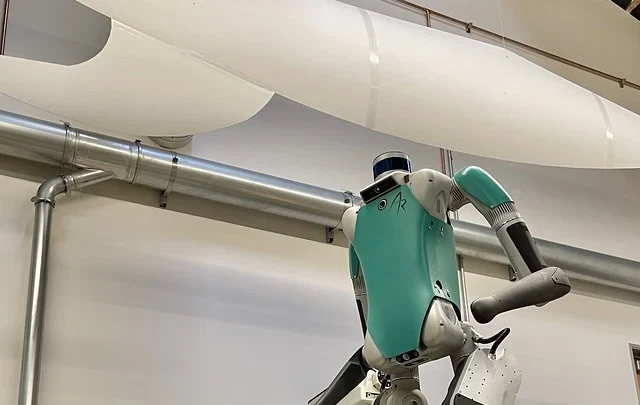
Steve Jurvetson, CC BY 2.0: cropped earlier Digit, February 2022. Not Digit 5 or the November 2026 Nasdaq event.
Image credit
Digit Bot Bop, February 3 2022
Steve Jurvetson · CC BY 2.0Cropped to the earlier robot upper body for a readable landscape thumbnail; resized and converted to WebP.
Agility begins AGLT trading with financing, operating-hour and conditional-order claims. They describe different things, not one measure of robot success.
A humanoid robot on a stage can demonstrate a movement. A public company has to account for a business. Agility Robotics' Nasdaq debut puts those two kinds of evidence next to each other.
The company announced trading as AGLT on November 5, describing itself as the first U.S.-listed pure-play humanoid robotics company with active commercial deployments. That "first" is the company's stated category, not a claim that no publicly traded business has ever made a robot.
The accompanying figures are useful precisely because they describe different things. Agility reports more than 65,000 hours of real-world robot operation, about $465 million in gross capital from the transaction and related financing, and more than $300 million in committed multi-year Digit 5 orders. None of those numbers is interchangeable with revenue earned from completed robot work.
Start with What Actually Closed
The SEC filing records the business combination's November 4 closing and identifies the common-stock trading symbol. This route through a business combination differs from a conventional initial public offering.
Capital raised is money available to support the business, subject to the transaction's costs and other details. It is not a measure of how many customers have paid for robots or how much useful work those robots completed. The word gross also matters: a gross financing figure is not automatically the cash remaining after expenses.
Those distinctions are bookkeeping, but they are also a way to resist a very common hardware headline problem. A large number can sound like customer demand even when it describes financing instead.
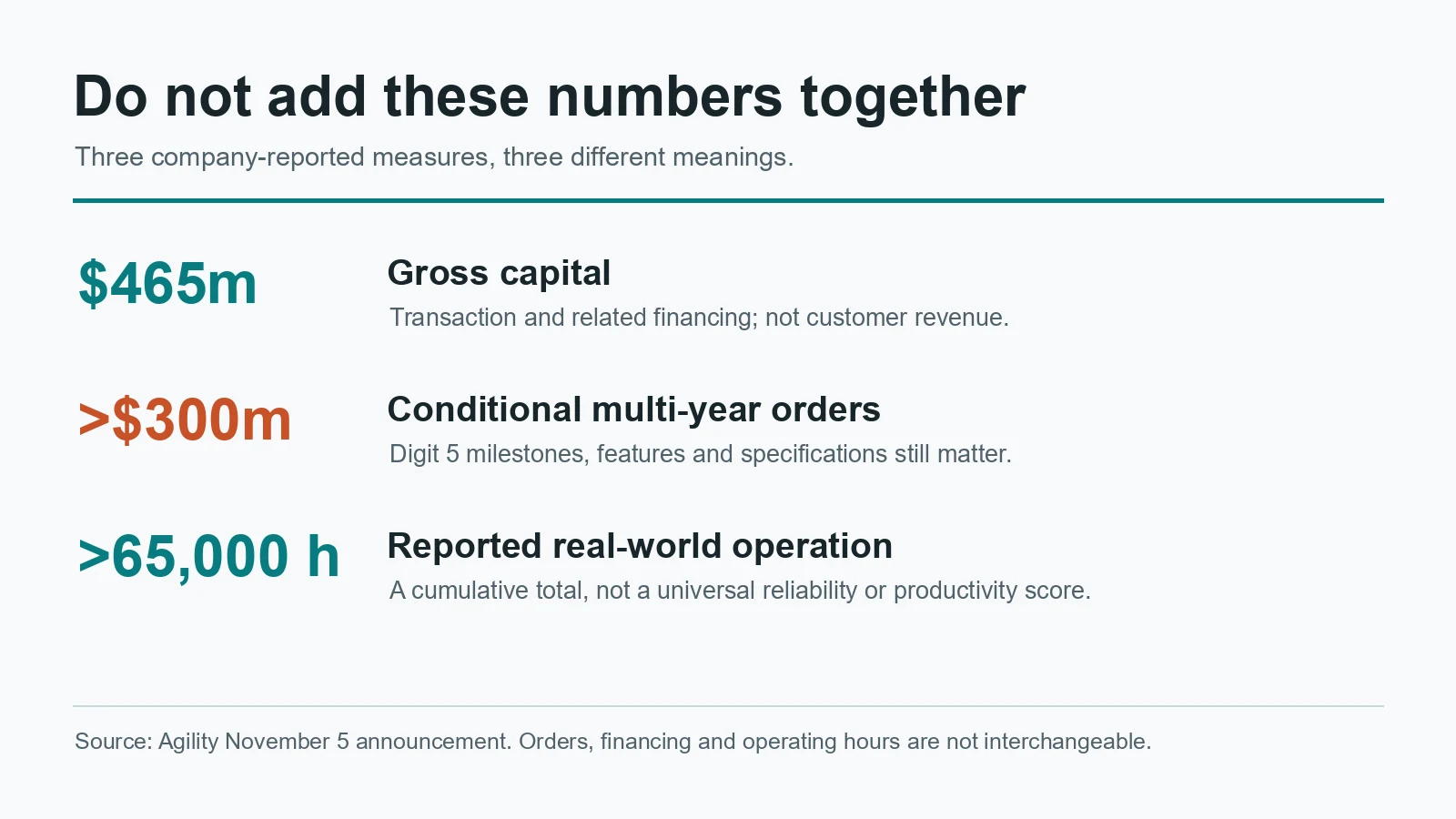
Original graphic of three differently defined company-reported measures; they must not be added or treated as revenue.
Orders Have Conditions
Agility's reported Digit 5 orders are dependent on contractual milestones, features and specifications. The company targets early customer access for the first half of 2027 and general availability by the end of that year. Those are forward-looking plans, not confirmation that all the ordered robots have shipped.
A committed order can matter without being equivalent to recognized revenue. It expresses a commercial relationship with terms attached. Whether the manufacturer delivers the required system, when delivery happens and what the contract requires are all part of the story.
For readers interested in the engineering, the conditions are especially revealing. Customers are not buying an impressive video in the abstract. They need a machine with specified capabilities that fits a workflow. A promise about a future robot therefore needs to be read alongside the requirements that make the promise meaningful.
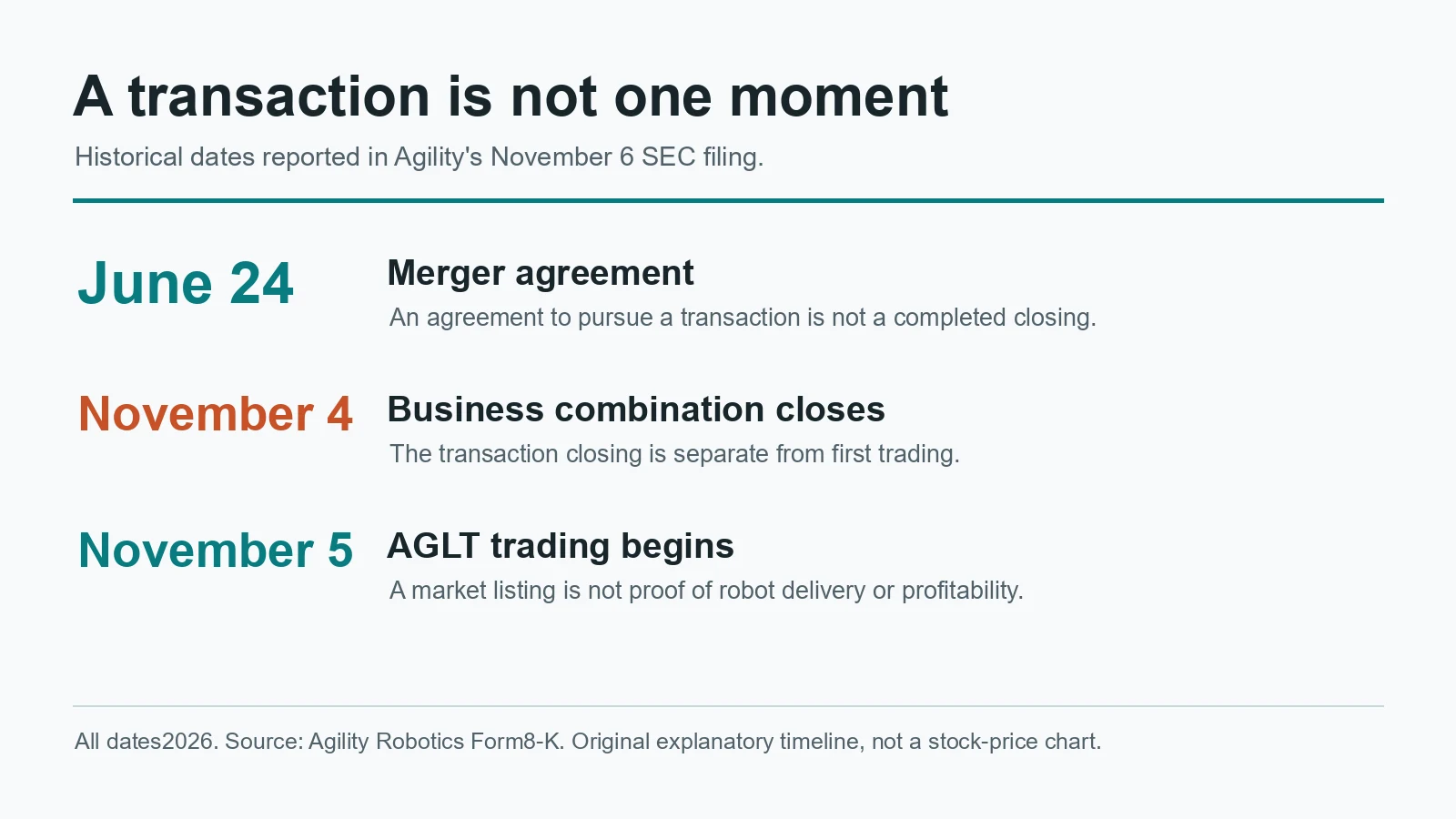
Original timeline based on the SEC filing. Closing and first trading are separate dated events.
Hours Describe Exposure, Not a Universal Reliability Score
The company's cumulative operating-hours claim gives more context than a short demonstration alone. It still does not tell a reader everything about reliability, intervention or cost.
A total number of hours needs a denominator and a setting to answer more specific questions. How many machines contributed? What tasks were they performing? How often did someone intervene? What counted as productive work? This article does not invent answers that the cited announcement does not supply.
The same caution applies to images. A photograph of an earlier Digit is useful historical context, but it is not a photograph of the announced Digit 5 configuration or evidence that a 2027 delivery target has already been met.
A More Inspectable Robotics Story
Public reporting creates a continuing record to compare with the company's claims. It does not make every forecast correct or turn technical demonstrations into guaranteed commercial success.
That makes this a worthwhile development for people following robotics, even without treating it as an investment recommendation. Future reports can be read for the difference between money raised, customer commitments, delivered systems and recurring business performance. The categories are more informative than a single large total under a photograph of a robot.
The engineering and the economics also meet at an ordinary operational question: does the system do useful work dependably enough for the customer who installed it? A robot's shape cannot answer that. Neither can a stock ticker on its own.
The interesting next chapter is not whether another demonstration looks impressive. It is how the company documents the transition from promised capabilities and conditional orders to delivered work. Keeping the numbers in their proper categories makes that chapter possible to follow.
Completed tasks, intervention frequency, downtime, cost per useful job: each tells a different story. Share the measure you would put first in the comments below.
Comments
Member comments are temporarily unavailable.
Log in to join the discussion.