
AlphaGenome 2 Asks Which Cell a DNA Change Actually Matters In
Published November 13, 2026
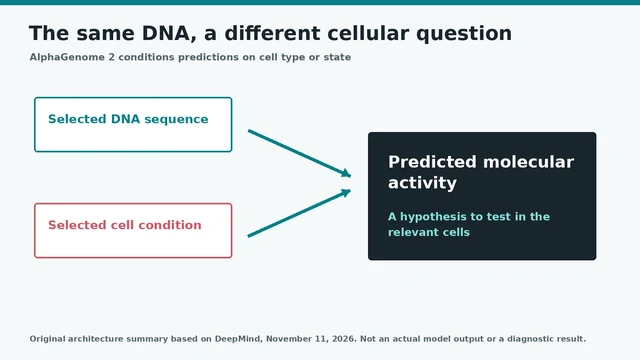
Original explanatory diagram based on the developer description, not a clinical result.
DeepMind's new model conditions DNA predictions on cell type and state. Its reported gains could guide experiments, but it is not a diagnostic tool.
The same stretch of DNA can matter very differently in two different cells. A change that affects an activated immune cell may have little visible effect in another cell type. Average those cells together and the important signal can become difficult to see.
That is the problem behind AlphaGenome 2, announced by Google DeepMind on November 11. The new research model takes a DNA sequence and a biological condition, such as cell type or state, and predicts molecular activity in that context.
The distinction is more useful than calling it an AI that "reads the genome." The task is not merely recognizing the letters. It is predicting how a particular cellular environment changes what those letters do.
Why Cell Context Changes the Question
Genes are regulated. A cell does not use every available instruction at once, and specialized cells have different patterns of activity. Some DNA variants act through regulatory sequences rather than directly changing a protein's code.
That creates a difficult chain of questions. Which variant matters? Which gene does it affect? In which cells does the effect occur? Does it increase or decrease activity? A broad genetic association does not automatically answer all four.
DeepMind says the new model was trained on data including more than 107 million individual cell profiles across 68 tissues. Unlike the original model's fixed parallel outputs across many experiments, AlphaGenome 2 conditions its predictions on a selected biological context throughout its architecture.
It can also take a representation derived from a scientist's own single-cell gene-activity measurements. The company reports that this lets the model make predictions for newly profiled states without retraining a separate model for each experiment.
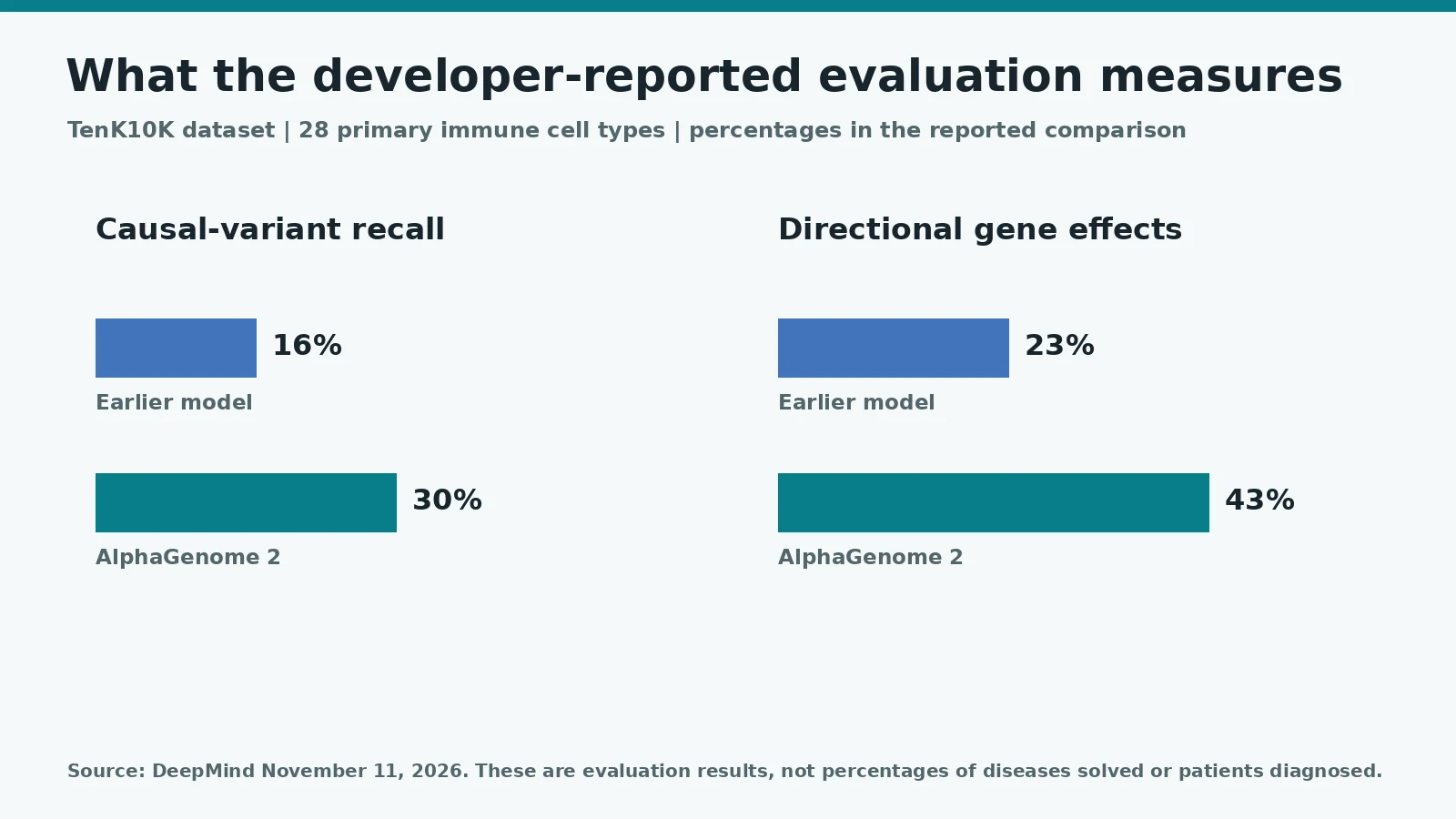
Original chart of DeepMind-reported TenK10K results; not percentages of diseases solved.
What the Reported Improvement Measures
In the company's evaluation using TenK10K, a dataset covering 28 primary immune cell types, the new model identified 30% of the evaluated causal variants, compared with 16% for the earlier model fine-tuned on single-cell data. The corresponding reported figures for directional gene effects were 43% and 23%.
Those are specific evaluation results, not the percentage of diseases the system can explain or patients it can diagnose. They should also be read as developer-reported results. Independent use across different experiments will help establish where the gains hold and where predictions remain unreliable.
The useful promise is experimental prioritization. If a model suggests that a variant changes a particular gene mainly in one immune-cell state, researchers have a more focused hypothesis to test. Predictions about missing molecular measurements could similarly help decide which experiments to perform next.
A Better Hypothesis Is Still a Hypothesis
The model has not turned computational prediction into a clinical result. DeepMind explicitly describes AlphaGenome and AlphaGenome 2 as research tools that have not been validated or approved for clinical or diagnostic purposes.
Access conditions matter too. The announcement offers the API for noncommercial research and a separate private preview for commercial research. Public availability of a tool does not mean unrestricted commercial access or permission to reproduce every image accompanying its announcement.
The most interesting shift is conceptual: a DNA change no longer has to be discussed as though it has one universal effect everywhere in the body. Better cell-specific predictions could make genomic research more selective, more testable and less dependent on averages that hide the biology researchers need to understand.
Which would help a research team most: finding the relevant variant, the affected gene, or the cell state in which it acts? Discuss it in the comments below.
Comments
Member comments are temporarily unavailable.
Log in to join the discussion.