
A 14-Foot Asteroid Passed Closer Than the Moon on October 10
Published October 11, 2026
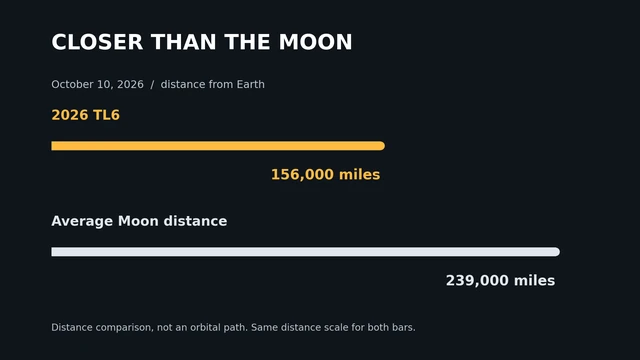
Both bars use the same distance scale. This comparison is not an orbital trajectory or an image of the asteroid.
Asteroid 2026 TL6 passed about 156,000 miles from Earth. Here is what the distance means, what the size estimate means, and what it does not imply.
On October 10, asteroid 2026 TL6 passed about 156,000 miles from Earth, closer than the Moon's average distance of 239,000 miles. The supplied NASA Asteroid Watch entry estimated the object at just 14 feet across. It was a small, close passage, not a reported impact or an announced emergency.
Because NASA's "next five approaches" dashboard changes as encounters come and go, yesterday's entry may no longer appear on that page. JPL's Close Approach Data API independently records this encounter at 05:40 UTC on October 10, with a nominal distance of about 0.001676 astronomical units. That converts to roughly 156,000 miles. JPL encounter record, Asteroid Watch dashboard and distance explanation.
Put Both Distances on the Same Ruler
Divide 156,000 by 239,000 and the result is about 0.65. The asteroid's closest approach was therefore roughly two-thirds of the average Earth-Moon distance.
That is the comparison in the lead graphic. Both bars start at zero and share a scale. There is no swooping trajectory, no implied collision course, and no suggestion that the Moon was sitting directly beyond the asteroid at that moment.
Those choices matter. A diagram showing a giant rock beside Earth can make an encounter look much more threatening than the underlying numbers. A scale for distance is not automatically a scale for object diameter. At the distances in this story, a fourteen-foot body would disappear in a faithfully scaled full-view drawing.
"Closer than the Moon" also uses an average. It does not tell you the Moon's exact position or distance during this particular encounter. It is a readable yardstick, not a reconstruction of the whole scene.
The Size Is an Estimate
Fourteen feet is about 4.3 meters. That conversion does not turn an estimated diameter into a precisely measured edge-to-edge dimension, and it certainly does not establish the object's shape.
The International Asteroid Warning Network's close-approach table also lists 2026 TL6, with a lunar-distance comparison consistent with the JPL record. Its discovery entry points to observations on October 8. IAWN approach table.
A catalog identifier can sound like a product model, but it is not a photograph. We do not have a close-up spacecraft image of this asteroid in the supplied research. Giving it an invented cracked surface and calling that a telescope view would add apparent detail without adding evidence.
Close Does Not Mean an Impact Threat
The reported closest approach is a miss distance. Neither that distance nor a place in a close-approach table establishes that the object was expected to hit Earth. No impact threat is indicated by the information supporting this report.
There is still something worth following here. Observations turn a faint moving source into a dated orbital record, and that record lets readers distinguish an ordinary close passage from a different kind of event. The interesting part is the measurement, not an imaginary near-disaster.
If you explore JPL's data, keep the units beside the values. An astronomical-unit distance, a lunar-distance ratio, and a diameter in feet describe different quantities. A small decimal in one column can become a large number in another without either source disagreeing.
The same discipline is useful when sharing the story: say when it passed, how close it came, and that the size is estimated. That is already an engaging account of a small neighbor moving through a very large space. What scale comparison would make these encounters easiest to understand? Tell us in the comments below.
Comments
Member comments are temporarily unavailable.
Log in to join the discussion.