
A Robot Built a Truss in Orbit. The Antenna Is Still Unfinished.
Published November 8, 2026
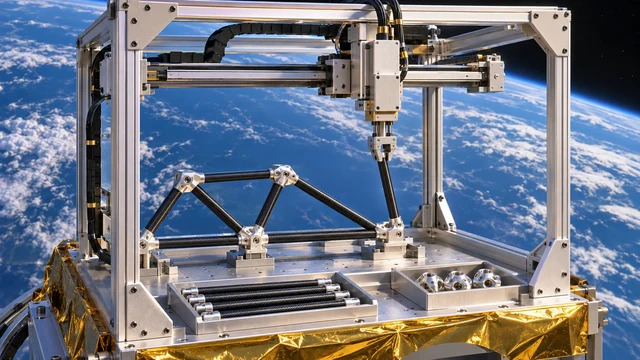
AI-generated editorial illustration of orbital truss assembly, not the actual ASTRA payload or flight footage.
Caltech ASTRA assembled an extra truss bay in space. The unfinished antenna reveals both the promise and the difficulty of orbital construction.
Getting a large structure into space usually begins with making it small enough to fit inside a rocket. Caltech's ASTRA experiment tested a different order: launch the building materials, then join them together in orbit.
The result announced on November 5 is real, but smaller than the most tempting headline. The payload launched with two truss bays already assembled and added a third in space. It did not finish its planned 11-bay reflector. Caltech's account makes that distinction unusually clear.
That is still an important piece of engineering. Extending a structure by joining individual members is different from releasing a folded structure that was assembled on Earth. The experiment demonstrated a construction step, rather than simply deployment.
A Small Builder, Not a Giant Space Factory
ASTRA stands for Autonomous In-Space Tensioned Reflector Assembly. Its basic arrangement combines a positioning mechanism, supplies of structural components and an assembly area. The system takes members and joints from dispensers and places them into a repeating truss.
DARPA describes a relatively simple gantry robot moving along three linear axes. This is not a humanoid construction worker or a demonstration that a general-purpose AI can build anything. The significance lies in combining a repeatable joining process with hardware that can operate after launch.
Think of the difference between opening a folding chair and making another section of a bridge. Both change the shape of something in space. Only the second requires a process for adding connected structural elements. ASTRA addresses that second problem on a deliberately small scale.
The article's lead image is an explanatory illustration, not a photograph of the payload. The official Caltech video and source photographs show the actual experiment.
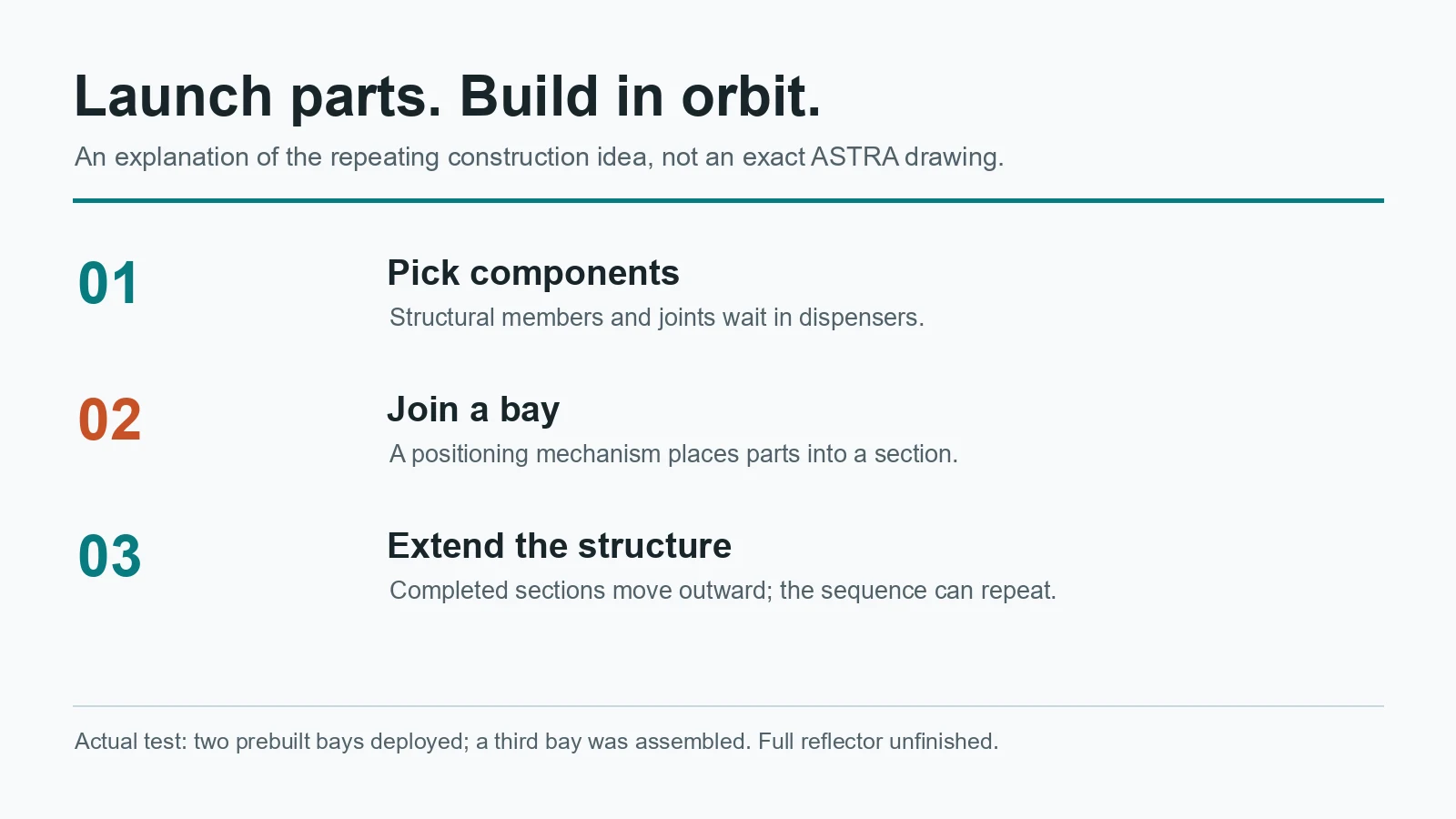
Original explanatory diagram, not an exact ASTRA engineering drawing. The source reports two prebuilt bays and one added in orbit.
The Unfinished Antenna Is Part of the Result
The intended reflector was about 1.4 meters across. The orbital test stopped after the initial construction section rather than completing that whole structure. Caltech reports that the team used a flight spare on Earth to reproduce problems and test workarounds before sending commands during limited communication windows.
Autonomous assembly therefore does not mean an unattended mission. The joining sequence ran aboard a spacecraft; people still diagnosed faults, decided what to try and checked downloaded images. Keeping both facts in the story makes the achievement more useful, not less impressive.
For a builder, a spare mechanism has a particular value. It lets an engineer ask whether a proposed recovery changes one problem into another before committing to a machine that cannot be reached. A ground spare cannot reproduce every orbital condition, but it gives troubleshooting somewhere concrete to happen.
Scale Is the Next Question
The experiment sits within DARPA's NOM4D program, which is investigating ways to make much larger structures practical in space. Large antennas, reflectors and other lightweight systems are prospective applications, not products delivered by this mission.
Repeating a small operation is the attraction. If another bay can be added without requiring the entire finished structure to fit inside a launch enclosure, launch packaging stops being the only way to set the structure's final dimensions.
But repetition also accumulates demands. A practical construction system needs dependable part handling, reliable joints, useful inspection and a way to respond when one step goes wrong. Those are engineering questions to investigate, not capabilities this short demonstration has already settled.
The headline achievement is therefore precise: an orbital robot joined components into an additional structural section. The full antenna remained unfinished. Between those two statements is a promising new construction method, with a substantial amount of development still ahead.
Which would be the harder next milestone: assembling more bays, inspecting every joint, or recovering from a jam? Tell us in the comments below.
Comments
Member comments are temporarily unavailable.
Log in to join the discussion.