
Bennu Molecules Hide Different Histories Behind Nearly Identical Averages
Published November 13, 2026
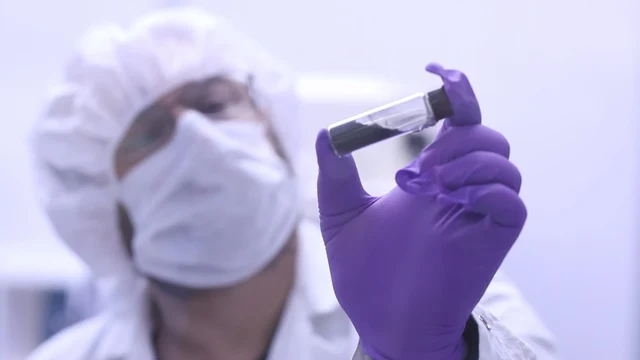
NASA/James Tralie: January2025 archival sample context, not the new November2026 isotope experiment.
Image credit
Asteroid sample in a vial, January2025
NASA/James Tralie · NASA factual editorial useResized and encoded as WebP; no semantic alteration.
Position-specific isotope measurements exposed differences between Bennu and Murchison beta-alanine that a whole-molecule average concealed.
Two molecules can have almost the same average isotope signature and still contain very different histories.
A new analysis of material from asteroid Bennu and the Murchison meteorite found just that. Researchers examined beta-alanine, an organic molecule present in both samples. When they compared the average carbon-isotope values, the results were close within uncertainty. When they examined different carbon positions inside the molecules, the similarities broke apart.
The Penn State research account, published November 10, describes work reported in Communications Earth & Environment. It is a story about extracting a chemical history from tiny amounts of asteroid material, not evidence that Bennu once contained living organisms.
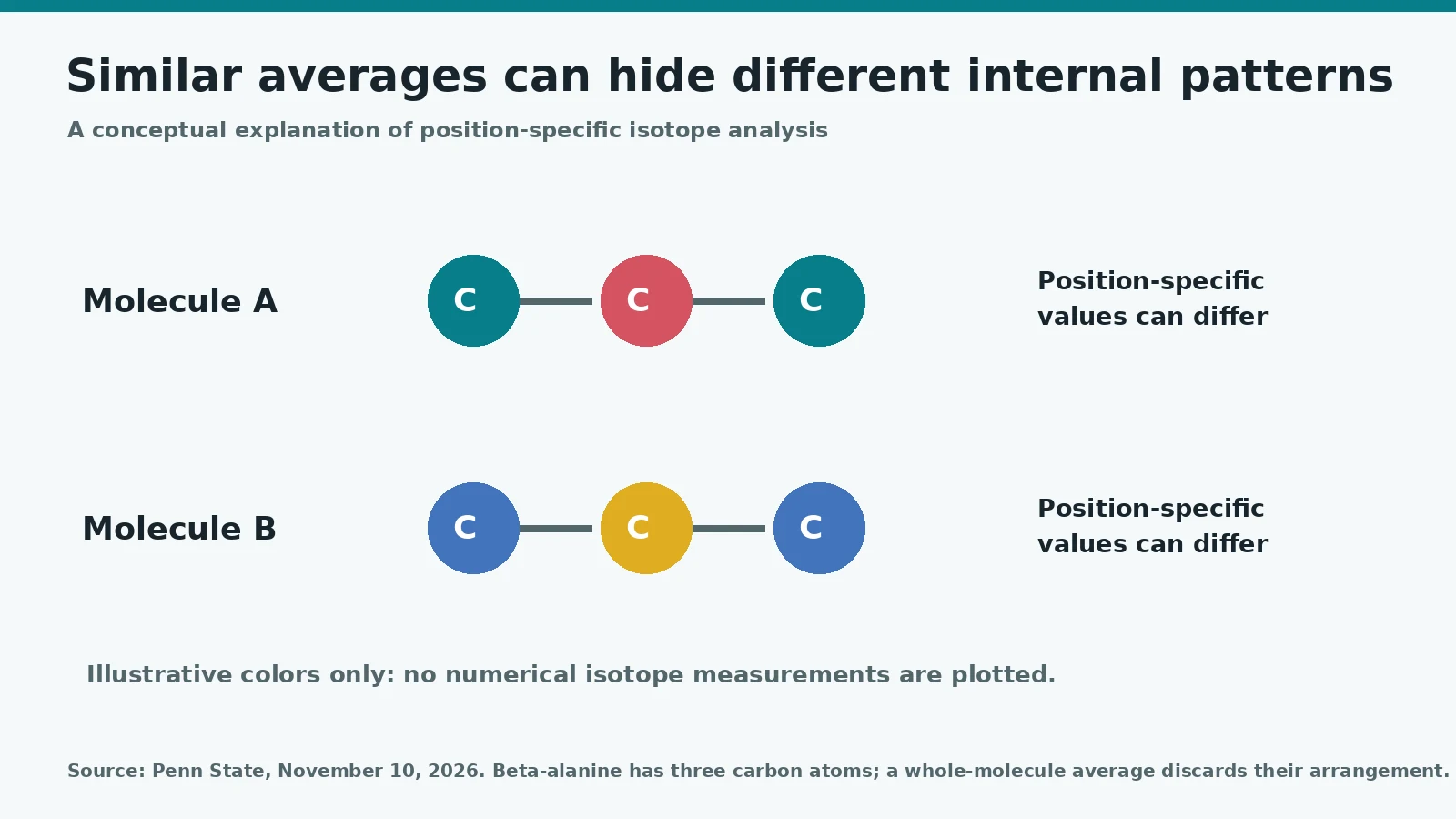
Original conceptual diagram; illustrative colors do not plot measured isotope values.
An Average Can Hide the Important Part
Isotopes are forms of an element with different numbers of neutrons. Carbon-isotope ratios can preserve clues about a molecule's ingredients and the processes that assembled or changed it.
Many measurements summarize a molecule's overall isotope composition. That is useful, but it discards information about where particular isotopes sit within the molecule. Beta-alanine contains three carbon atoms. Treating all three as one average can make two different internal arrangements look similar.
The team used two complementary approaches. A pico-CSIA instrument measured averages in extremely small amounts of material. A modified GC-Orbitrap measured isotope composition at different positions within a molecule. Together, the techniques allowed a more detailed comparison than the bulk measurement alone.
In both samples, one carbon position was strongly enriched while the others were depleted. The pattern had a broad resemblance, but the actual position-specific values differed substantially between Bennu and Murchison. According to the researchers, the enriched Bennu carbon produced the largest isotope anomaly yet recorded in an organic molecule from space.
That does not mean the molecule was radioactive, dangerous or biologically active. "Anomaly" here describes an unusually large difference in isotope composition.
Similar Chemistry, Different Places
The shared internal pattern may point toward related underlying chemistry. The different measurements may indicate that the starting materials or formation environments were different, even if parts of the process were similar.
This is the intriguing possibility: similar kinds of organic molecules might have formed through related pathways in different regions of the early solar system. A single neat recipe in a single location may be too narrow a picture.
But isotope patterns are clues, not labels giving an exact address. The researchers identify further work on how environmental conditions, including exposure to water, might modify those patterns. Connecting a measured molecular structure to a particular formation pathway requires understanding what can preserve or overwrite the signature.
Murchison, which fell in Australia in 1969, provides a comparison with a well-studied meteorite. Bennu adds the value of a sample deliberately collected in space and returned by NASA's OSIRIS-REx mission in 2023. Its controlled collection and curation help researchers investigate extraterrestrial chemistry while carefully addressing contamination.
Not Every Amino Acid Builds a Protein
Beta-alanine is an amino acid, but it is not one of the 20 standard amino acids used to build proteins. That is an important detail in a subject where "the building blocks of life" can easily become an all-purpose headline.
The molecule is relevant to prebiotic chemistry precisely because space samples contain a diverse collection of organic compounds, not only the small subset biology uses in familiar ways. Understanding that wider mixture can help explain which chemical possibilities were available before living systems selected particular pathways.
None of this demonstrates life on Bennu, identifies an organism, or settles how life began on Earth. The result instead improves the resolution of the question. Researchers can look beyond whether an organic molecule is present and ask what its individual atoms reveal about its past.
The sample-return mission brought home grains. The laboratory work is turning those grains into records of processes that happened long before anyone could observe them directly. Sometimes the record is hidden not in a new molecule, but in differences that an average would erase.
What other histories might be hidden inside material already sitting in a sample collection? Add your thoughts in the comments below.
Comments
Member comments are temporarily unavailable.
Log in to join the discussion.