
An Ultrafast 3D Camera Measures the Shape of a Collision
Published November 17, 2026
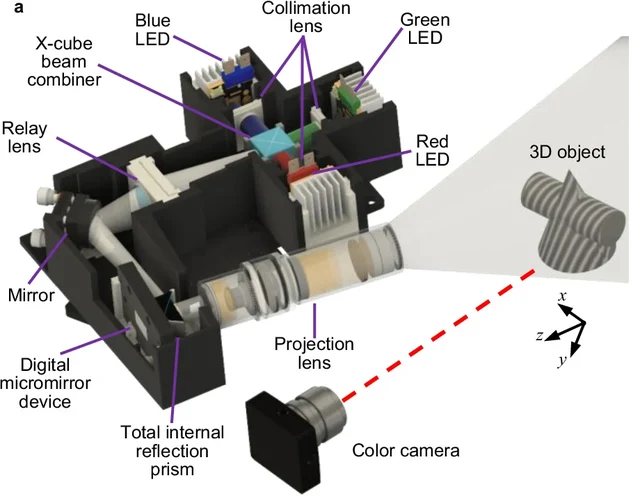
The research team's optical-system diagram, cropped to the apparatus. Not a product photograph.
Image credit
C-BLIP optical apparatus diagram
Cheng Jiang and Jinyang Liang (2026) · CC BY 4.0Cropped apparatus panel only, then resized and WebP encoded; diagram remains identified as such.
C-BLIP reconstructs collisions, falling seeds and vibrating surfaces in 3D. Its experiments explain why the headline frame rate needs a closer look.
The orange projectile is soft. The fan is a toy. The measurements are the remarkable part.
In an experiment by Cheng Jiang and Jinyang Liang at Canada's INRS, a small object strikes a rotating fan while a new imaging system reconstructs the changing surface in three dimensions. The result is more than an unusually slow replay. It records where the visible surface is as the collision unfolds.
Their system, C-BLIP, reaches 150,000 reconstructed 3D frames per second in one operating mode. But that headline number is easy to misuse: the colour collision experiment runs at 25,000 frames per second, and the highest-speed demonstrations sacrifice colour information. The open research paper appeared on October 12, 2026. INRS highlighted it again in November. This is a closer look at that work, not a claim that it was invented this week.
A Fast Movie Still Has a Blind Spot
Film a moving object from the front and you see its outline, shading and apparent motion. You do not automatically get a calibrated measurement of how far every visible patch lies from the camera. Two very different shapes can produce surprisingly similar flat images.
That distinction matters when the question is not simply whether something moved. An engineer might need to know how a surface deformed. A researcher studying a falling seed needs its orientation as well as its position. A bright, sharp frame is useful evidence, but it does not answer every geometric question.
C-BLIP belongs to a family of techniques called fringe projection profilometry. Instead of waiting for a surface's natural texture to provide enough clues, the instrument projects a known stripe pattern onto it. The way that pattern bends supplies information about surface geometry.
The trick is to perform that measurement quickly enough that the event does not change beyond recognition while the necessary information is being gathered.
The Stripes Do Work
C-BLIP stands for chromatically band-limited illumination profilometry. Its projection system combines programmable micromirrors, coloured LED illumination and a specially designed lens. The detection system records multiplexed fringe information, which is then processed into reconstructed surfaces.
Think of the pattern as a measuring tool placed on the object with light. It is not a decorative overlay added to an ordinary recording after the fact. The experiment depends on controlling what is projected and understanding how that signal reaches the camera.
The researchers also used optical illusions as a useful check. Structures that appear to be complete cubes from a particular viewpoint are revealed as incomplete surfaces in the depth reconstruction. That is an intuitive way to see the difference between a convincing appearance and a measurement of shape.
It also explains why the output often looks like a plotted surface rather than a glossy consumer-camera video. Those axes and depth values are part of the point.
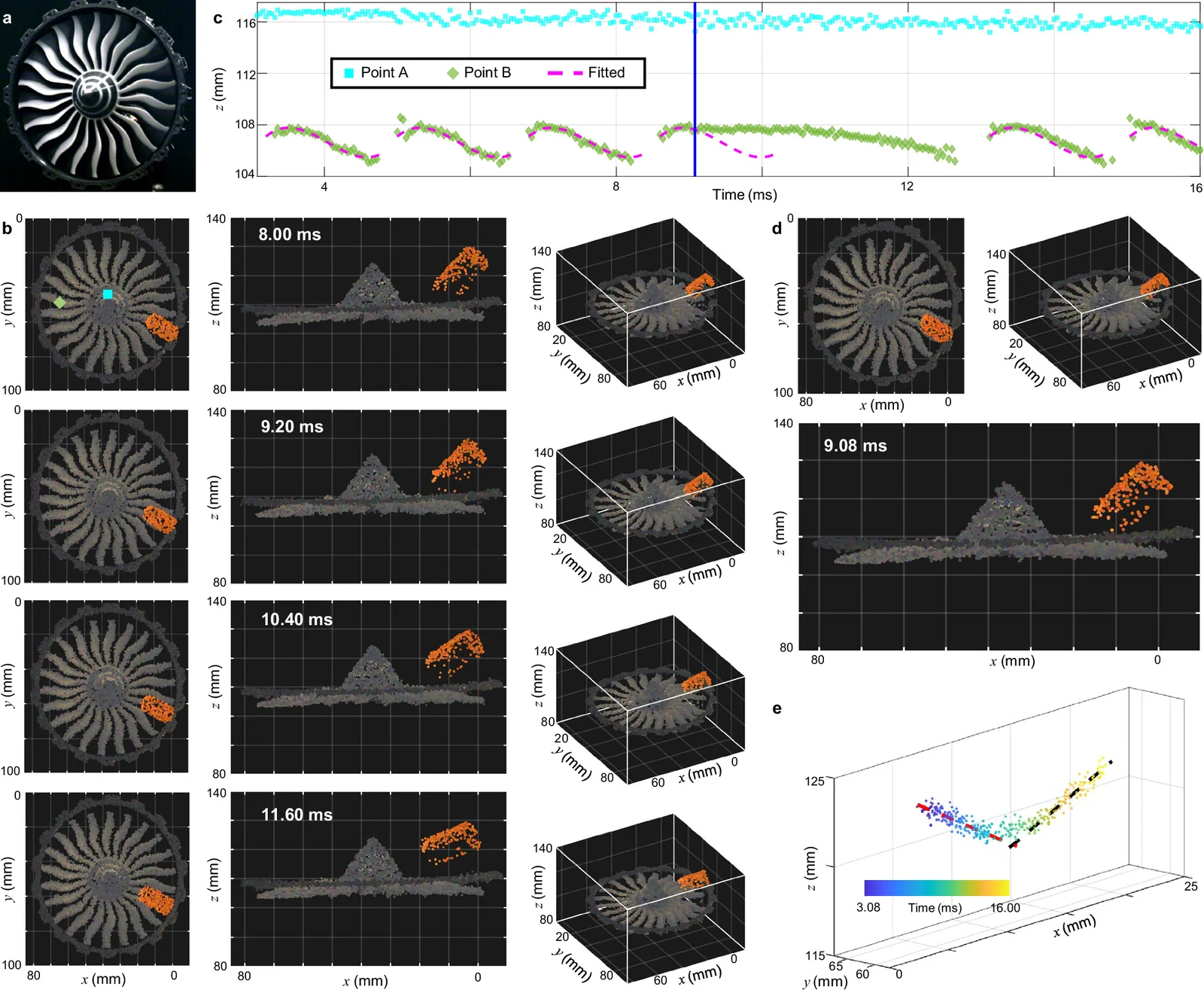
Image credit
Toy fan collision apparatus and measured geometry
Cheng Jiang and Jinyang Liang (2026) · CC BY 4.0Resized and WebP encoded without semantic alteration; original scientific labels retained.
The toy-fan apparatus and measured collision geometry. This is not a production turbine test.
Three Experiments, Three Different Speeds
The fan collision demonstrates colour 3D imaging at 25,000 frames per second. The paper identifies the projectile as an orange earplug and the rotating object as a white toy turbofan. Calling it a jet-engine impact test would make the scene sound more impressive while making the reporting less accurate.
For falling maple seeds, the team used an intensity-imaging mode at 75,000 frames per second. The reconstructed motion let them follow changing orientation and compare the descent of single- and dual-winged samaras. The shape of a familiar falling seed becomes a measurement problem rather than merely a pleasant slow-motion subject.
The fastest mode, at 150,000 reconstructed frames per second, measured rapidly vibrating surfaces in ultrasound experiments. These are distinct demonstrations with distinct settings. Combining the best feature of each into an imaginary full-colour, maximum-speed camera would describe an instrument the paper did not demonstrate.
Nor is this the fastest camera in every possible sense. Ultrafast imaging encompasses methods designed for very different events, fields of view and recording constraints. A frame-rate comparison without those conditions is more advertising than explanation.
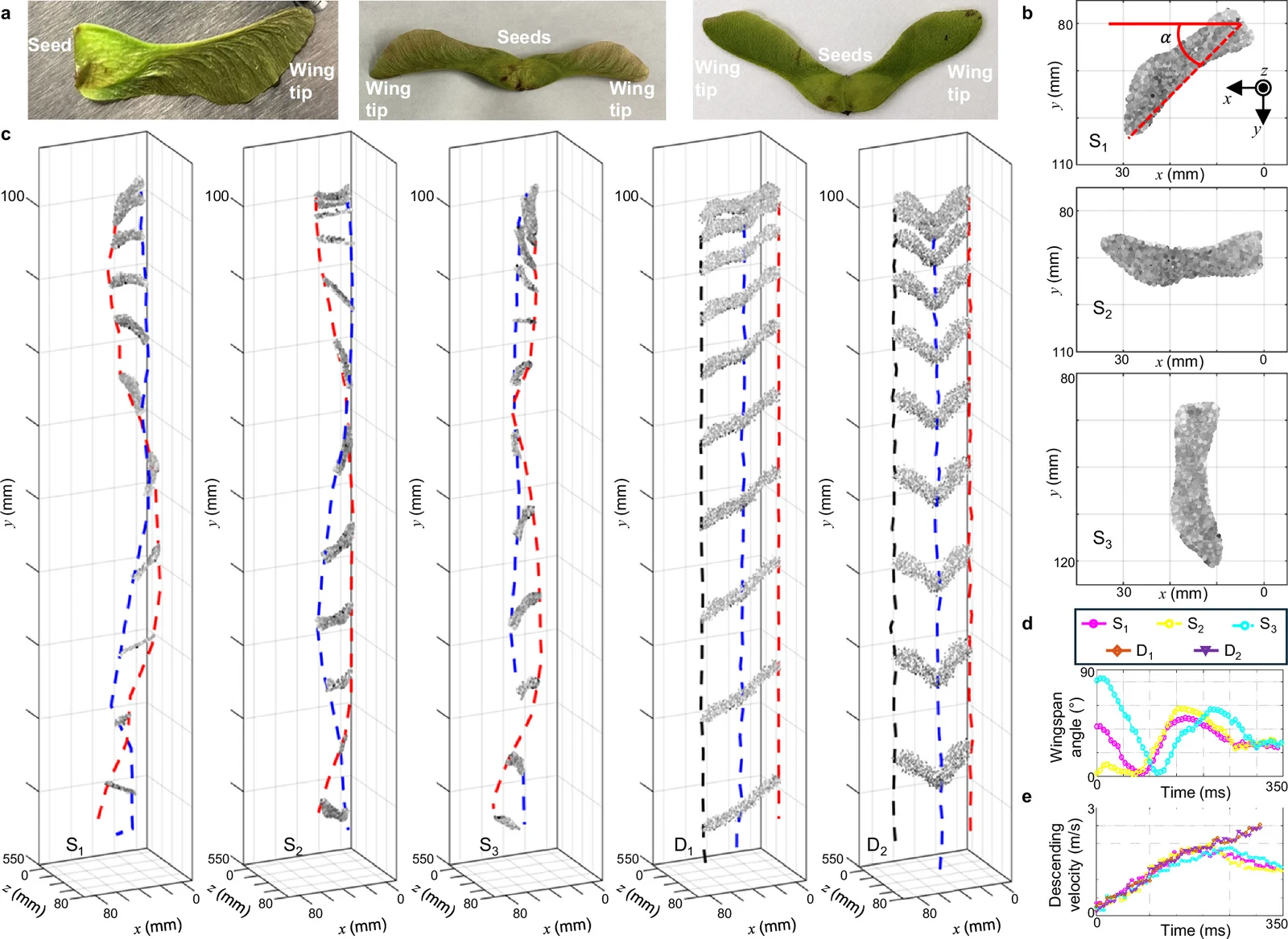
Image credit
Measured maple-seed descent
Cheng Jiang and Jinyang Liang (2026) · CC BY 4.0Resized and WebP encoded without semantic alteration; original scientific labels retained.
Measured trajectories and three-dimensional reconstructions of falling maple seeds.
What Would Make It Useful?
The promising part is the combination of rapid observation and measurable geometry. A flat recording can show a collision, but a surface reconstruction can help explain how contact progresses. A video can show a seed turning; a calibrated reconstruction can help quantify that motion.
Those possibilities do not establish that the present laboratory system is ready to inspect an arbitrary factory line. Illumination, accessible surfaces, reconstruction accuracy and operating mode all matter. Seeing the demonstrations is a reason to examine those constraints, not a reason to pretend they have disappeared.
The authors also provide experiment movies and supporting information. Watching those alongside the figures is more informative than treating the largest frame-rate number as the entire story.
The most interesting upgrade here is not simply making motion look slower. It is making the motion answer a more useful question: what shape was the object, at that instant?
What moving object would you most want to measure in three dimensions? Share it in the comments below.
Comments
Member comments are temporarily unavailable.
Log in to join the discussion.