
A Galaxy Collision May Have Revived a Black Hole's Ancient Radio Glow
Published October 17, 2026
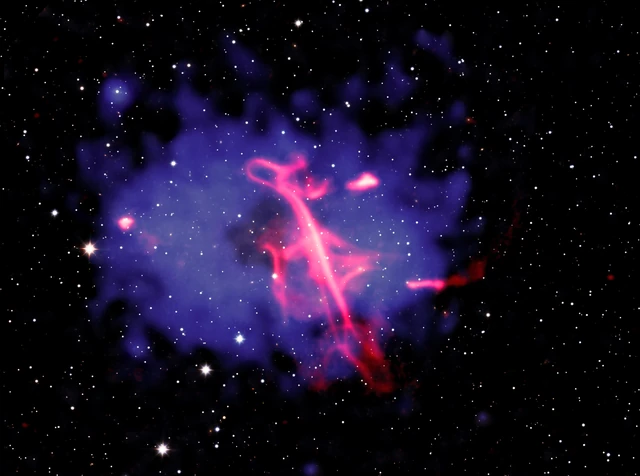
A multiwavelength composite: radio emission is red/pink and X-rays blue. This is not a visible-light view of a pink object.
Chandra's new Treble Clef release connects a strange radio structure to an old black-hole outburst and a later collision between galaxy clusters.
The pink line curls through a purple cloud like someone has drawn a musical symbol across the sky. The resemblance gave it a name, the Treble Clef. The proposed explanation has nothing to do with music.
A new Chandra release describes evidence that the radio structure was shaped by two episodes: an earlier outburst from a supermassive black hole, followed by a collision between galaxy clusters that revived the fading radio glow. Andrea Botteon of Italy's National Institute for Astrophysics led the work. Chandra's October 14 release, NASA's account.
The collision itself is thought to have occurred a few hundred million years ago. October 14 is the date of the new explanation and image release, not the date two clusters suddenly struck one another.
The view is also complicated by our own Galaxy: the formation lies nearly behind the Milky Way's plane. Different wavelength observations help investigators work through the intervening material rather than relying on a single optical view.
Different Light Reveals Different Parts
The picture combines observations that answer different questions. X-rays from Chandra and eROSITA trace extremely hot gas. LOFAR radio observations reveal the curling structure. Infrared observations from the United Kingdom Infrared Telescope contribute much of the field of stars and galaxies.
The colors make those layers visible together. Pink is not a direct photograph of pink material. It marks radio emission mapped into a color that the eye can see. The blue-purple cloud is another translated measurement, not the natural color of an enormous cloud as a traveler would see it.
The distinction does not make the image less real. It tells us which part of the evidence we are looking at. Remove the wavelength labels and the composite becomes an attractive picture with a much less useful explanation.
Each layer supplies a different piece of the explanation; none is simply a prettier replacement for another.
An Old Outburst, a Later Source of Energy
In the team's interpretation, the black hole first pushed energetic particles and magnetic fields into the surrounding region. That material produced radio emission, which subsequently faded as the particles lost energy.
The cluster collision then compressed or re-energized the plasma, making the radio structure bright again. Shock waves may have helped. The result is a possible record of more than one event, rather than a single burst whose current shape tells the whole history.
That is the appealing part of the finding: an old outburst can remain relevant after it becomes harder to see. A later change in the environment can make the material conspicuous again. The present image can therefore preserve an interaction between different stages of the system's past.
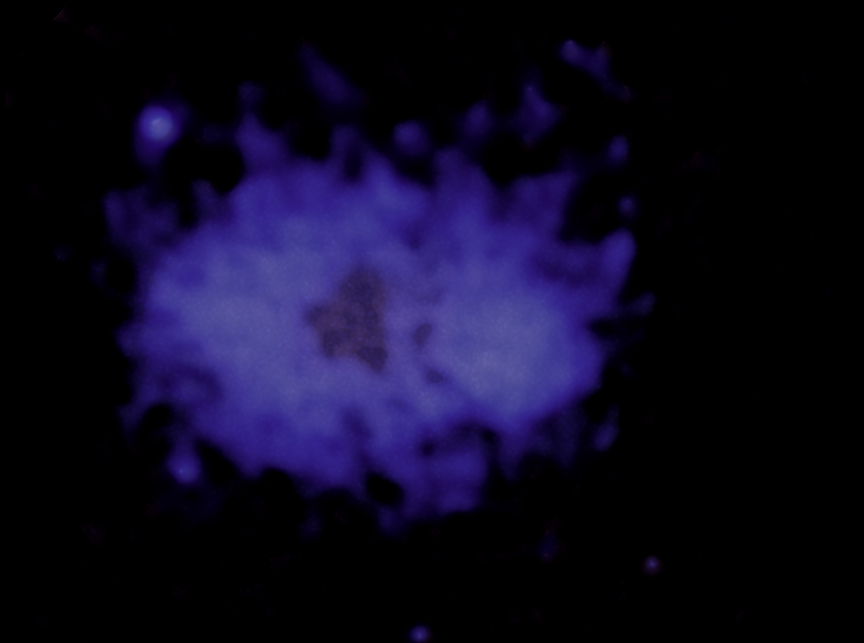
Finding a Collision in the Gas
The researchers examined departures from a symmetrical model of the hot gas. Subtracting that smooth component left a residual pattern brighter toward the left and right and fainter near the center. NASA explains that this supports a collision along the left-right direction in the image.
A residual is not an additional object that a second camera found. It is a way of asking what remains after an expected smooth pattern is removed. The answer depends on both the data and the model being compared with them.
That is why it is useful to keep the original observations alongside the processed view. The processing can make a subtle structure legible, while the underlying measurements show the setting from which that structure was derived.
The Shape Is a Clue, Not a Code
The Treble Clef is an example of pareidolia: a familiar outline recognized in an unrelated pattern. It is a memorable label, not evidence of a physical connection to musical notation.
The more substantial connection is between the gas, the radio-emitting plasma and the history inferred from both. A nickname invites a first look. Multiple kinds of light make it possible to ask what actually happened.
Would you like a closer look at how astronomers separate an X-ray observation from its residual image? Leave your questions in the comments below.
Comments
Member comments are temporarily unavailable.
Log in to join the discussion.