
NASA Is Sending 12 Heat-Shield Experiments Down With the Trash
Published October 11, 2026
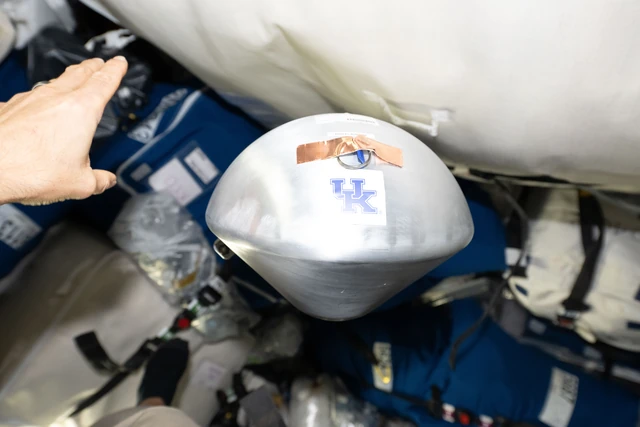
KREPE-3 hardware inside Cygnus XL on October 7, before departure. Reentry results are not yet available.
Cygnus XL left the space station with twelve KREPE-3 capsules. Its planned October 12 reentry will turn a cargo disposal trip into a materials test.
Usually, taking out the trash ends the useful part of a job. For twelve small spacecraft experiments, it is where the useful part begins.
Cygnus XL departed the International Space Station on October 9, carrying waste and a set of instrumented capsules called KREPE-3, the Kentucky Reentry Probe Experiment. NASA plans to dispose of the cargo spacecraft through atmospheric reentry on October 12. The capsules are intended to emerge as their carrier breaks apart, gather measurements, and transmit data during descent. As of October 11, that test has not happened. NASA's experiment announcement.
There is a pleasing economy to the arrangement. A spacecraft already scheduled for disposal becomes a ride for materials that need an encounter with a real atmosphere. It is not a recoverable package delivery, and the goal is not to bring the station's garbage home intact.
The Departure Is Real. The Results Are Still Ahead.
NASA's station log records Cygnus XL's release by Canadarm2 at 12:44 p.m. Eastern on October 9. It also sets out the planned October 12 deorbit. That gives us two different milestones: a departure already completed, and an experiment still approaching its critical conditions. Departure log and footage.
Keeping them separate is especially important for heat-shield news. A flight-ready specimen is not a successful flight result. The researchers still need the descent, working instruments, useful telemetry, and an interpretation of the measurements before anyone can say what the test demonstrated.
The University of Kentucky's Hypersonics Institute is part of the collaboration. Its announced October 12 watch party is another reminder that the event is upcoming, not a performance report quietly released after the fact. University experiment event.
A Material Is Only Part of a Heat Shield
Look at the real laboratory specimen below. It is an object with thickness, edges, and a surface, rather than an abstract promise to tolerate a spectacular temperature.
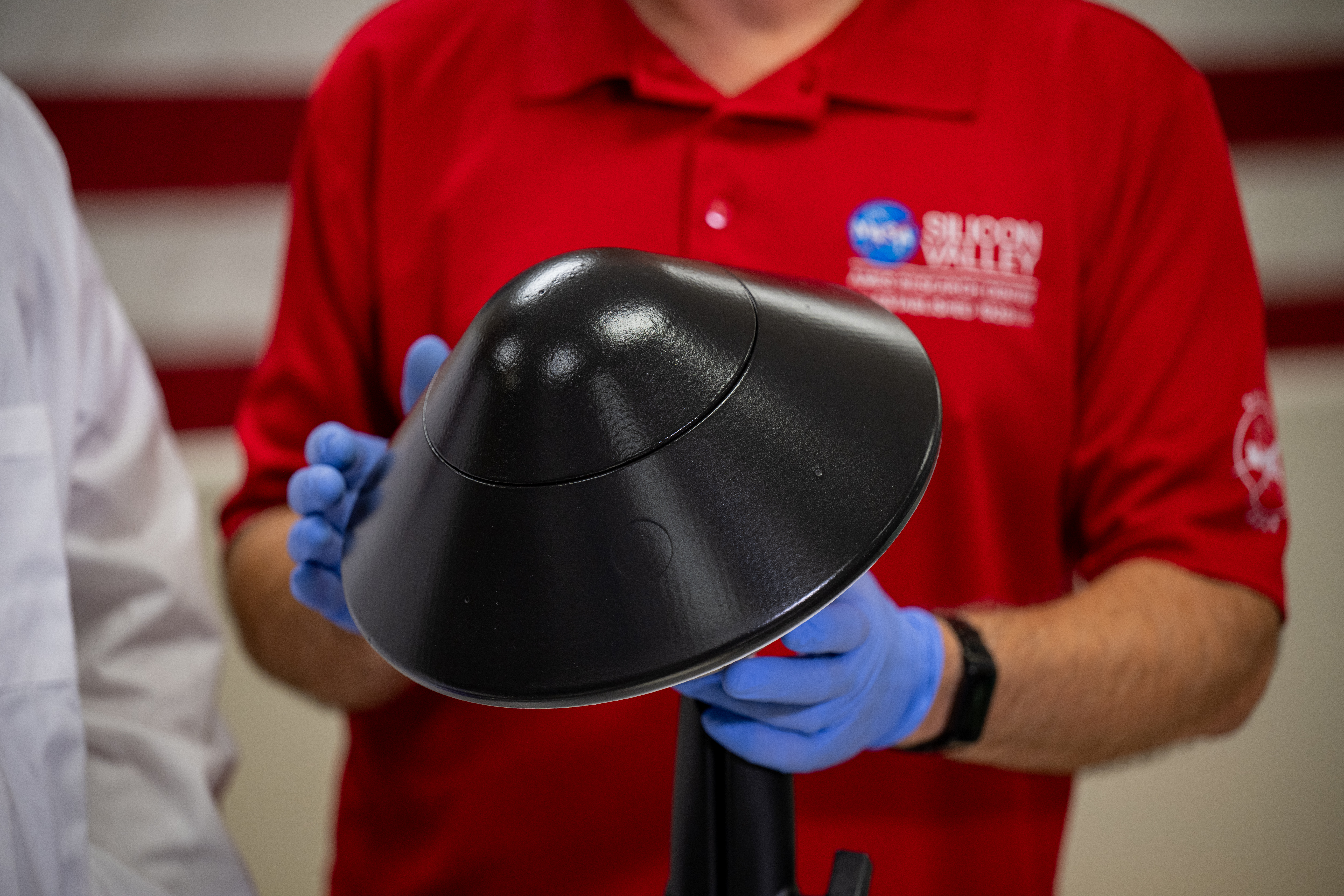
NASA's flight overview includes a 3D-printed thermal protection system and MERINO, a family of carbon-and-phenolic-fiber coverings assembled through needling. Other capsules investigate shapes, including a dual-cone design and an aeroshell shape associated with Dragonfly. Some carry established materials alongside newer candidates.
Those distinctions are useful. A manufacturing method, a material recipe, and a vehicle shape are not interchangeable innovations. One can change how a specimen is made; another changes what it is made of; another changes the way the air flows around it.
The word "printed" can steal the headline while concealing most of the engineering. A printable geometry still has to meet the demands of its application. Likewise, a promising fiber architecture is not a universal replacement for every existing thermal protection system. The relevant question is what this particular test can measure about this particular construction.
There is a practical lesson for anyone making experimental hardware: compare the proposal with the measurement, not just with the photograph. An attractive sample can show that fabrication is possible. It cannot, on its own, show how that sample behaved in flight.
An Umbrella With a Different Job
One KREPE-3 capsule will test ADEPT, short for Adaptable Deployable Entry and Placement Technology. The design opens a larger heat-shield surface from a compact, folded configuration.
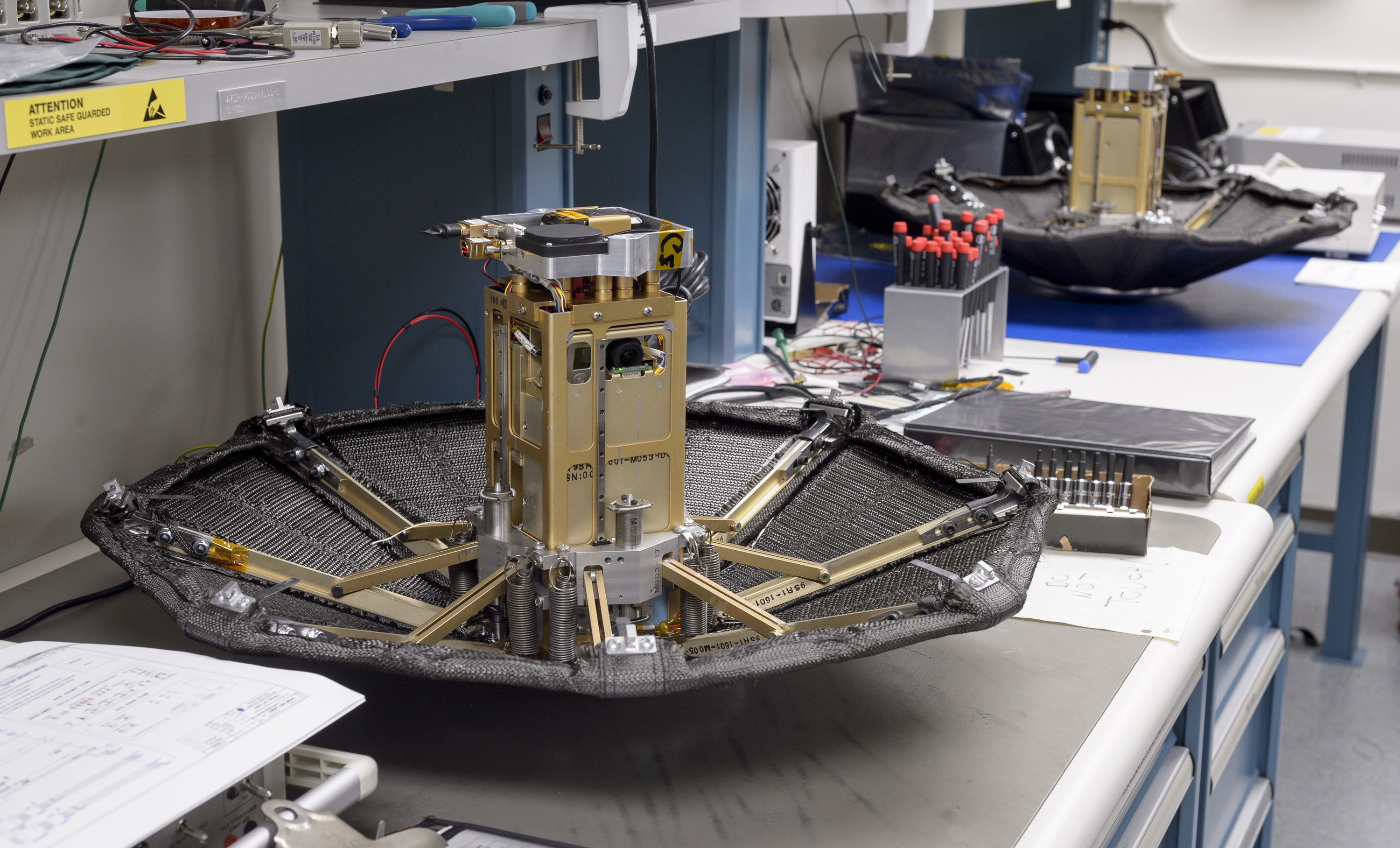
NASA's earlier ADEPT work explains the approach: a woven carbon-fabric structure combines a deployed shape with thermal protection. Packing small and opening wide addresses the mismatch between the room available inside a launch vehicle and the surface useful during atmospheric entry. ADEPT technology background, 2018 development and flight-test context.
The old photograph is valuable because it makes the mechanical idea legible. But it does not establish the dimensions or configuration of the new flight unit. Development hardware and a current mission payload should not be merged into one imaginary vehicle.
Deployability also moves some of the problem from fabrication to sequence. A compact structure has to become the intended larger structure at the intended time. That transition belongs in the test, not just in an animation of the final shape.
The Precious Cargo Is the Data
KREPE-3's sensors cover quantities including temperature, pressure, and motion, with satellite telemetry intended to send measurements to the ground. The capsules do not have to return to a display case for the experiment to be useful.
That changes the meaning of success. A dramatic descent image would be memorable, but a time history can answer questions the image cannot: when a condition changed, how one measurement related to another, and whether the observations matched a model.
A model comparison also needs context. A discrepancy can point to a material response, a changing flight condition, an instrument limitation, or a mistaken assumption. One number stripped from its surroundings is a poor substitute for the record of an event.
For now, the important achievement is getting the experiment into position. The next meaningful story will be what the team can actually recover from the data, not a premature announcement that a new heat shield has passed every test needed for astronauts.
Twelve capsules, one retiring cargo ship, and a short opportunity to observe a very difficult environment: that is an unusually resourceful way to make use of a final trip. What would you want to see in the results, the printed material or the deploying shield? Put your questions in the comments below.
Comments
Member comments are temporarily unavailable.
Log in to join the discussion.