
Scientists Found 245 Animals Inside One Deep-Sea Nodule
Published November 17, 2026
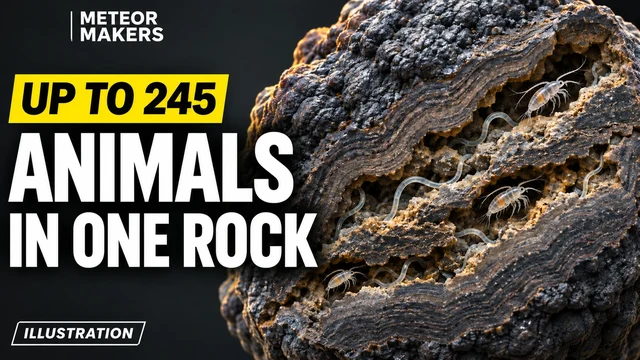
Illustration, not a photograph of the study specimen. Tiny inhabitants are made visible to explain the crevice habitat; 245 is the maximum number of individuals, not species.
A study of 244 Pacific nodules recovered thousands of tiny animals. Their distinct crevice communities change what it means to remove a metal-rich rock.
A metal-rich lump on the seafloor can look like a resource waiting to be collected. Open it carefully and the description changes: it is also a place to live.
Researchers examined 244 polymetallic nodules from the Pacific's Clarion-Clipperton Zone and recovered 4,139 tiny animals from their crevices. One nodule contained 245 individuals. The finding is not that 245 new species were discovered inside one rock. It is that a mining target contains a crowded, easily overlooked habitat.
The study in Scientific Reports, published November 11, 2026, also found that the communities inside nodules differed from those in nearby sediment. That distinction gives the numbers their importance. Removing a nodule is not necessarily equivalent to removing an interchangeable patch of mud.
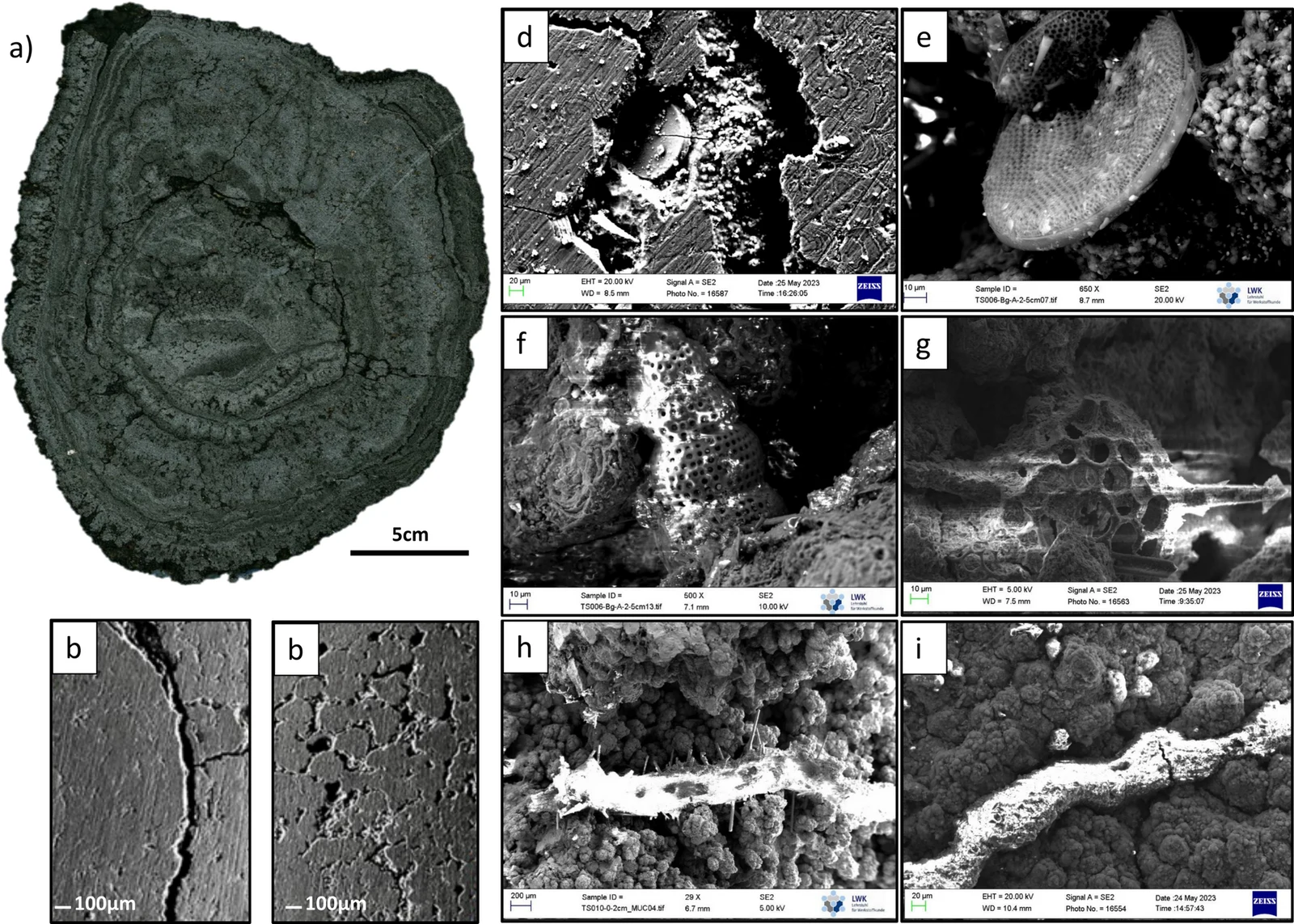
Image credit
Polished nodule and microscopy including microfossils
Diaz-Recio Lorenzo et al. (2026) · CC BY 4.0Resized and WebP encoded without semantic alteration; original scientific labels retained.
A polished nodule and microscopy of its internal structure. These panels include microfossils, not just living recovered animals.
The Habitat Is Inside the Mineral Deposit
Polymetallic nodules contain metals including nickel, copper and cobalt, which help make them targets for proposed deep-sea extraction. They also introduce hard, irregular structures into environments otherwise dominated by soft sediment.
Much of the ecological interest in a nodule is easy to picture from outside: an exposed surface can provide something for organisms to attach to. This study asks a less obvious question about the cracks and pores within it.
The team used microscopy to examine that internal architecture, extracted small organisms and compared the crevice fauna with nearby sediment communities. Nematodes and copepods dominated the animal assemblages. The paper also discusses foraminifera, which are single-celled organisms rather than animals; they should not be casually folded into an animal-species headline.
The research team's institutional announcement describes the nodules as three-dimensional shelters. That is a more useful mental model than a smooth stone with a little life attached to its top.
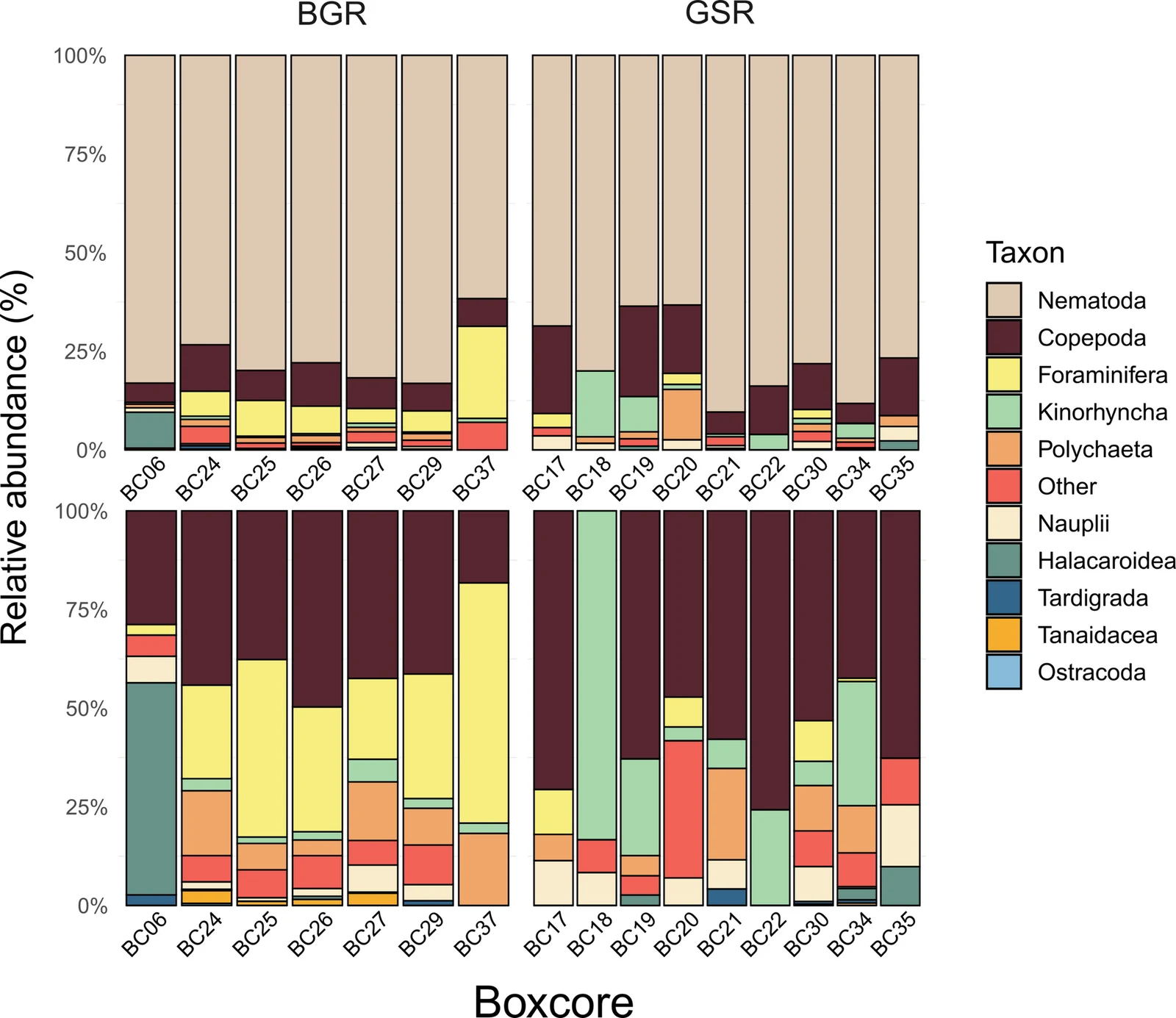
Image credit
Relative taxonomic abundances in sampled communities
Diaz-Recio Lorenzo et al. (2026) · CC BY 4.0Resized and WebP encoded without semantic alteration; original scientific labels retained.
Relative abundances by taxonomic group in the study. These are not counts of newly discovered species.
Why the Average Is Not the Whole Story
The average was about 17 animal individuals per nodule. The maximum of 245 is a striking example, not a typical occupancy figure that should be multiplied across every nodule on the seabed.
Likewise, 4,139 recovered individuals is a count from the material examined, not a complete census of the Clarion-Clipperton Zone. The nodules came from samples collected during a 2019 expedition. The November date belongs to publication of the analysis, not to a new dive that happened this week.
Genetic comparisons added another layer. The assemblages recovered from crevices were distinguishable from those recovered from nearby sediments. That does not mean every organism found inside a nodule can live nowhere else, or that every unfamiliar genetic sequence represents a newly described species.
Incomplete reference databases and the limits of sampling matter. A different community is meaningful evidence without being a complete inventory of everything living there.
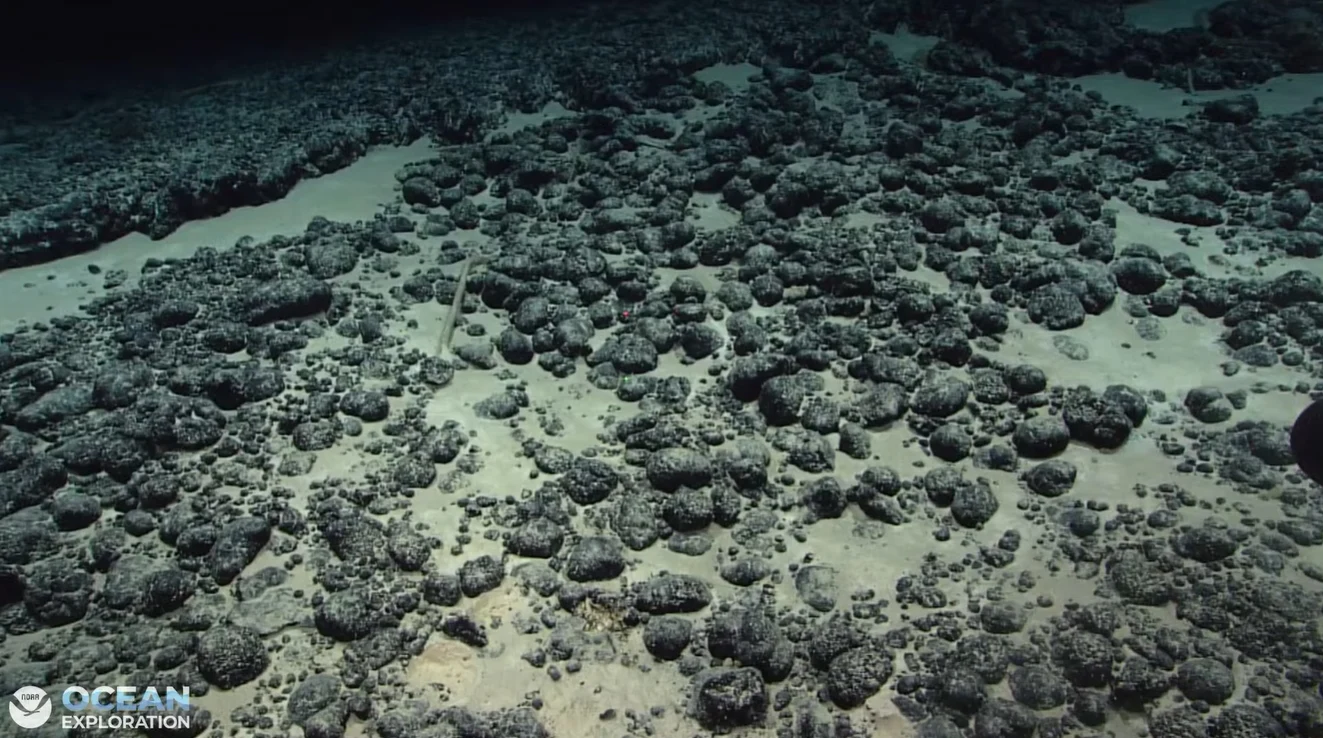
Archival context: NOAA, Cook Islands, July24 2026. Not the CCZ study samples or photographs of its extracted animals.
A Missing Room in the Environmental Baseline
Before a disturbance, researchers need to know what occupies the place being disturbed. If a survey treats the seabed mainly as sediment and exposed surfaces, it risks missing organisms using the interior of the mineral structures themselves.
That creates a practical management problem. A protected area or impact assessment needs to account for the habitats it is intended to represent. A nearby patch of sediment is not automatically a substitute for a crevice-rich nodule simply because both appear within the same stretch of ocean.
The nodules themselves form over geological timescales. Their removal is therefore not followed by quick replacement of the same physical shelter. That is different from claiming this particular paper measured every consequence of a working commercial mine. It is a baseline biodiversity study, not an operating-mine impact experiment.
Nor does it establish that removing nodules would inevitably drive a named species globally extinct. To answer that, researchers would need a much clearer understanding of distribution, dependence and populations elsewhere. The institutional release explicitly identifies those questions as work still to do.
Look Closely, Then Decide What Is Being Removed
There are two ways to miss the story. One is to reduce the nodule to a package of useful metals. The other is to turn a careful ecological result into a claim that scientists have already catalogued an entirely unknown world.
The evidence supports something both narrower and consequential: animals occupy the internal spaces of these nodules, and the communities are not simply duplicates of the surrounding sediment. The object being considered for extraction is also habitat.
That makes the next good question less spectacular than the biggest possible headline, but more useful: how should those hidden living spaces be represented in surveys and protection plans before the rocks are removed?
Share your thoughts in the comments below.
Comments
Member comments are temporarily unavailable.
Log in to join the discussion.