
The Self-Driving Lab Has a Bigger Problem Than Moving a Robot Arm
Published October 11, 2026
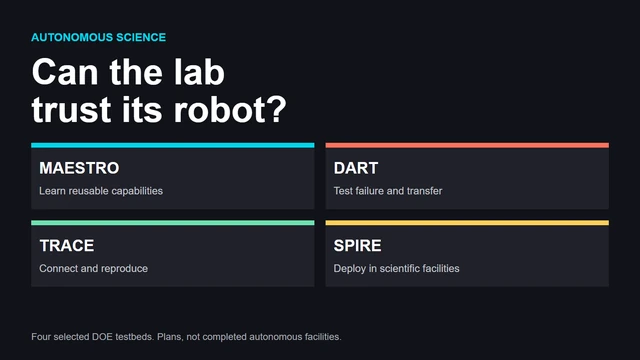
Original editorial diagram of the selected testbeds' roles, not a photograph of completed facilities.
DOE's four selected testbeds target reusable skills, failure testing, connected experiments, and autonomy inside major scientific facilities.
A robot can carry a sample to an instrument. That does not mean a laboratory can run itself.
The difficult work starts when the sample is misidentified, an instrument returns a suspicious result, or a perfectly completed motion produces the wrong scientific outcome. Someone has to notice, preserve the evidence, decide what to do next, and explain the decision later.
On October 8, the U.S. Department of Energy selected four national-laboratory-led projects for robotics and automation testbeds. The emphasis is not just impressive demonstrations. DOE wants capabilities that can transfer between instruments, workflows, and laboratories: software, interfaces, reusable skills, digital twins, benchmarks, safety practices, and provenance records. DOE announcement.
The funding description is conditional. DOE lists a $30 million total, including $2 million in fiscal 2026, with later funding contingent on appropriations. Selection begins award negotiations; it is not a guarantee that all funding will be issued.
The four projects are easiest to understand as different answers to the same question: what has to be true before an automated experiment deserves trust?
MAESTRO: Learn a Useful Skill, Then Use It Elsewhere
Argonne leads MAESTRO, short for Modular Autonomous Experimentation through Self-improving Testbeds for Robotic Operations. Its announced approach combines reusable robot skills, digital twins, world models, orchestration, and safety mechanisms. The intended proving grounds test whether capabilities can improve through experience and transfer across settings.
Transfer is the important word. A robot that succeeds with one instrument in one carefully arranged room can still be expensive to adapt to the room next door. The fixture changes, the sample holder changes, and a workflow assumption that was never written down suddenly becomes critical.
A reusable skill should therefore mean more than a saved motion. It needs a description of when it applies, what inputs it expects, how success is observed, and what happens when the conditions are not met. Otherwise the library is reusable mainly by the person who already understands the original setup.
This is an engineering interpretation of the goal, not a specification DOE says is finished. It is also a good test for any maker's automation: could someone use the routine after moving the hardware, without inheriting your unwritten assumptions?
DART: A Completed Motion Can Still Be a Failed Experiment
Brookhaven leads DART, the DOE AI Robotics Testbed to Generalize Autonomous Science. DOE describes adversarial digital counterparts, a verified failure atlas, multimodal learning, and knowledge transfer across robotic platforms. It explicitly distinguishes a robot completing a motion from an experiment achieving the required physical and scientific outcome.
That distinction is easy to lose in a demo. A gripper closes; the controller reports success. Did it grip the intended object? Was the object damaged? Was its orientation suitable for the next measurement? A visually neat sequence can conceal the exact failure that matters scientifically.
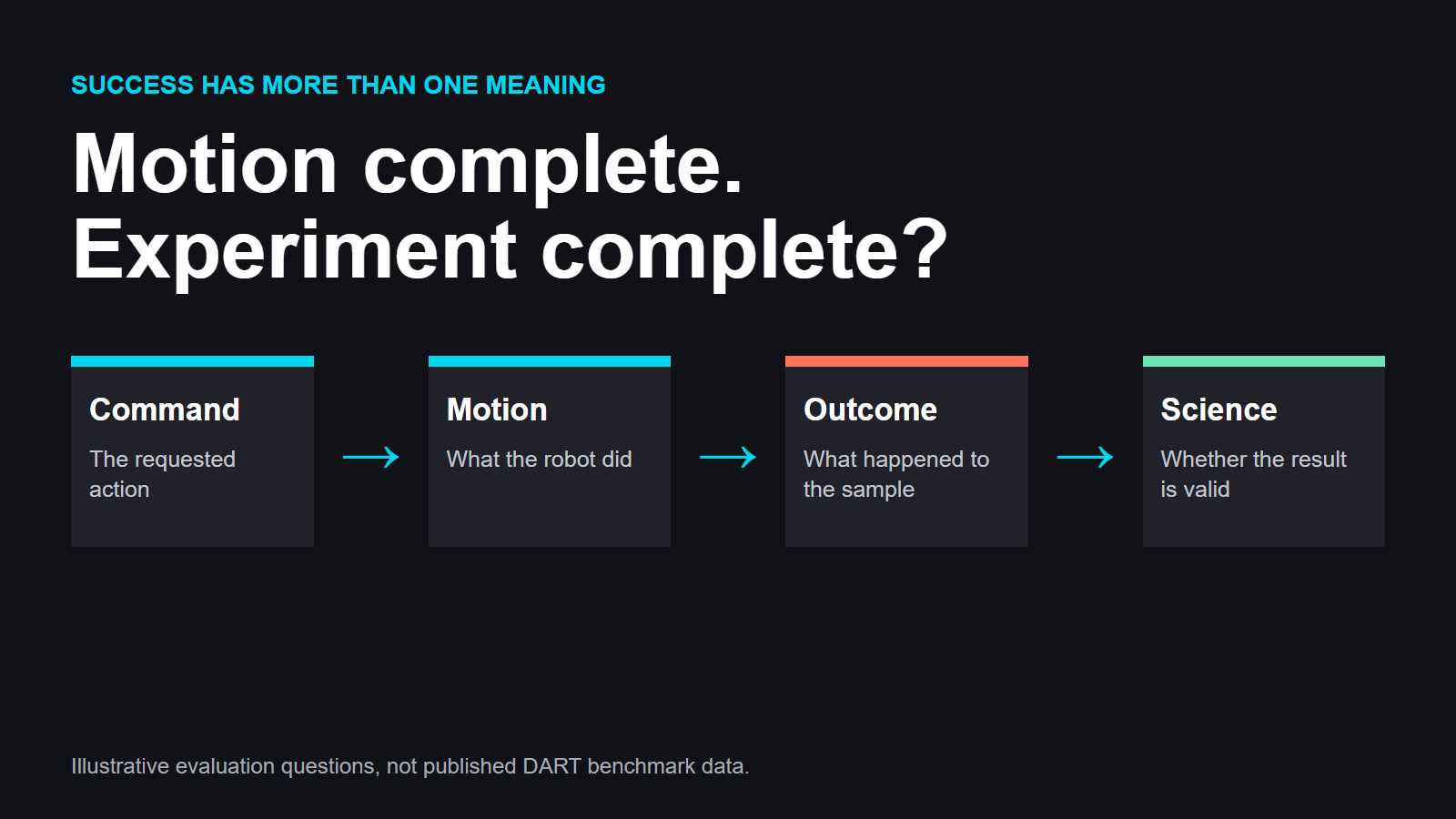
A useful failure record is more specific than "the robot got confused." It ties the setup to the observed outcome and the evidence used to judge it. Without that specificity, one team cannot tell whether its own system passed the same challenge or merely avoided the same visible mistake.
There is a less glamorous question too: can the system stop safely while preserving a useful experiment state? Recovery need not mean automatically trying again. Sometimes the correct response is to stop, label the uncertainty, and ask for a human decision.
TRACE: Connect the Lab Without Rebuilding the Stack
Oak Ridge leads TRACE, the Testbed for Robotics and Autonomy in Connected Experiments. It builds on the laboratory's INTERSECT ecosystem and targets standardized connections between robots, instruments, agents, digital twins, data systems, and computing resources. The announcement includes typed capability contracts, provenance, and independently rerunnable evaluation methods.
The value of a contract is that a request becomes explicit. What can this instrument do? What state must it be in? What result will it return? What counts as completion? The answer should not depend on a second team reverse-engineering a set of scripts.
In a small workshop, an undocumented instrument wrapper is an annoyance. In a connected scientific facility, the same ambiguity can propagate across a sequence of decisions. A timeout might mean a command was rejected, a measurement is still running, or a result was produced but never delivered. Treating those as the same event creates avoidable risk.
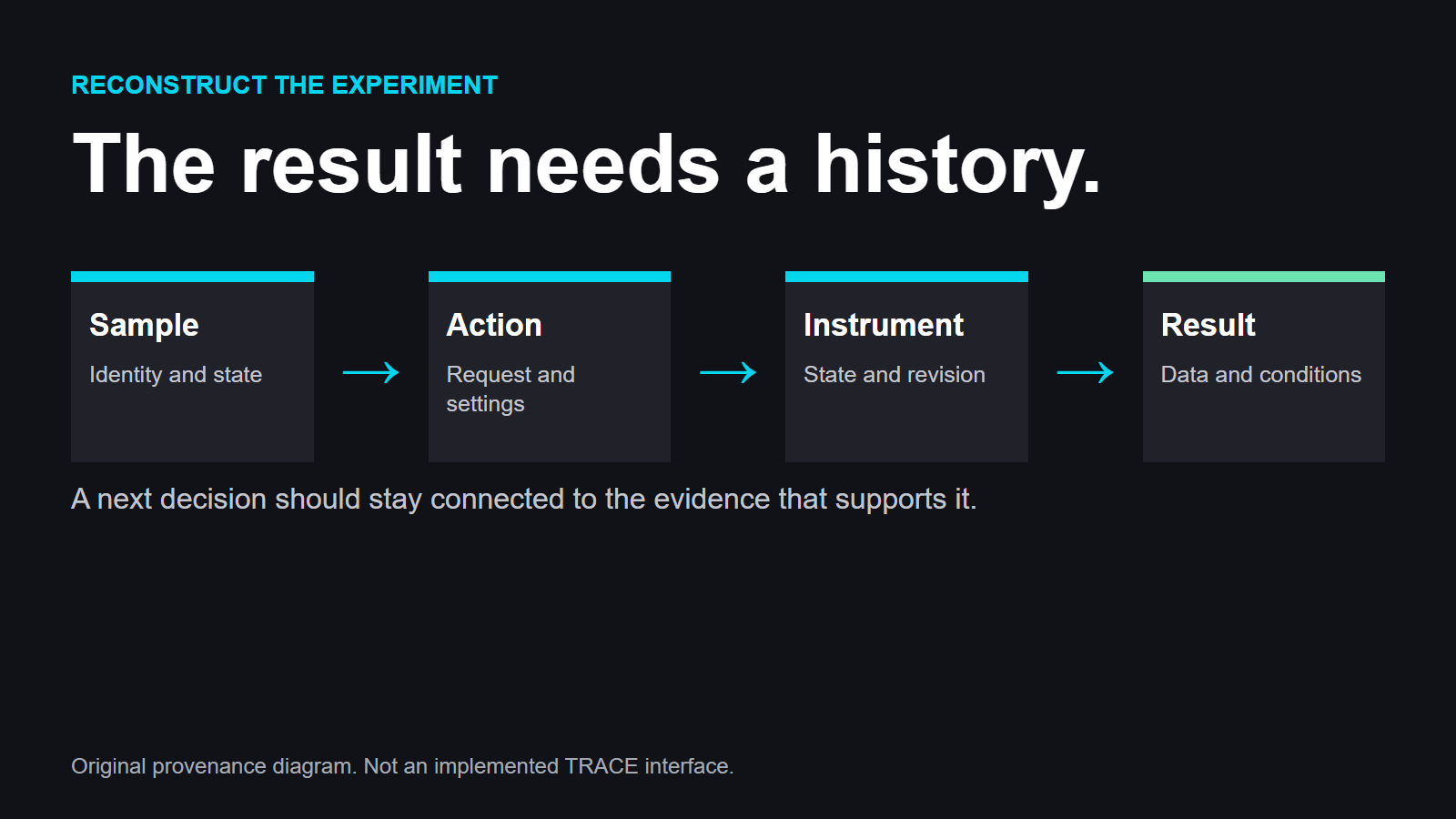
Provenance is similarly broader than a folder full of output. A result becomes interpretable when it retains its relationship to the sample, settings, software revision, and sequence that produced it. If an autonomous system changes a setting, the reason and the resulting state belong with that record.
A good interface should make the boring cases legible too: cancelled work, interrupted work, duplicate requests, and data that arrived too late to support the decision it was meant to inform.
SPIRE: Close the Loop in a Scientific Facility
SLAC leads SPIRE, a Source-to-Discovery Platform for Instrumentation, Robotics, and Embodied AI in DOE Photon-Science Facilities. The planned integration spans sample manipulation, detectors, accelerator and instrument controls, persistent state, and computing from the edge to high-performance systems.
DOE describes decision timescales ranging from microseconds to hours. Those are not interchangeable problems. A fast detector response cannot wait for a deliberative workflow, while a scientific strategy should not be reduced to the fastest available control loop.
The challenge is coordinating those layers without losing the context of the experiment. If a sample is changed or an acquisition condition shifts, downstream computation needs the right state. If an analysis suggests another measurement, the physical system needs a request that it can safely interpret.
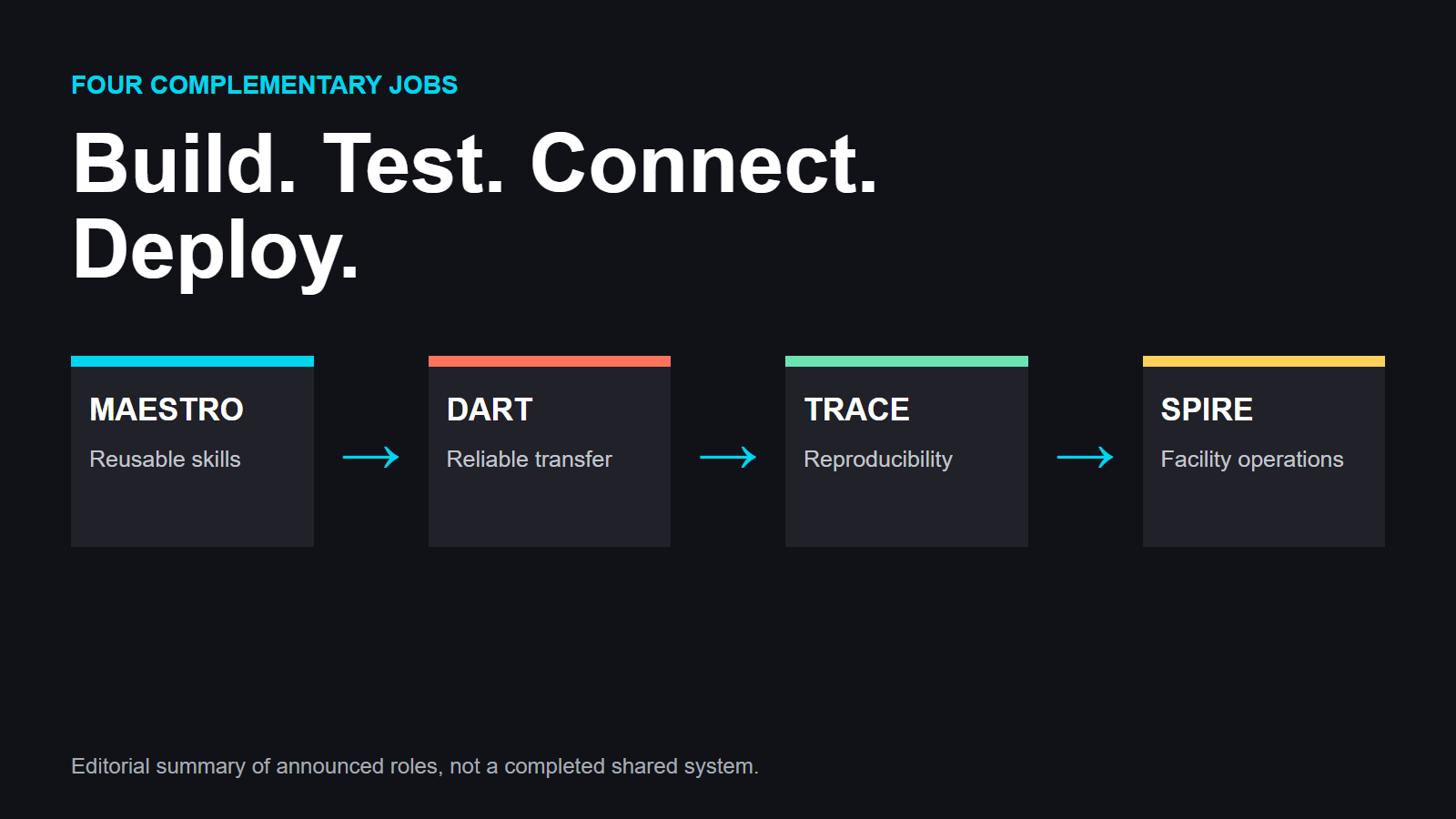
SLAC's account of SPIRE describes the difference between a fixed automated workflow and a system that can choose tools and parameters toward a scientific goal. The latter is the more ambitious proposition. It also needs a more demanding audit trail.
What Would Count as Progress?
The obvious milestone is a successful demonstration. The more consequential milestones are artifacts another team can use: a documented interface, a benchmark with stated conditions, a skill whose limits are clear, or a failure case that can be reproduced independently.
That is how an impressive prototype can become infrastructure. It is also how the public announcement can eventually be evaluated without relying on a promotional video.
Useful questions to bring to future releases include:
- Which parts are actually public, and under what terms?
- Can another lab reproduce the evaluation without the original team?
- Are failures classified by scientific outcome, not only controller status?
- Does a transferred skill retain its safety assumptions?
- Can an interrupted experiment be reconstructed from its records?
These are questions for the projects as they develop, not claims that the selected teams have already solved them.
A Maker-Sized Version of the Same Problem
You do not need a national laboratory to recognize the pattern. A home-built sample carousel, automated microscope, or instrument logger has a miniature version of it. The machine can perform a sequence and still leave you unsure whether the right thing was measured.
A modest improvement is to separate command sent, action observed, and result accepted. Add a record of what changed between runs. Make a failed condition explicit instead of allowing the next step to proceed on an assumption.
Those practices do not turn a workshop project into an autonomous lab. They do make the experiment more inspectable, which is the common thread across these four selections.
The big story is not that science has acquired another robot arm. It is that DOE is targeting the systems around the arm: the interfaces, evaluation, recovery, and records that make autonomy scientifically useful.
Where does your own automation usually fail: the motion, the instrument connection, or knowing whether the result is trustworthy? Discuss it in the comments below.
Comments
Member comments are temporarily unavailable.
Log in to join the discussion.