
Dragonfly Rehearses Its First Titan Landing Without Leaving Earth
Published October 25, 2026
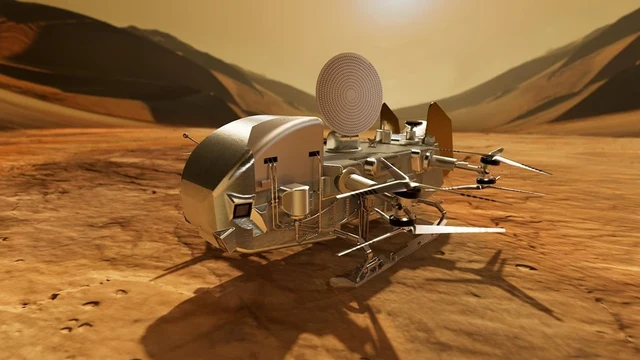
Artist's concept, not a Titan photograph. NASA / Johns Hopkins APL.
Image credit
Dragonfly on Titan, artist's concept
NASA / Johns Hopkins APL · NASA factual editorial useResized and encoded as WebP; no semantic alteration.
NASA's real-time simulation brings flight software, navigation cameras, lidar and flight-like avionics together for Dragonfly's demanding first landing.
The landing site passed beneath the vehicle before it committed to touching down. Dragonfly inspected the terrain, identified a safe patch, turned back and descended. The spacecraft's first autonomous flight on Titan is still years away, but that sequence has now been rehearsed in real time on flight-like computers.
NASA's October 23 test report describes the most comprehensive first-flight simulation yet for its rotorcraft mission to Saturn's largest moon. The news is not that a finished spacecraft has flown through a Titan-like atmosphere. It is that flight software, avionics and simulated sensor inputs have been exercised together through a demanding arrival sequence.
That makes this a story about coordination as much as flying. Seeing a hazard, estimating motion and choosing a landing site all have to happen in the right order, on the available hardware, while the vehicle is still moving.
A Landing That Starts by Letting Go
Dragonfly's first flight is an unusual departure. The rotorcraft will arrive inside an entry system, protected during the journey into Titan's atmosphere. Before it can fly, a mechanism must lower it from its stowed position beneath the backshell, allowing its rotors to start before it separates.
NASA's report describes two related but distinct lines of work. The computer testbed at Johns Hopkins Applied Physics Laboratory rehearsed autonomous flight and landing. At Lockheed Martin, a separate campaign is testing the physical mechanism that positions the rotorcraft for release. Static loads, deployment motion, locking and operation at different tilt angles are part of that mechanical work.
Neither result substitutes for the other. A navigation system can choose a good place to land only if the vehicle reaches the point where it can fly. A successful deployment mechanism cannot supply the terrain information needed for the descent that follows.
The first-flight simulation brought together most of the systems and manoeuvres used in that autonomous flight sequence. It is a substantial integration step, while still leaving later tests on the actual flight system ahead.
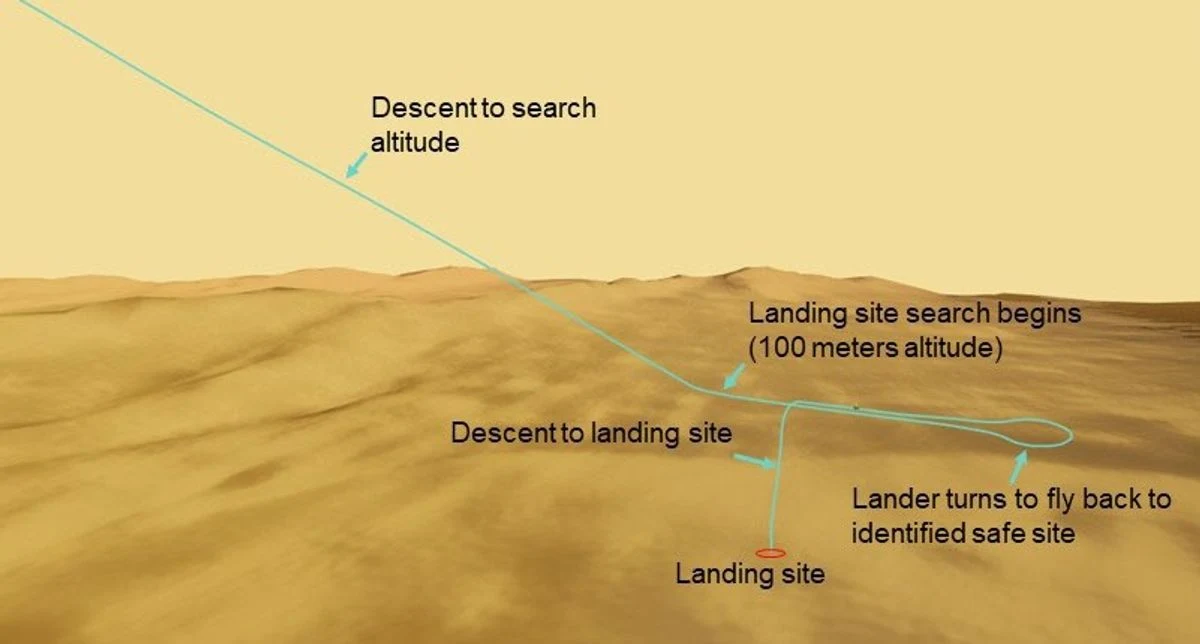
Image credit
Dragonfly real-time first-flight simulation
NASA / Johns Hopkins APL · NASA factual editorial useResized and encoded as WebP; no semantic alteration.
NASA / Johns Hopkins APL. This is the simulated first-flight path, not flight footage from Titan.
The Ground Must Arrive at the Computer on Time
The simulated inputs represented navigation cameras, inertial measurement units and lidar. Each contributes something different. Camera images contain visual information about the scene; inertial sensors track changes in motion; lidar helps measure the terrain and identify slopes or potential hazards.
The point is not simply to produce attractive images of Titan dunes. The test must give flight software a stream of inputs that makes sense together. If the camera view and the other sensor information describe different moments, the system is being asked to solve the wrong navigation problem.
NASA says a custom camera emulator used graphics processors to generate the simulated scenes in roughly the 20-to-70-millisecond exposure times expected for the navigation cameras. Running the sequence on flight-like hardware lets engineers examine interactions at those time scales, including the passage of information between processes.
This is why a simulation that runs correctly on a powerful desktop is not automatically the same achievement. A flight computer has its own timing, interfaces and resource constraints. The integration test asks whether the pieces work together in that more representative arrangement.
The Lidar Was an Important Missing Piece
The team did not begin with a complete autonomous landing and hope for the best. Its earlier work included simpler activities, from spinning a single rotor to short repositioning and partial scouting flights. Capabilities and sensor inputs were added incrementally.
According to the new report, incorporating lidar supplied the final element needed to fully simulate the first-flight environment. The simulator generated terrain for that sensor as well as the images the navigation cameras would see. The resulting flight path passed a candidate landing site, circled back and began the final descent.
The published screenshot is valuable evidence of the test precisely because it is identified as a simulation. Its coloured trajectory records a virtual flight path, not a track measured across the surface of Titan. The neighbouring cleanroom photograph shows actual navigation-camera installation, a different kind of evidence about the mission's progress.
Future work includes repeating first flight on Dragonfly's actual flight avionics and deliberately injecting faults. A nominal sequence answers whether the system can handle the intended situation. Fault testing asks what it does when a sensor, process or condition fails to behave as expected.
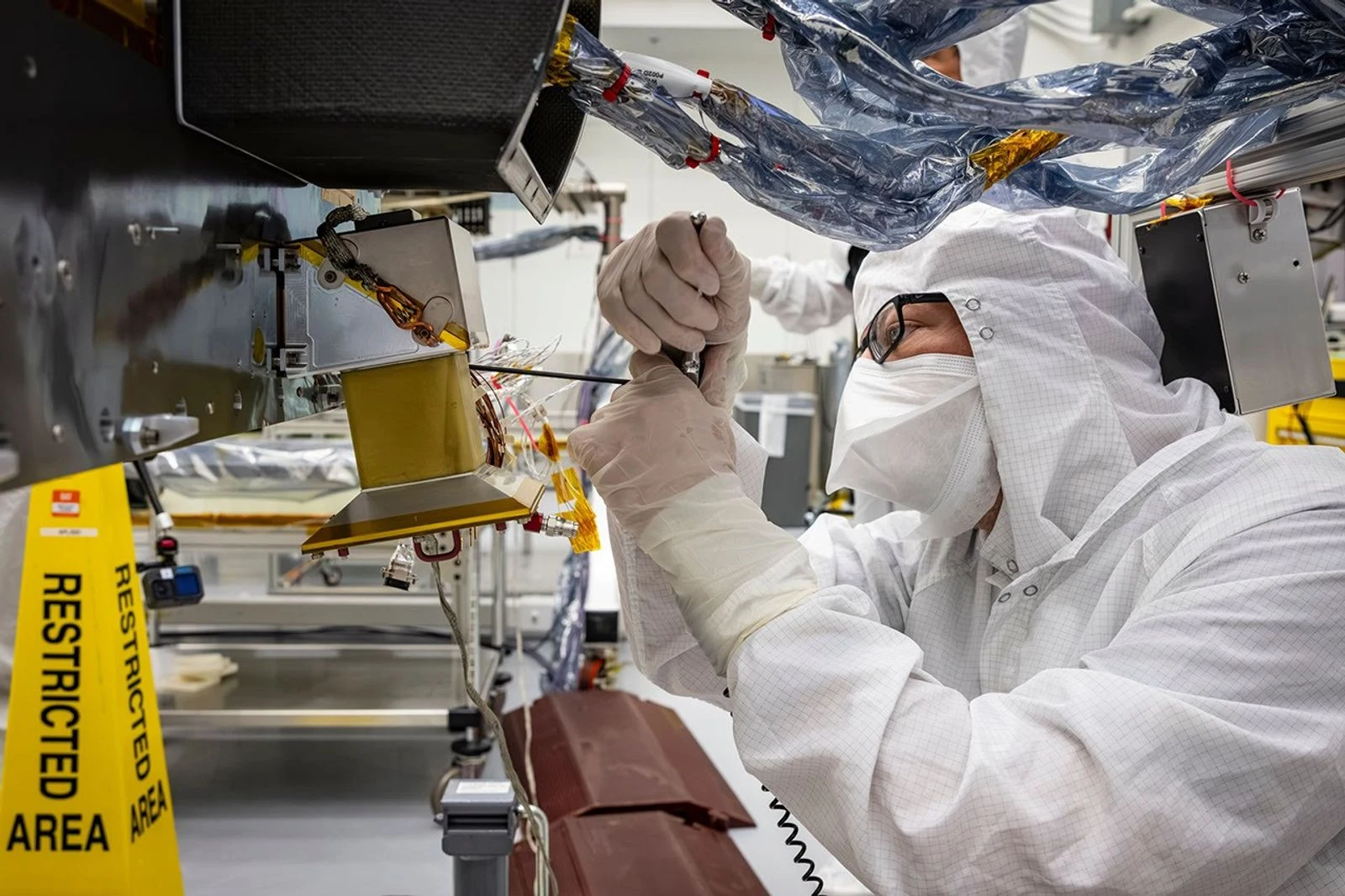
Image credit
Dragonfly navigation-camera installation
NASA / Johns Hopkins APL / Ed Whitman · NASA factual editorial useResized and encoded as WebP; no semantic alteration.
NASA / Johns Hopkins APL / Ed Whitman. Navigation-camera installation on August 19, accompanying the October test report.
Autonomy Is Part of the Mission, Not an Optional Feature
Titan is too far away for an operator on Earth to fly Dragonfly through a landing in real time. The vehicle has to make the immediate decisions itself. That does not remove people from the mission; it changes the boundary between planning a sortie and responding to the ground passing underneath the aircraft.
The mission overview describes a rotorcraft that can move between scientifically interesting locations, sampling surface material and investigating Titan's chemistry, geology and atmosphere. Its purpose includes understanding prebiotic chemistry: the chemical steps relevant to how life could begin. It is not an announcement that life has been found on Titan.
NASA lists launch no earlier than 2028 and arrival in 2034. Those remain planned milestones. This week's achievement is nearer and more specific: an integrated rehearsal of the autonomous sequence that must turn arrival into a controlled first landing.
Which part would you like a future engineering deep dive to unpack: simulated sensors, hazard selection or the release mechanism? Leave your questions in the comments below.
Comments
Member comments are temporarily unavailable.
Log in to join the discussion.