
Euclid's New Comet Images Show a Discovery Hiding in the Background
Published October 20, 2026
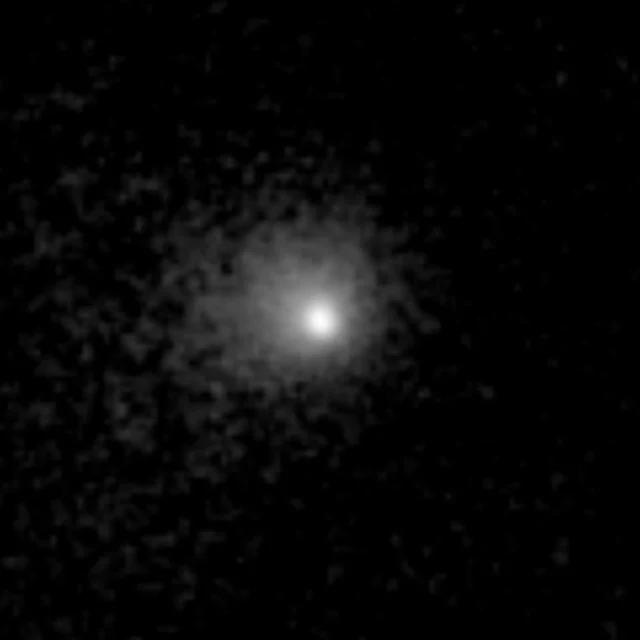
The actual comet in ESA's October 19 release: eight shorter exposures aligned on its motion, with background sources removed. The diffuse glow is a coma, not a resolved surface.
Image credit
Eight-exposure composite of comet C/2026 S1 (Euclid)
ESA/Euclid/Euclid Consortium/NASA, M. Pontinen et al. 2026 · CC BY-SA 3.0 IGOResized and encoded as WebP; no semantic alteration.
ESA's newly released Euclid images reveal how moving-object software, repeat observations and follow-up turned a faint streak into comet C/2026 S1.
The streak was something the telescope's main experiment did not need. In a survey built to measure distant galaxies, a moving object is foreground clutter. Follow it carefully enough, though, and that clutter becomes a discovery.
ESA's October 19 Euclid release presents the images behind C/2026 S1 (Euclid), the first previously unknown comet discovered by the mission. The dates deserve to stay separate: Euclid recorded the object in September, the Minor Planet Center confirmed it on October 8, and ESA has now released the detailed image story. This is a look at that newly published evidence, not a claim that the comet appeared for the first time this week.
What makes the pictures interesting is not a spectacular tail across the sky. It is the chain of decisions that turns a faint, fuzzy mark into an object other astronomers can investigate.
A Moving Target in a Survey of Distant Galaxies
Euclid is designed to study the large-scale universe through observations of galaxies. It is not a telescope that spends each night following comets around the solar system. Its survey generally steps between fields and holds its view while collecting exposures.
That creates a useful distinction in the images. A distant galaxy stays effectively in place during an exposure. A nearby solar-system object can move enough to stretch into a streak. The streak is not necessarily a long physical tail; it can be the record of motion while the camera was collecting light.
The wide-field image and inset show exactly why context matters. The September 20 observation lasted 560.52 seconds. The enlarged region identifies the moving object within a much larger field, rather than asking the reader to trust an isolated bright patch with no surroundings.
A fuzzy envelope around the object supplies another clue. That diffuse material is the coma, associated with an active comet shedding dust and gas. Motion and fuzziness are evidence to examine together; neither should be replaced with an artist's impression of what a comet ought to look like.
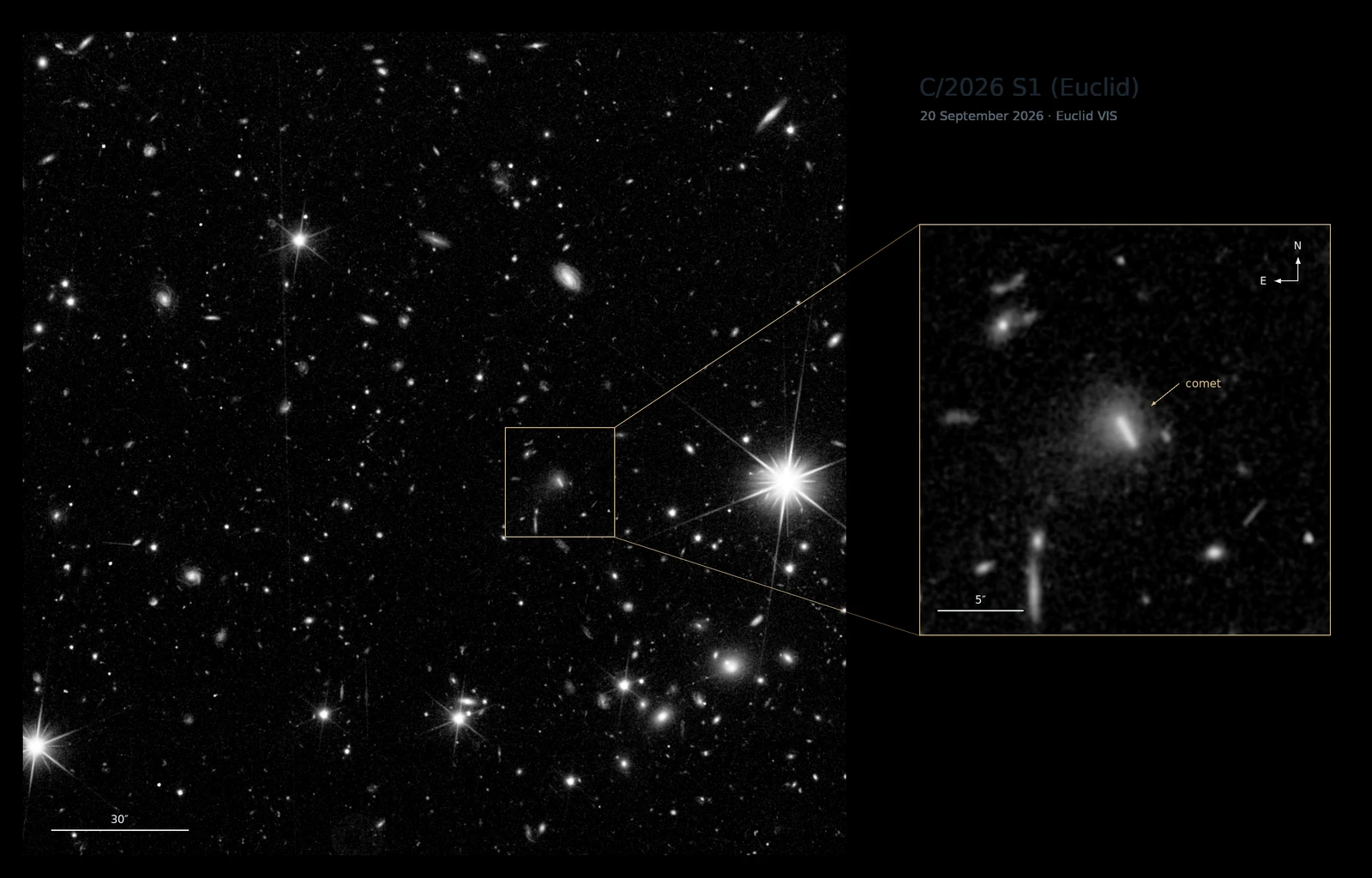
Image credit
Euclid comet observations in the surrounding survey field
ESA/Euclid/Euclid Consortium/NASA, M. Pontinen et al. 2026 · CC BY-SA 3.0 IGOResized and encoded as WebP; no semantic alteration.
The September 20 wide field and publisher's inset preserve observational context. The 560.52-second exposure stretches the moving comet into a streak.
Five Fields, Then a Catalogue Check
Mikko Pontinen at the University of Helsinki identified the candidate using moving-object detection software developed for Euclid's images. Predicting its position allowed the team to locate it in additional observations. ESA reports five fields of view and 16 exposures collected between September 16 and 24.
The next question was whether the object was actually new. The team compared it with catalogues of known comets and asteroids and found no match. Reporting the observations to the Minor Planet Center allowed ground-based observers to contribute follow-up measurements. The October 8 confirmation and designation belong to that process.
This was not Euclid's first sighting of any comet. The distinction is its first discovery of one that was previously unknown. Keeping those phrases separate prevents an impressive result from turning into an exaggerated one.
It is also a useful example of software working with the observing strategy rather than replacing it. The detection program could flag a candidate, but the available repeat views, the catalogue comparison, and outside follow-up each supplied something different.
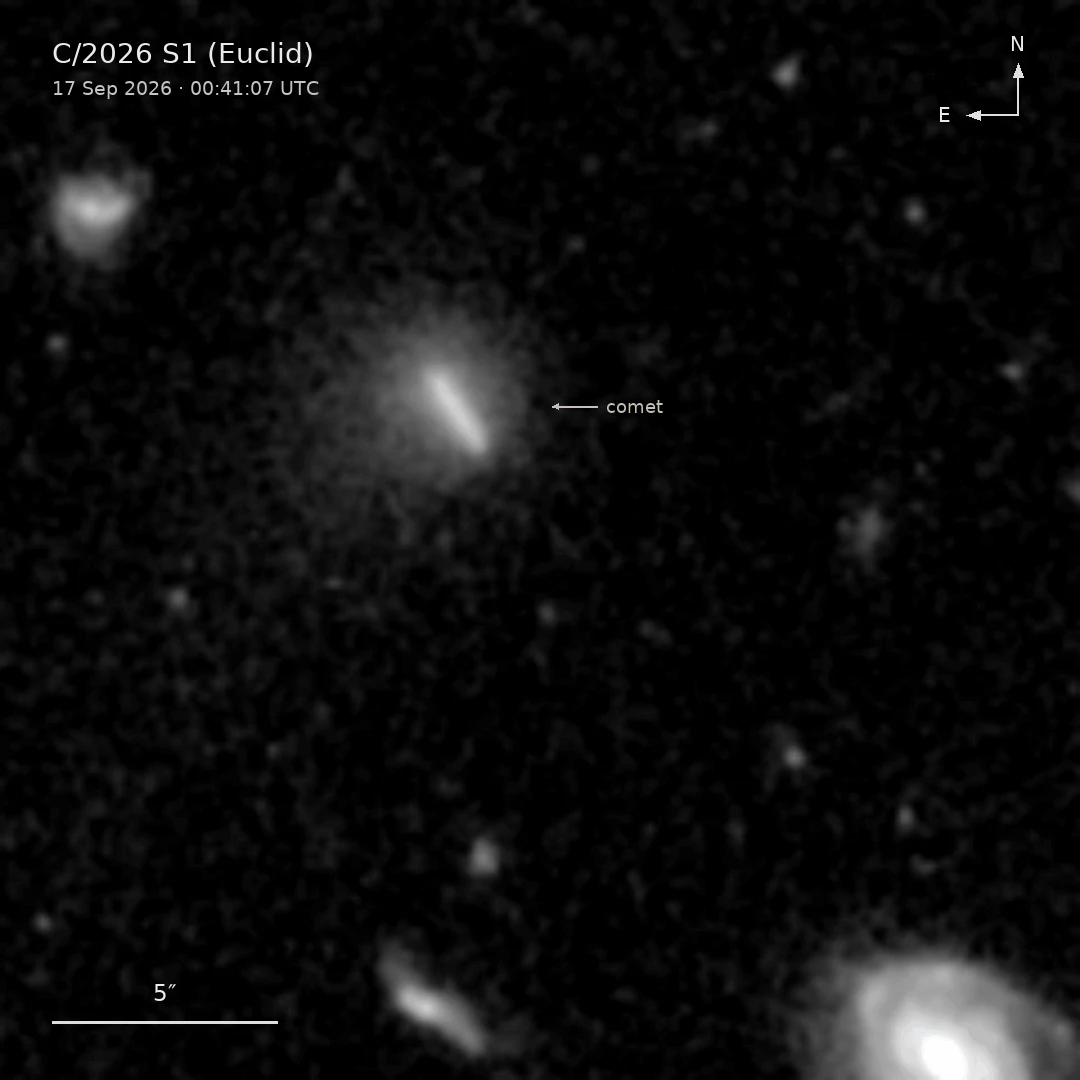
Image credit
Annotated Euclid comet sequence, first observed frame
ESA/Euclid/Euclid Consortium/NASA, M. Pontinen et al. 2026 · CC BY-SA 3.0 IGOFirst frame extracted from the original annotated GIF; resized and encoded as WebP. The timestamp and publisher annotations are retained.
A still extracted from ESA's annotated September 17 sequence. The original linked sequence shows changing position; this still is not an animated simulation.
Why the Same Comet Looks Different in Two Images
The cleaner composite accompanying ESA's release is not a second comet or a sudden change in the first one. It combines eight shorter exposures, each lasting 89.5 seconds, aligned on the moving object.
ESA says contaminated regions were masked and background objects removed in making that composite. The result emphasizes the comet and its surrounding coma. Shorter individual exposures also mean the object travels less far while each image is being recorded, reducing its stretched appearance.
The annotated sequence answers a different question. It preserves the surrounding sky and timestamps, making the changing position visible against background stars and galaxies. A cleaned close-up helps inspect the object; a sequence helps establish its motion. They are complementary views, not competing accounts.
Not the Destination for Comet Interceptor
ESA places the comet about 1.3 billion kilometres from Earth in the release. Its long orbit is still being refined as observations accumulate. An eye-catching discovery image is not a completed orbital solution.
The agency also explicitly rules this object out as a suitable target for its future Comet Interceptor mission. The useful connection is procedural: finding a distant comet and distributing a timely alert gives the mission teams experience coordinating a discovery and follow-up campaign.
That is a quieter result than announcing a spacecraft's next destination, but a valuable one. The images show an observing system producing useful evidence beyond its central galaxy-mapping task, without pretending that every unexpected streak leads to a visit.
Which view helps you most: the wide field, the cleaned composite, or the time sequence? Leave your questions in the comments below.
Comments
Member comments are temporarily unavailable.
Log in to join the discussion.