
A Fly's Brain Can Splice Jumping Genes Into Its RNA
Published November 17, 2026
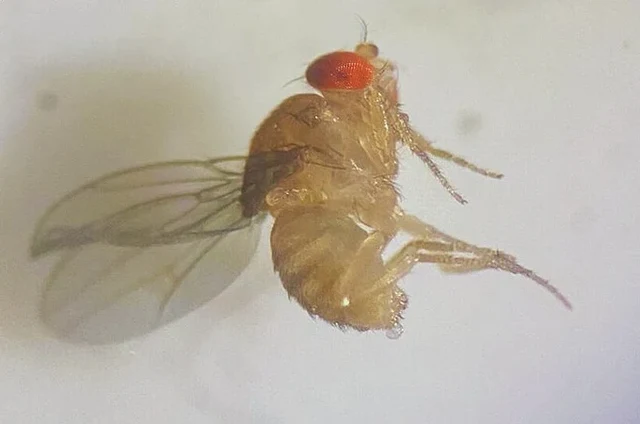
Representative species photograph, not one of the flies measured in this study.
Oxford researchers trace transposon-derived RNA messages in fruit flies. The striking 17.8% figure needs a denominator: it is not all brain RNA.
The important action in this fruit fly study is not a gene jumping somewhere new. It is a cell using a piece of DNA that is already there when it assembles an RNA message.
Researchers at Oxford have examined how sequences from transposable elements become part of messenger RNA in the fruit fly brain. Their eLife study finds that these hybrid messages can be reproducible and, at some selected sites, common. That is evidence for an additional source of RNA diversity. It is not yet evidence that the resulting messages change a fly's behaviour or make a particular protein.
Oxford highlighted the research on November 17, 2026, the date of its latest published version. The work had appeared as a January 26 preprint, followed by reviewed versions in April and October. The current report develops and tests an existing finding rather than introducing the whole idea for the first time.
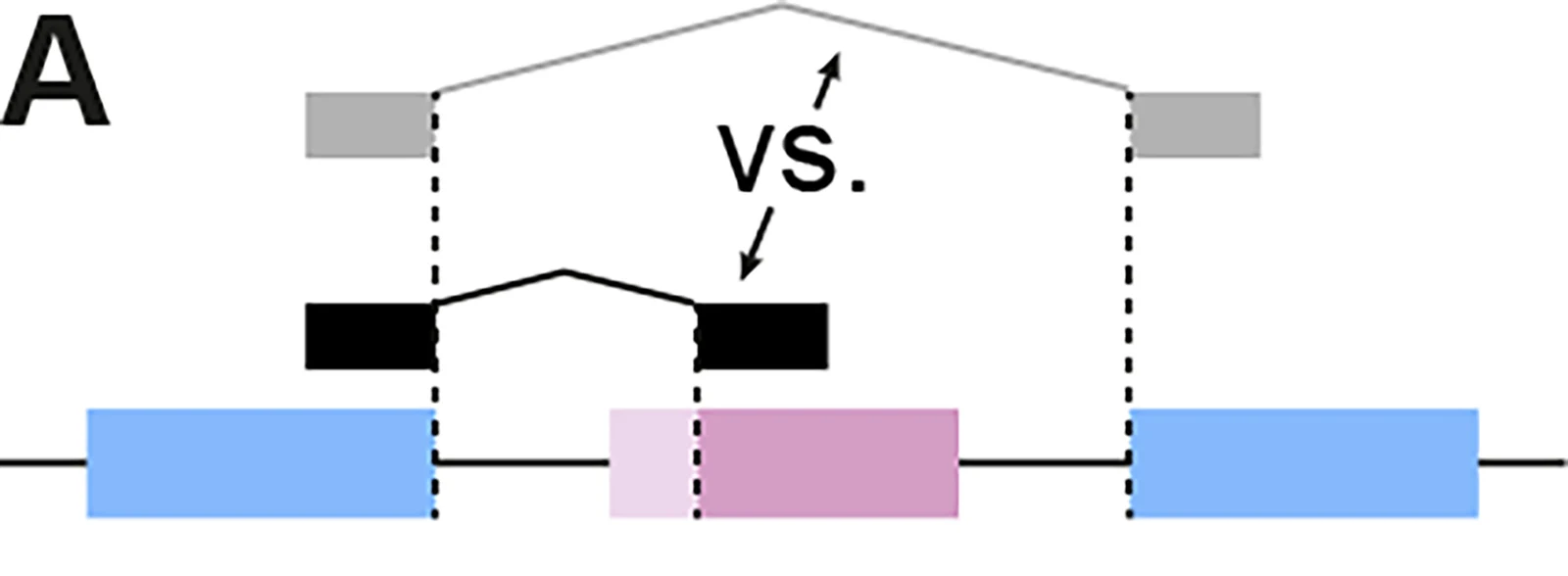
Image credit
The study's schematic compares a conventional RNA splice connection with inclusion of a transposon-derived section.
Malak Choucri, Tina Rainey and Christoph D Treiber · CC BY 4.0Exact integer source-pixel crop; RGB output; lossless PNG. 320px preview uses Lanczos downsampling. No upscaling, compositing, enhancement, invented content or generative editing.
Original study schematic; an explanation of RNA processing, not a movie of genes jumping.
An Extra Section in the Message
A gene's DNA sequence is not simply copied into one final, unchangeable instruction. Cells process RNA, removing some sections and joining others. Alternative splicing can produce different messages from the same gene.
Transposable elements, often called jumping genes, provide another possible source of sequence. Some sit inside introns, the regions normally removed during RNA processing. A cell can sometimes use splice sites within an element and retain some of its sequence in a mature message. The paper calls this exonisation: material inside an intron becomes an included section of RNA.
The distinction matters. Detecting a transposon-derived section in a message does not show that the transposon moved into a new location during that cell's lifetime. Nor does detecting its RNA necessarily mean the element is independently active. It can be transcribed and processed as part of a neighbouring gene.
The paper's full text explicitly distinguishes gene-linked messages from autonomous transposon expression. Treating both as evidence of genes busily hopping around a brain would obscure the mechanism being measured.
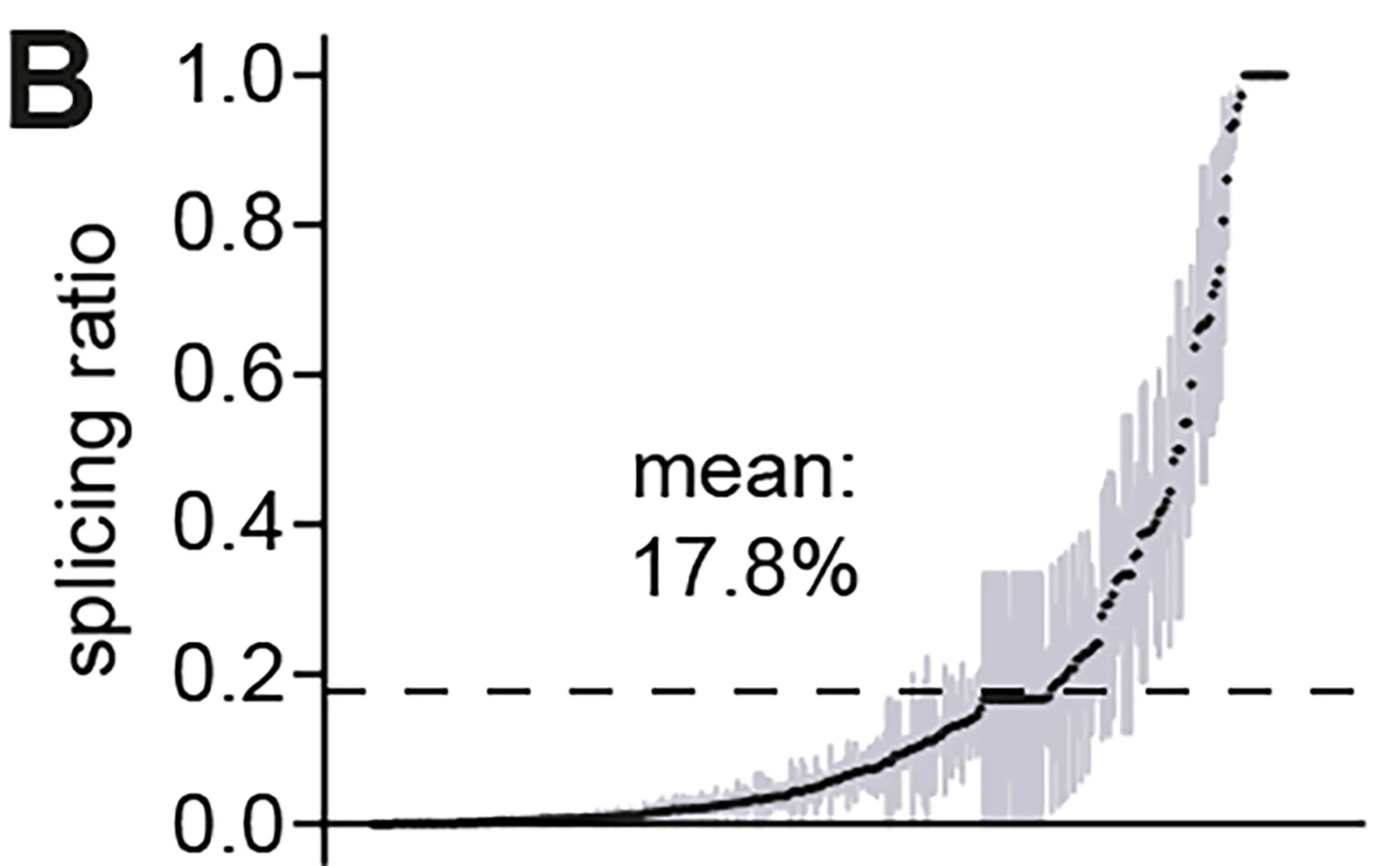
Image credit
The published ranked splicing-ratio plot retains the zero-to-one y-axis, complete ranked series, error bars and dashed mean line labelled 17.8 percent.
Malak Choucri, Tina Rainey and Christoph D Treiber · CC BY 4.0Exact integer source-pixel panel crop; RGB lossless PNG; 320px Lanczos preview. No plot reconstruction, label invention, contrast change, compositing or generative editing.
Original ranked measurements: the 17.8% mean concerns the selected gene-element pairs, not all brain RNA.
The Denominator Behind One in Five
The team extended its TEChim analysis software to compare sequencing reads supporting transposon-derived splice junctions with those supporting the ordinary connections between exons. The starting set contained 264 previously identified transposon-gene pairs from one fly genotype, using bulk midbrain RNA sequencing.
Some pairs had more than one relevant connection. In total, the analysis measured 456 junctions, with inclusion rates ranging from barely detectable to almost complete. Estimates were consistent across biological replicates.
The familiar headline number needs its sampling frame attached. Figure 1 displays the highest-ratio breakpoint for each of the 264 pairs. The mean on that graph is 17.8%. It is not a measurement showing that 17.8% of every RNA molecule across a fly's brain contains transposon sequence.
Across all 456 junctions, the median ratio was 3%, and a quarter exceeded 15%. Those statistics describe a different aggregation of the same selected material. They show why an average alone cannot describe what happens at a typical junction, much less establish a brain-wide total.
The result is still interesting with the denominator restored. Some particular insertions contribute a large share of the messages detected at their associated sites. Others contribute very little. The variation is part of the finding.
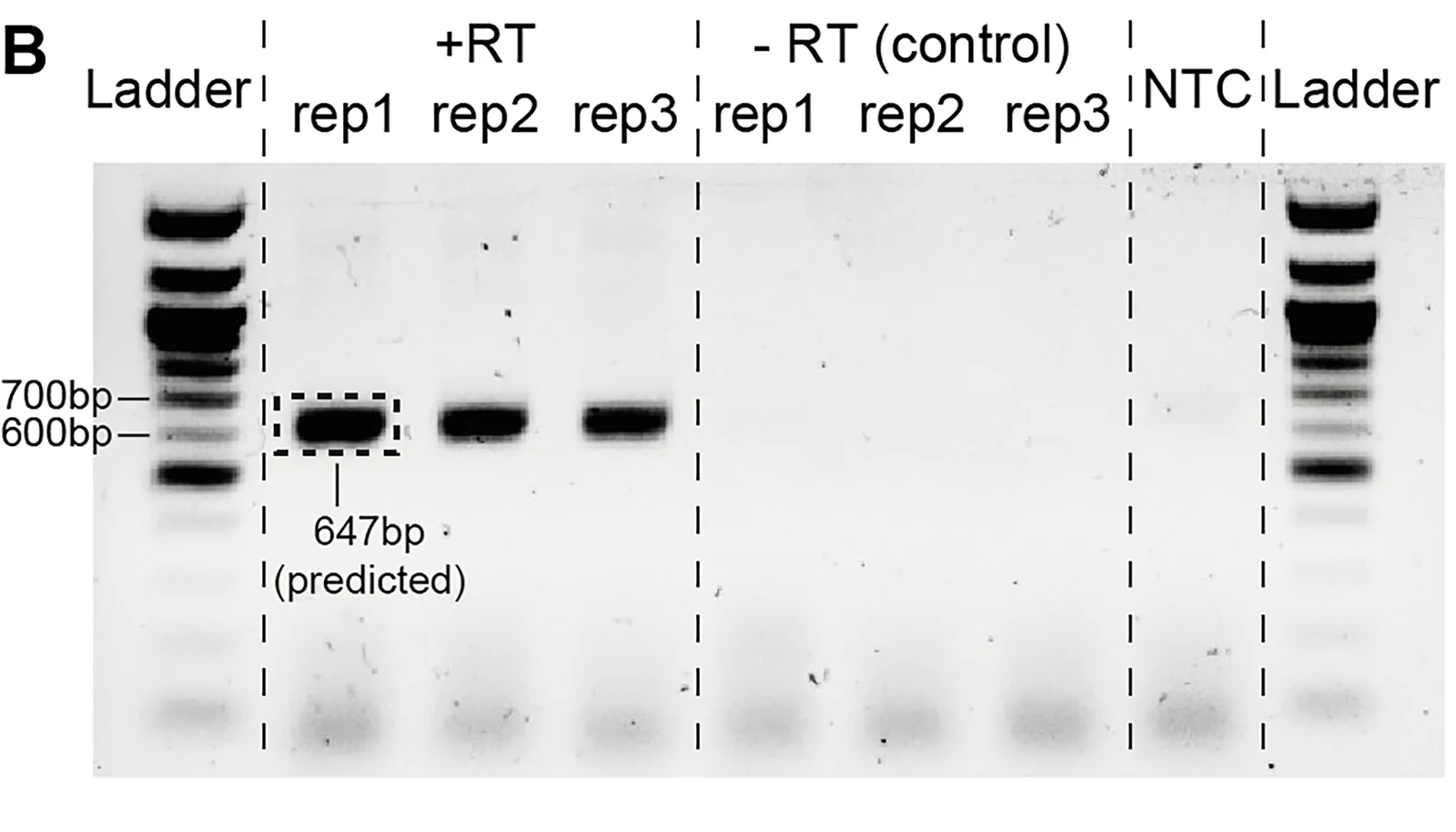
Image credit
The published validation gel retains positive replicate lanes, minus-RT control lanes, a no-template control and molecular-size ladders.
Malak Choucri, Tina Rainey and Christoph D Treiber · CC BY 4.0Exact integer source-pixel crop; RGB output; lossless PNG. 320px preview uses Lanczos downsampling. No upscaling, compositing, enhancement, invented content or generative editing.
Targeted RT-PCR validation from the study; one validated junction is not every result in the 264-pair analysis.
A Measurement That Survives Another Method
The paper also addresses a disagreement over whether previously reported hybrid messages were genuine. The authors argue that computational settings and experimental design can hide real junctions, including when analysis assumes a narrow distance between connected sequences.
They examine primer placement too. A primer is a short sequence used to target material for amplification. If the target section has been removed during splicing, an assay designed around it cannot reliably test for the mature message in question. A negative result then needs interpretation in terms of what the assay could detect.
The researchers tested a junction between the Beadex gene and an element called opus using targeted RT-PCR. In three biological replicates, they obtained a product of the predicted size and checked its sequence using Sanger sequencing. Matching reactions without reverse transcriptase, plus a no-template control, helped distinguish the RNA-derived result from unwanted amplification. The actual gel and sequencing trace appear in Figure 3.
This is narrower than experimentally validating every one of the 264 pairs. It is also stronger than relying on an unexplained software count alone. The sequence check connects a particular predicted junction to a physical laboratory result.
RNA Diversity Is Not Yet a Different Brain
The remaining questions concern what the messages do. Retained transposon sequence might alter a coding region or affect a non-coding section that influences RNA handling. These are possibilities discussed by the authors, not protein functions demonstrated by this experiment.
Bulk tissue measurements also combine signals from many cells. They cannot by themselves assign each RNA variant to a particular neuron or support cell. The authors propose cell-resolved sequencing, targeted protein measurements and genetic changes to individual inserted sections as ways to test those consequences.
Differences in transposon insertions between flies could therefore provide material for individual variation in gene expression. Whether that changes neural physiology or behaviour remains to be established. Evidence from this fruit fly dataset does not establish a mechanism for human personality or neurological disease.
What the study supplies is a more carefully measured starting point: inserted sequences can become recurring parts of neural RNA, and the methods used to look for them matter. The next step is to follow those messages far enough to find out which ones make a functional difference.
Which follow-up would you find most revealing: identifying the cells involved or measuring the proteins they produce? Join the discussion in the comments below.
Comments
Member comments are temporarily unavailable.
Log in to join the discussion.