
Scientists Found a Star That Should Look Green
Published October 17, 2026
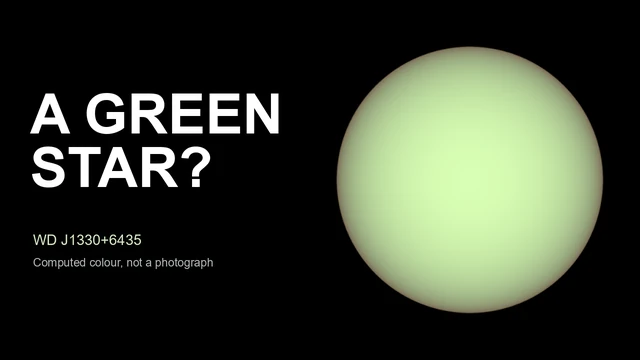
Computed stellar-disc color from the study, with an editorial title. A scientific visualization, not a telescope photograph.
Image credit
WD J1330+6435 computed-colour panel in an editorial headline layout
Mark A. Hollands, Boris T. Gansicke, Pier-Emmanuel Tremblay, Detlev Koester · CC BY 4.0Computed-disc panel mechanically extracted from the authors' figure, resized, placed on black and given an editorial title. No recolouring, generated stellar texture or invented measurement. CC BY 4.0 derivative; original full figure appears in the article.
WD J1330+6435 breaks the usual stellar color rules. Its dense, sodium-rich atmosphere produces a green appearance in a model of human vision.
Stars can look orange, white or blue. A genuinely green one has been conspicuously missing from that familiar sequence. Now a team studying white dwarfs has identified a strong candidate: WD J1330+6435, a stellar remnant whose light should look chartreuse green to human eyes.
The qualification is important, and also interesting. Nobody has flown close enough to photograph a green stellar surface. The researchers worked from spectra and atmospheric models, then calculated how the resulting light would be perceived. The green disc in the image is their computed visualization, not a camera view painted green for effect.
The study by Mark Hollands and colleagues appeared in RAS Techniques and Instruments on October 15, following an October 13 preprint. The authors describe the object as the first credibly identified genuinely green star known to them. That makes this a finding about the star's predicted appearance, not a claim that astronomers have just discovered the object itself. Published study, open manuscript.
Green Light Does Not Usually Make a Green Star
An ordinary star emits across a broad spread of wavelengths. Changing its temperature changes the balance across that spread; it does not isolate one narrow band like a colored LED.
That is why a star can produce plenty of green light without looking green. Our eyes combine the incoming wavelengths. A broad mixture can appear white even when a particular part of the spectrum is strong. The color of the combined light is not simply the color at the highest point of a graph.
The new work asks a different question: what happens when an atmosphere changes that mixture enough to move away from the usual temperature-color sequence?
White dwarfs provide an unusually demanding laboratory. They are dense remnants of stars that have exhausted their ordinary fuel-burning lives. Their outer layers can be very different from the atmosphere of a Sun-like star. Temperature still matters, but composition and the conditions around the absorbing atoms can matter enough to change the apparent color.
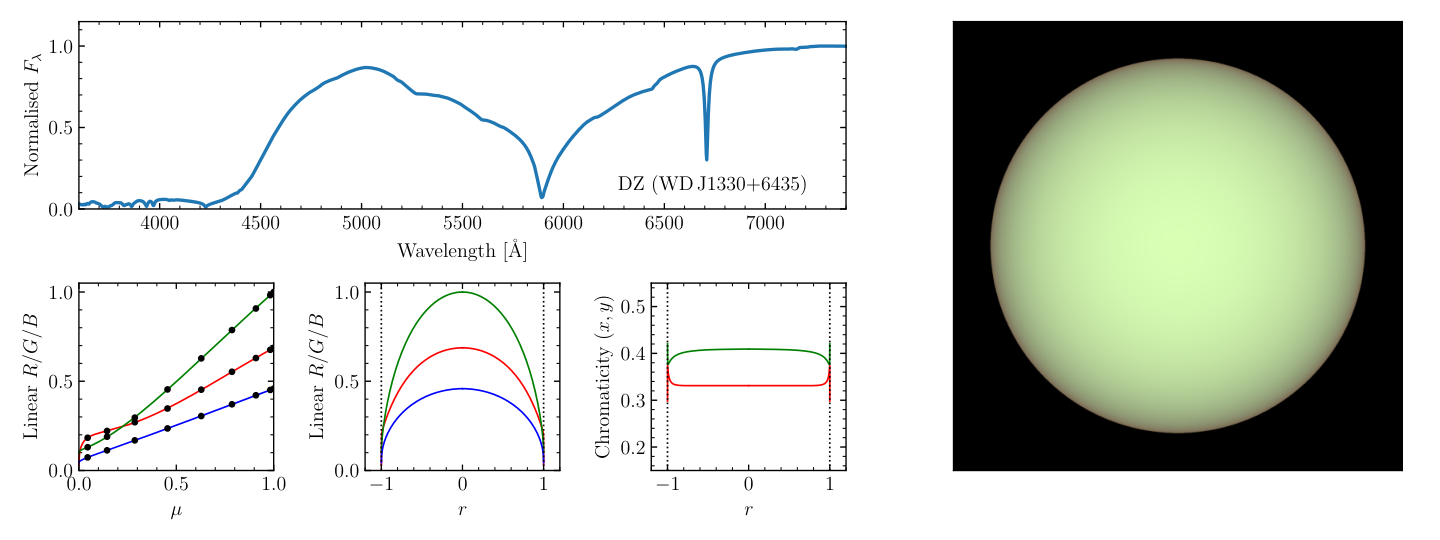
Image credit
green-model.png
Mark A. Hollands, Boris T. Gansicke, Pier-Emmanuel Tremblay, Detlev Koester · CC BY 4.0Original image downloaded without semantic alteration; responsive copies resized and encoded as WebP.
Sodium Changes the Mix
WD J1330+6435 has accumulated rocky material from its planetary system. Warwick's account identifies calcium, lithium and sodium in its atmosphere, and gives a temperature of roughly 4,000 degrees Celsius.
The striking ingredient is sodium under extreme atmospheric conditions. Its absorption is broadened across a substantial range of wavelengths, removing more yellow, orange and red light than a narrow, isolated spectral line would suggest. The remaining balance produces the green result in the team's human-vision model. University of Warwick explanation.
It is a useful reversal of the everyday intuition that an object's color tells you what it adds. Here, what the atmosphere takes away is central. The reported green appearance does not require a mysterious green energy source inside the remnant.
Nor does sodium automatically make any star green. The result depends on the particular atmosphere and spectrum. Naming an element is the start of an explanation, not a complete recipe that can be transferred unchanged to a different star.
Two Routes to an Unusual Atmosphere
The study also distinguishes material arriving from outside a white dwarf from material brought up from within it. That turns the collection of unusual colors into something more informative than a palette of astronomical curiosities.
In the green object's case, rocky planetary material has enriched the atmosphere from above. In some cool, carbon-rich white dwarfs, convection can instead carry carbon from the interior toward the surface. Carbon molecules then change which visible wavelengths emerge, producing some of the pink appearances explored in the research.
Those are different histories that can both alter the light we receive. A surprising color is therefore a prompt to investigate composition and atmospheric conditions, not a complete explanation of how the material got there.
The distinction is especially appealing in an old stellar remnant. The bright, fuel-burning phase is over, but interactions with the remains of a planetary system can still leave a measurable signature. The object has not stopped being scientifically active just because its name sounds like an endpoint.
A Model of Seeing, Not Just a Color Filter
The researchers convert a spectrum into a model of human color response and then into values that a display can show. That chain differs from assigning different telescope filters to red, green and blue channels to make astronomical structures easier to study.
Both approaches are useful. They answer different questions. A scientific false-color image might emphasize a chemical signature or reveal radiation our eyes cannot detect. This study instead asks how the combined visible light would appear to an observer close enough to see the stellar disc.
There are limits to the screen version. Its brightness is nothing like the real stellar surface, and displays, settings and surrounding light affect what a viewer sees. The published disc should not be treated as a calibrated physical light source just because its pixels come from a careful model.
For anyone who works with LEDs, photography or displays, this is the particularly satisfying part of the story: color is a relationship between a spectrum and a visual system. A single RGB triplet is an output of that relationship, not a full description of the original light.
Most White Dwarfs Still Earn the Name
The same study examined a representative sample of 151 white dwarfs within 20 parsecs of Earth. Five had conspicuously unusual colors; the median correlated color temperature was about 6,800 kelvin. Those are sample results, not a count of all the unusual white dwarfs in the Galaxy.
Pink, cyan and yellow examples appear in the broader investigation too. The result is not that every white dwarf has been misnamed. It is that some combinations of atmospheric conditions and composition can produce appearances outside the familiar orange-white-blue progression.
The green object is therefore more than an amusing exception. It shows why a spectrum can carry information that a single broadband photograph conceals. Two sources can look broadly similar in an astronomical image and still distribute their light differently enough to matter for human perception.
The strongest version of this headline needs no imaginary close-up: astronomers have a spectrum, a physical explanation and a calculated appearance that challenges a longstanding expectation. Which part would you like to explore further, the dense atmosphere or the conversion from light to screen color? Leave your questions in the comments below.
Comments
Member comments are temporarily unavailable.
Log in to join the discussion.