
Hera's Heat Vision Reveals the Asteroid Hiding in Shadow
Published November 17, 2026
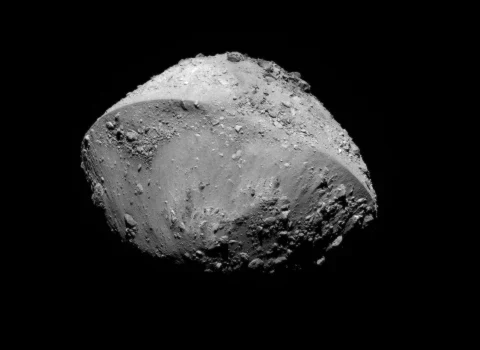
Didymos, observed November 6, 2026; about 2.7 m per AFC pixel. (c) ESA. Empty border cropped.
Image credit
hera-visible
(c) ESA · ESA factual editorial useEmpty black border cropped to keep the complete illuminated asteroid and ridge; WebP conversion only.
Visible light, 25 spectral bands and thermal emission give Hera three views of the Didymos system. The new survey is not a DART crater reveal.
In one view, a ridge catches the light. In another, the same asteroid is divided into bands of reflected colour. In a third, its nearly hidden companion becomes visible through heat. Hera is looking at one small system with three different kinds of attention.
ESA's November 17 update brings together visible, multispectral and thermal infrared observations of Didymos and its smaller moonlet, Dimorphos. These are complementary measurements, not three decorative treatments of the same photograph.
The dates need separating. The AFC image record, HyperScout H record and TIRI record all identify observations acquired on November 6, 2026, from 28.5 kilometres away. The individual assets carry November 16 release dates. November 17 is the date of the explanatory article, not the day the cameras took these pictures.
Start With The Shape
The monochrome Asteroid Framing Camera view is the most immediately legible. Didymos has an angular outline and a bright, conspicuous equatorial ridge. The image caption gives a spatial resolution of approximately 2.7 metres per pixel. That number belongs to this AFC observation; it should not be attached indiscriminately to all three instruments.
There was already a useful comparison on November 12. ESA released a view from 56 kilometres away showing boulders, smoother areas and the sharp ridge. The new set adds a closer look and other ways of reading the surface. It is not the mission's first sight of the pair.
Didymos turns once every roughly 2.2 hours. ESA describes rapid rotation as a possible driver of material moving towards its equator. That is an interpretation to investigate, not a landslide caught in progress. A slope visible in a still image is not, by itself, a measurement of motion.
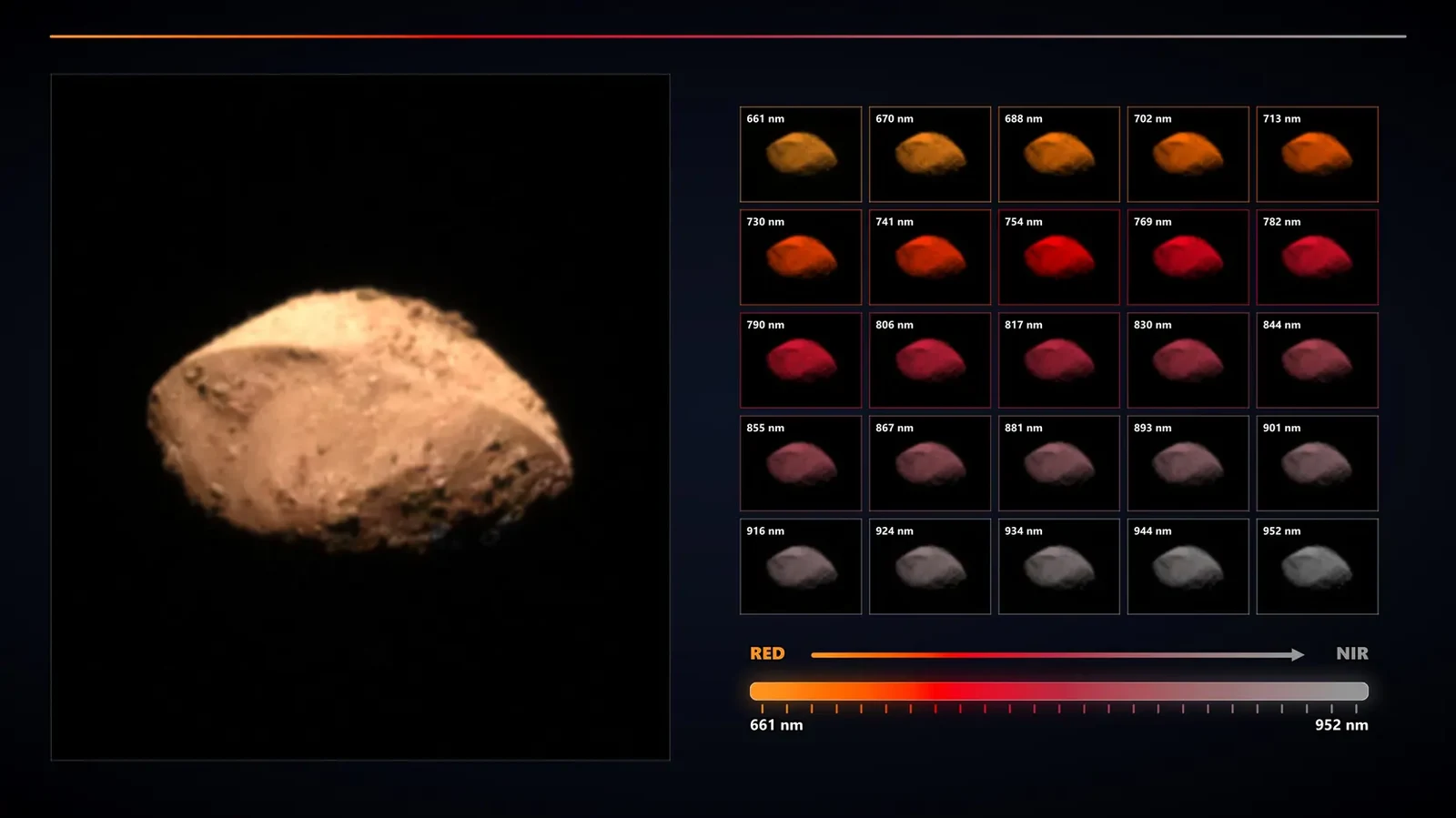
Image credit
hera-bands
(c) ESA · ESA factual editorial useWebP encoding only; complete source measurement retained.
HyperScout H comparison: visible red to near-infrared, not a natural-colour photograph. (c) ESA.
Separate The Light
HyperScout H observes in 25 spectral bands, spanning visible red light and near-infrared. Its released comparison image lays out the asteroid repeatedly beside wavelength labels. The changing colours are a scientific presentation of different measurements, not an ordinary colour portrait.
Why divide the light? Different materials reflect sunlight differently across wavelengths. ESA explains that researchers can compare the resulting spectral signatures with laboratory measurements of meteorites and minerals. A patch that looks unremarkable in a monochrome view might be worth examining spectrally.
The important word is compare. This preview does not announce a finished mineral inventory. The instrument supplies evidence from which composition can be investigated; the attractive array of coloured asteroids is not itself a list of identified substances.
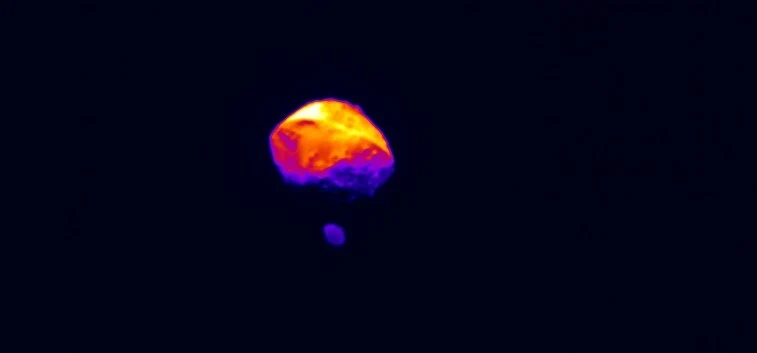
Image credit
hera-thermal
(c) ESA · ESA factual editorial useWebP encoding only; complete source measurement retained.
TIRI thermal observation, November 6, 2026. (c) ESA; instrument supplied and operated by JAXA.
Look Into The Shadow
The thermal view changes what can be seen at all. Dimorphos is almost entirely in shadow in the other observations, but appears through its thermal emission in TIRI's image. ESA identifies the instrument as supplied and operated by the Japan Aerospace Exploration Agency, JAXA.
The TIRI instrument paper, published in November 2025, explains the underlying measurement. Its broad thermal imaging band covers wavelengths of 8 to 14 micrometres. It measures emitted infrared radiation rather than simply collecting the sunlight reflected towards a conventional camera.
Temperature also changes with local time, surface orientation, roughness and the physical properties of the material. Following heating and cooling can help constrain thermal inertia: how strongly a surface resists changing temperature. Interpreting that behaviour requires geometry and modelling as well as the images.
So red and blue should not become shorthand for two proven kinds of rock. Nor is this a view through the asteroid. TIRI reveals thermal emission from a surface that reflected-light imaging struggles to show.
The Impact Question Is Still Open
The reason to examine Dimorphos so carefully remains NASA's DART experiment. On September 26, 2022, the spacecraft deliberately struck the moonlet. NASA's original approach sequence shows its final minutes before collision, with the target expanding across the frame. The last picture is incomplete because transmission ended during impact. It is an extraordinary before-view, not a photograph of a resulting crater.
Hera's new preview does not supply that missing after-view. ESA still presents the crater-versus-broader-reshaping question as unresolved and says more detailed imagery is planned for November 25. That is an announced future release, not evidence already available on November 17.
For now, the achievement is quieter and more useful than a premature crater headline: shape, reflected spectrum and emitted heat are becoming observations that can be considered together.
Which view most changes how you picture these asteroids? Share your thoughts in the comments below.
Comments
Member comments are temporarily unavailable.
Log in to join the discussion.