
Hubble's New Galaxy Portrait Has a Foreground Star Hiding in Plain Sight
Published October 17, 2026
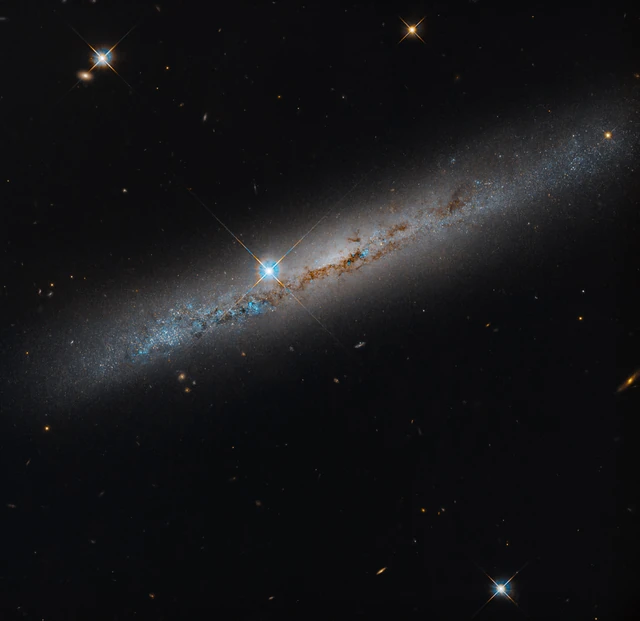
The new Hubble image. The spiky star near the central bulge is in the foreground, not inside NGC 1827.
NGC 1827's dusty, edge-on disc looks like one scene. A bright star projected near its center is actually much closer to us.
Look just to the left of this galaxy's bright center. The prominent star seems to belong to the scene around it, but it is a foreground object between us and the galaxy.
Hubble's October 16 image release features NGC 1827, an intermediate spiral galaxy roughly 37 million light-years away in Columba. Seen nearly edge-on, it becomes a long, luminous disc cut by rusty-brown dust lanes. NASA's image release.
The bright star is a useful reminder that a telescope image stacks unrelated distances onto one flat view. Nearby stars, the target galaxy and much more distant background galaxies can all occupy neighboring pixels.
What to Look For
The dust lanes cross the disc lengthwise. Bright-blue regions along it are associated with likely recent or ongoing star formation. Faint galaxies appear in the background.
The foreground star's four spikes come from diffraction around the supports for Hubble's secondary mirror. They are features of the imaging system, not four enormous structures extending from the star.
It is worth separating those clues. Dust belongs to the galaxy's structure. A projected foreground star belongs to another distance. Diffraction spikes belong to the optical path. All three contribute to the same picture, but they do not describe the same physical object.
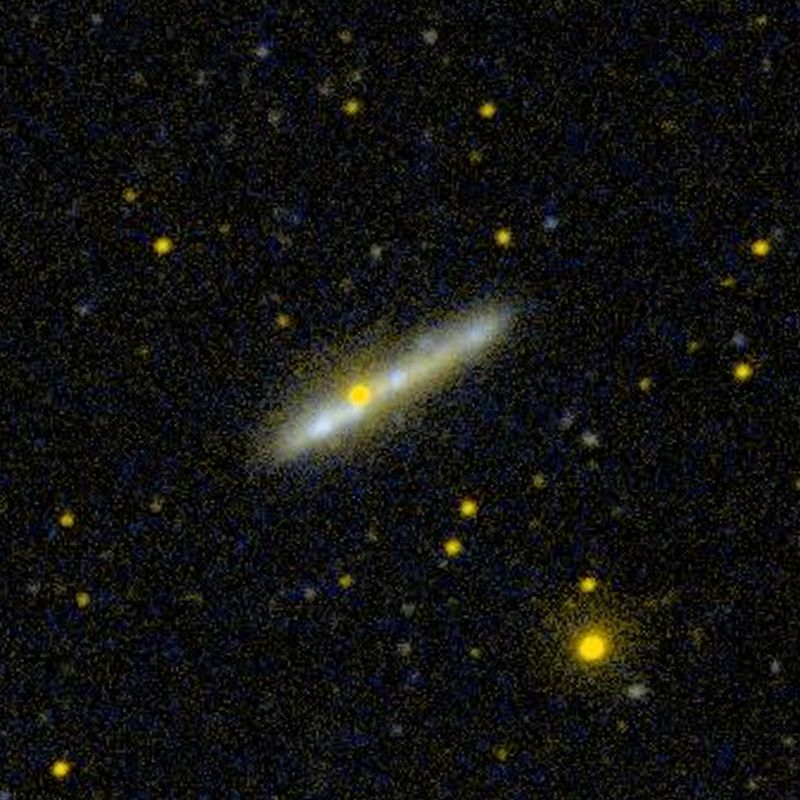
The ultraviolet comparison also makes a simple point: two instruments do not have to show identical-looking galaxies to be observing the same target. Wavelength selection and image sampling change which details stand out. The comparison is not evidence that the galaxy transformed between the two images.
The Survey Behind the Portrait
NASA places the Hubble observation in a program examining 260 satellite galaxies around 22 Milky-Way-like host galaxies. At the time of the release, Hubble had observed 111 of the targets, leaving 149 to go, with an orbit allocated to each remaining target.
An orbit here is telescope observing time. It is not the time it takes one of those galaxies to circle its host.
Low-mass galaxy populations provide tests for cosmological models at smaller scales. The attractive image is one part of an observing program intended to build a broader comparison, not a declaration that the whole survey is finished.
A good way to explore the frame is to begin with the disc, then look outward: which small points have spikes, which objects look extended, and which are interrupted by the dust lanes? Those distinctions reveal more than treating every bright spot as another member of the target galaxy.
What detail caught your eye first? Share it in the comments below.
Comments
Member comments are temporarily unavailable.
Log in to join the discussion.