
Hubble's Cosmic Rings Are a Preview of Roman's Dark-Matter Hunt
Published November 14, 2026
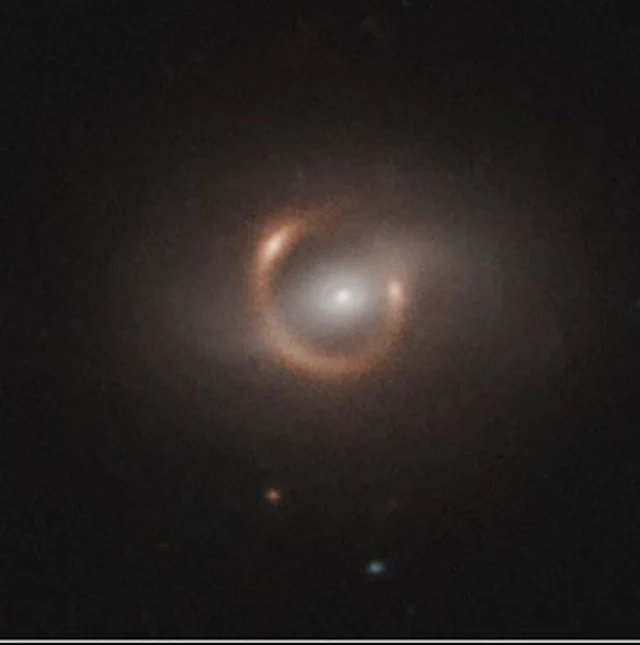
NASA/ESA Hubble observation, cropped from the gallery; not a Roman image.
Image credit
One Hubble Einstein-ring example
NASA, ESA, and X. Huang (University of San Francisco); processing Gladys Kober (NASA/Catholic University of America) · NASA factual editorial useCropped one existing image panel for the thumbnail, then resized and WebP encoded; no invented detail.
A newly released Hubble gallery shows why distorted galaxies are useful measurements, how Roman widens the search, and why a forecast is not a discovery.
The strange circles are not decorations. In these Hubble images, a foreground galaxy's gravity redirects light from another galaxy behind it. The distant object becomes an arc, a ring or several images arranged around the nearer one.
A gallery released on November 12 gives those distortions a practical purpose: helping researchers prepare for the much larger lens samples expected from the Nancy Grace Roman Space Telescope. The pictures are Hubble observations, not Roman's first survey results.
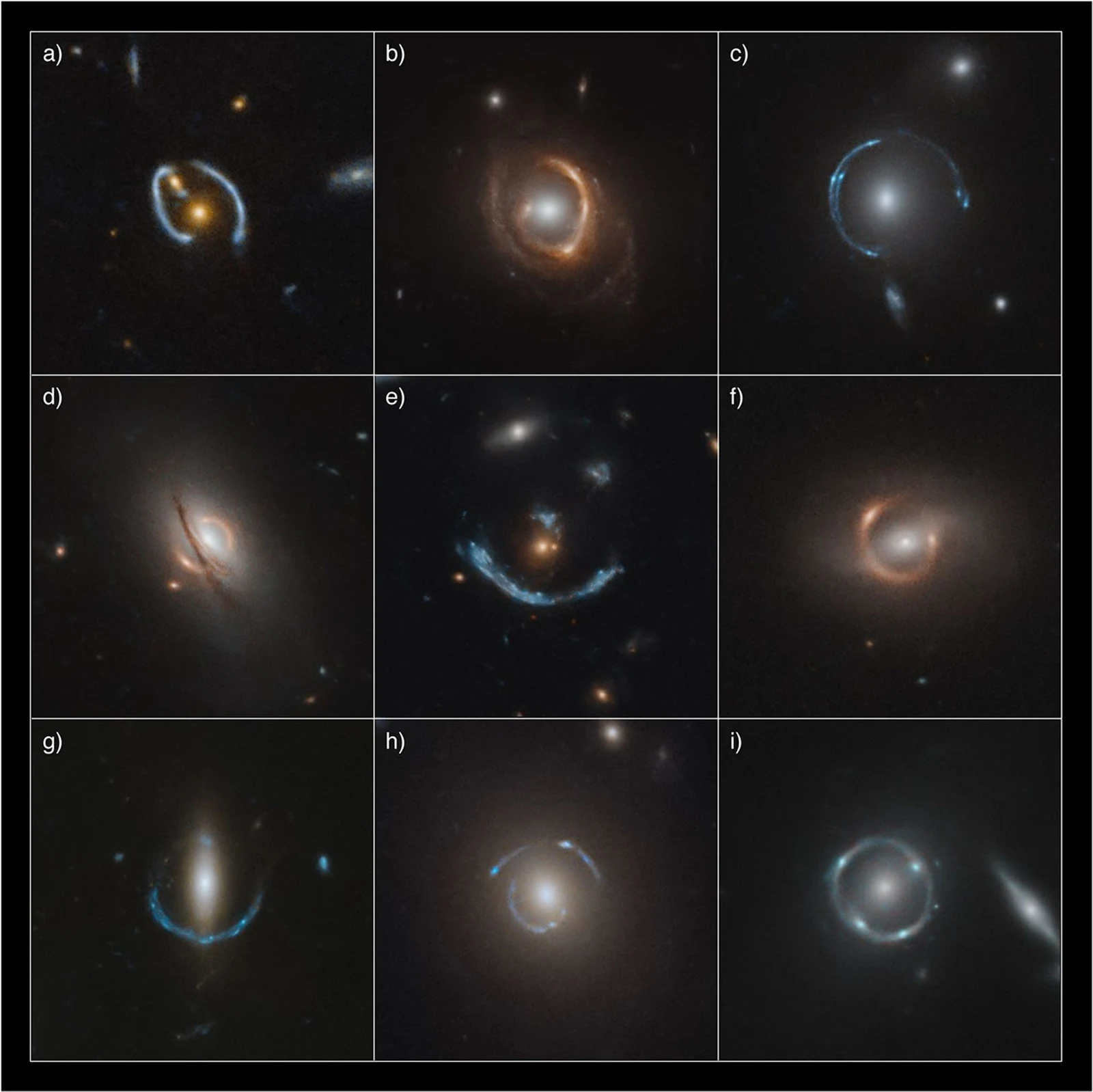
Image credit
Hubble strong gravitational lenses, with original panel labels
NASA, ESA, and X. Huang (University of San Francisco); processing Gladys Kober (NASA/Catholic University of America) · NASA factual editorial useResized and encoded as WebP; no semantic alteration.
NASA/ESA Hubble gallery. Panel F is nearly a complete ring; I shows four images of one background galaxy.
Read the Ring Before Counting the Galaxies
In the labelled gallery, panel F approaches an Einstein ring: the background galaxy's light almost encircles the foreground lens. Panel I instead contains four conspicuous images of the same background galaxy. Four bright spots do not necessarily mean four separate galaxies.
Panel D has a different complication. A dust lane interrupts the view of a possible ring. Roman's infrared observations could help researchers see through more of that dust and establish how complete the structure is. These examples come from the image explanations accompanying the release.
That makes this a particularly good gallery to look through slowly. The differences are the information, not imperfections to edit away.
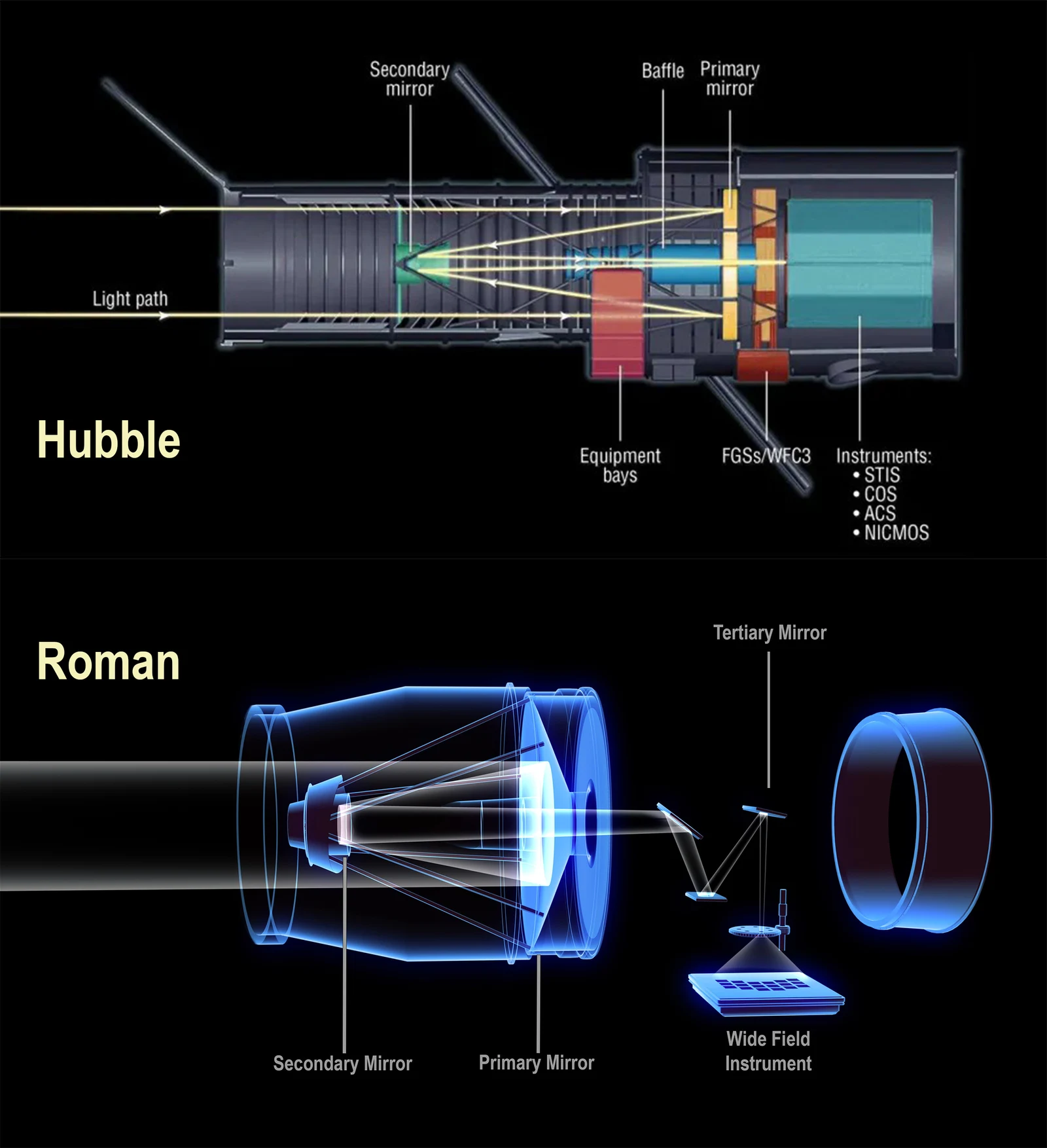
Image credit
Different Hubble and Roman optical arrangements
NASA's Goddard Space Flight Center · NASA factual editorial useResized and encoded as WebP; no semantic alteration.
NASA Goddard schematic, not a current instrument-status chart or telescopes drawn to the same physical scale.
A Wider View Is Not a Larger Mirror
Roman and Hubble both have primary mirrors about 2.4 metres across. The important difference is the optical arrangement around them. Roman uses three curved mirrors and a shorter focal length to deliver a much wider field; Hubble's two-mirror design directs light through a longer folded path. The NASA optical comparison shows why equal mirror diameter does not mean identical photographs.
Roman's Wide Field Instrument covers roughly 100 times as much sky per observation in the comparison. That is an area advantage, not a claim that every object becomes 100 times sharper. Hubble also retains ultraviolet capabilities that Roman does not duplicate.
For a survey, coverage matters enormously. A narrow, detailed image and a wide search do different jobs. Finding a rare object and examining it closely are related tasks, but they are not interchangeable. One instrument can make the target list that another investigates.
The Big Number Is Still a Prediction
A June 2025 simulation study illustrates the opportunity and its limits. For a particular version of Roman's planned High Latitude Wide Area Survey, using single 146-second exposures, researchers predicted around 160,000 detectable galaxy-galaxy strong lenses.
Only about 500 in that simulated population had enough signal relative to noise for the detailed dark-matter-substructure analysis considered by the study. Those are model-based forecasts, not objects already counted in Roman images. Different exposure strategies and detection conditions matter.
The distinction is useful: a very large catalogue does not make every entry an equally powerful experiment. The most demanding questions require particularly informative images and careful modelling. The authors released simulation products to help train searches and test analysis methods before interpreting real observations.
What Would Make This More Than a Beautiful Picture?
The next step is not simply collecting more rings. The scientific goal is to connect observed distortions with a defensible model of the mass producing them. The Hubble release identifies small dark-matter clumps as one target for that work; it does not announce that these images have settled what dark matter is.
This is the appealing part of the gallery. A picture can be both immediately striking and the beginning of a measurement. The ring catches the eye. Understanding why it has that particular shape is the harder, more interesting job.
Which lens would you want to examine more closely? Tell us in the comments below.
Comments
Member comments are temporarily unavailable.
Log in to join the discussion.