
This Telescope's Job Is to Stay Still Enough to Measure Space-Time
Published October 11, 2026
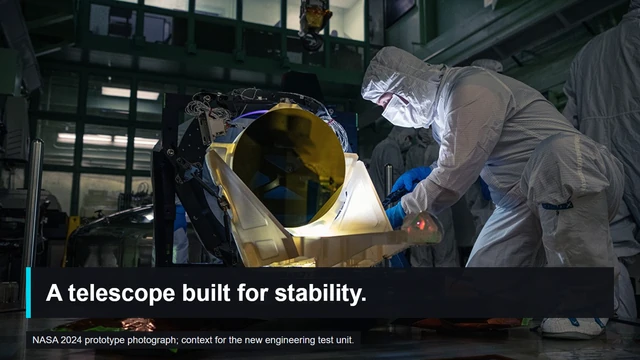
Historical prototype photograph. The October 2026 development concerns a new engineering test unit, not this prototype's first delivery.
Photo credit
lisa hero.png
NASA/Dennis Henry · NASA media use guidelinesSource photograph cropped for a 16:9 layout, editorial headline added; image itself not regenerated. NASA 2024 prototype photograph; context for the new engineering test unit.
Resized for display; composition unchanged.
NASA's next LISA telescope test unit uses a low-expansion glass-ceramic design for laser measurements between distant spacecraft.
The amber-colored telescope looks like an object you might want to put on a desk. Its intended job is rather less forgiving: help measure tiny changes in the distances between spacecraft millions of kilometers apart.
On October 8, NASA announced the next engineering test unit for its LISA telescope contribution. L3Harris will design, assemble, and integrate the unit. NASA describes it as a step toward eventual flight hardware; LISA, led by ESA, is planned for the mid-2030s. This is not a launched observatory. NASA update.
The released clean-room photograph shows an earlier prototype delivered in 2024. It is useful context for the design, but it should not be mistaken for a photograph of a completed new flight telescope.
A Telescope for a Laser Link
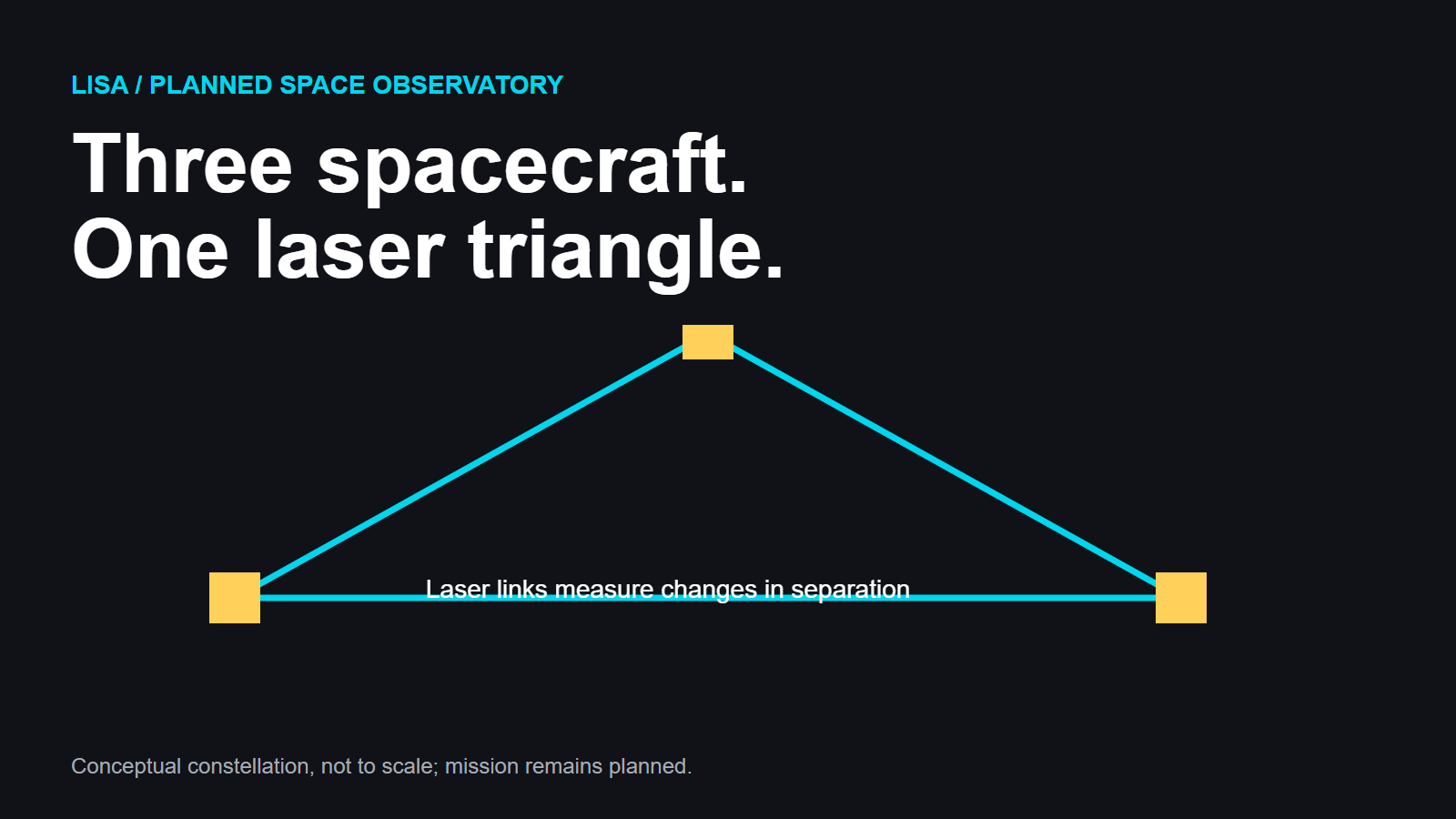
LISA's three spacecraft form a large triangle, with telescopes transmitting and receiving infrared laser signals between neighbors. Changes in the measured distances can reveal passing gravitational waves.
That is different from using a telescope to make a sharper picture of a galaxy. The optical link is part of a precision measurement. Its own changing geometry can become an unwanted signal if it is not controlled and characterized.
The design uses Zerodur, a glass-ceramic material valued for very low thermal expansion. NASA describes the telescope as entirely made from the material. The attraction is not simply that glass looks elegant. It is that dimensional stability is part of the instrument's function.
Staying Still Is an Engineering Problem
Everyday instruments teach the same lesson on a smaller scale. A support expands as it warms. An alignment shifts. A mounting choice introduces stress. The change may be tiny in a workshop and still be large compared with the signal a precision experiment wants to measure.
Choosing a low-expansion material reduces one problem. It does not eliminate the need to test the assembled telescope. Joining parts, surviving the environment, and keeping an optical path predictable all belong to the hardware's behavior, not just the material datasheet.
That explains why an engineering test unit is meaningful. It provides a bridge between a promising prototype and hardware that can be manufactured and qualified for the mission. A prototype can establish an idea while still leaving practical questions about integration and repeatable production.
The New Milestone Is Specific
It is tempting to describe every new LISA component as a breakthrough in detecting gravitational waves. The October announcement is narrower: progress on a telescope development unit within a much larger mission.
That narrower description is also more useful. It tells readers what changed without implying that the spacecraft, laser system, or full observatory has already completed its work.
For makers interested in optics, the enduring story is that an instrument can depend as much on what does not move as on what its sensor detects. Stable structures are not passive scenery around the clever electronics. Sometimes they are the clever engineering.
What part of precision optics would you most like to see unpacked: thermal expansion, alignment, or the laser measurement itself? Leave a question in the comments below.
Comments
Member comments are temporarily unavailable.
Log in to join the discussion.