
This Thin Mars Helicopter Blade Could Open Up Much Longer Flights
Published October 25, 2026
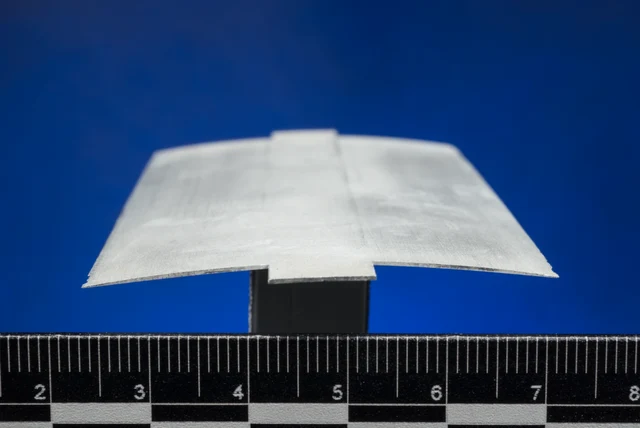
The actual experimental cross-section in NASA's comparison, not a finished rotor or Mars flight vehicle.
NASA's roamx-0201 research points toward a striking range increase, but the 18.7-kilometre figure is a simulation result, not a flight already performed on Mars.
The experimental Mars helicopter blade looks almost too thin to be the answer. Beside Ingenuity's rounded cross-section, roamx-0201 is a sharp, slender, asymmetric profile. The point is not to make a familiar rotor lighter by shaving off material. It is to rethink how that section works in the Martian flight environment.
NASA's October 20 engineering report describes research by Ames, Imperial College London and Nagoya University. The underlying AIAA paper was published September 22. This is an explainer of the newly highlighted work, not a claim that the paper or an operational helicopter appeared this week.
1. Read the Range Number as a Prediction
NASA reports simulation studies suggesting that optimized blades could expand a future helicopter's uninterrupted flight from an Ingenuity-class 0.7 kilometres to as much as 18.7 kilometres while carrying scientific instruments.
That is an eye-catching possibility. It is not an 18.7-kilometre flight already performed on Mars, and it is not a demonstrated range for a finished aircraft. The work combines computational design with wind-tunnel experiments on the aerodynamic section. The complete vehicle, its energy system, payload and operating conditions still matter to a mission's range.
The comparison belongs beside those qualifications, not separated from them in a headline promising a helicopter that already flies 27 times farther. Even the rounded ratio would describe the quoted study scenario, not an independently verified improvement for every Mars rotorcraft.
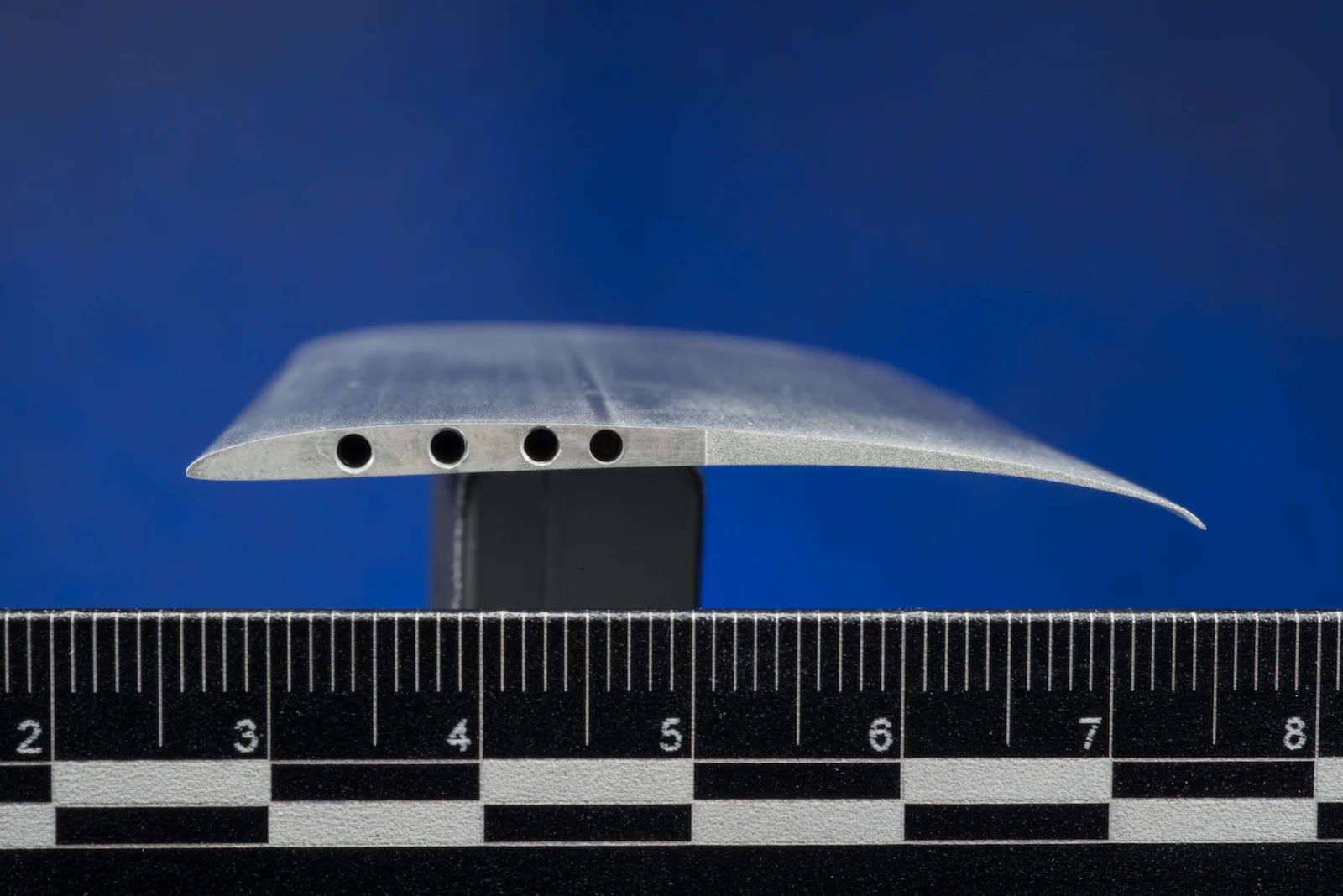
NASA's Ingenuity comparison sample. The separately reproduced views are not an equal-scale dimensional measurement.
2. Examine Where the Airfoil Loses Performance
One target is drag divergence: a sharp increase in aerodynamic penalty as parts of a rotor's flow approach transonic conditions. Mars' lower speed of sound makes that limit important when designing fast-moving blade sections for its thin atmosphere.
The researchers used high-fidelity simulation and optimization tuned to those conditions. NASA says the resulting profile can operate farther into the high-speed regime before drag divergence becomes a problem. A shape that works well in one atmosphere is not automatically a suitable starting point in another.
The design also treats the boundary layer differently. That is the thin region of flow beside the blade surface. NASA describes intentionally disturbing it near the leading edge to improve lift, rather than assuming the smoothest-looking flow must always be best.
Under the conditions studied, roamx-0201 also showed more forgiving stall behaviour than the Ingenuity section. Stall involves a sharp degradation in aerodynamic performance as the angle of the incoming flow changes. A less abrupt response could make useful operating conditions easier to maintain, but it is not proof that a future aircraft cannot stall.
3. Keep the Wind Tunnel in the Story
NASA explicitly says the technology is not ready for Mars. Researchers are still examining differences between computational predictions and experimental performance. Those discrepancies are part of why the physical tests matter; they are not details to discard after extracting the largest range number.
The photographs show the actual cross-section samples used to explain the design difference. They are not whole rotor blades, and the two separately reproduced photographs should not be used as a precise, equal-scale dimensional comparison.
NASA also distinguishes this research from SkyFall, the planned 2028 mission using an earlier blade architecture. Roamx-0201 concerns possible later generations. A future mission name and an experimental airfoil do not, by themselves, establish a flight assignment for that airfoil.
The useful result is a clearer design direction, backed by both models and experiments: Mars may reward a rotor section that looks unlike the familiar terrestrial starting point. Which comparison would help most in a follow-up, drag divergence or stall? Leave your questions in the comments below.
Comments
Member comments are temporarily unavailable.
Log in to join the discussion.