
Microbes Grew From 101.5-Million-Year-Old Seafloor Sediment. What Survived?
Published November 13, 2026
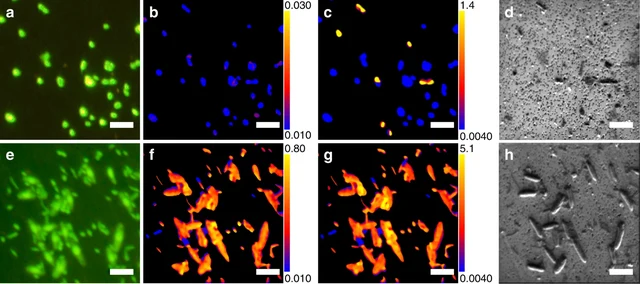
Morono et al. (2020), CC BY4.0: original Figure1 from the historical incubation study; preserved panel labels and scales.
Image credit
Original microbial incubation study figure 1
Morono et al. (2020) · CC BY 4.0Resized and encoded as WebP; no semantic alteration.
A landmark incubation experiment revealed living potential in ancient South Pacific sediment. The sediment's age is not a direct birthday for each cell.
The sediment was deposited while dinosaurs still walked the Earth. When scientists brought samples into the laboratory and supplied nutrients, microbes inside it began incorporating those nutrients and multiplying.
The oldest sediment in the experiment was 101.5 million years old. That makes an irresistible headline, but it also creates the most important distinction in the story: researchers dated the sediment, not the birth of every individual cell.
The actual result is remarkable without turning it into a claim of individually immortal bacteria. In an exceptionally energy-poor environment beneath the South Pacific seafloor, microbial communities had retained the capacity to respond to food and grow.
The study by Yuki Morono and colleagues was published on July 28, 2020. It remains one of the more unsettling demonstrations of how far life can stretch the meaning of a habitable environment. This is a look back at that experiment, not a newly announced 2026 revival.
An Environment Almost Without Food
The South Pacific Gyre is a vast region of very low biological productivity. Relatively little organic material falls to its seafloor, and its sediment accumulates slowly. Compared with more productive marine environments, the microbial populations beneath it are extremely sparse.
That scarcity is scientifically useful. In places where large amounts of organic material arrive, microbes can consume available oxygen and create a very different chemical environment. At the study sites, oxygen extended through sediment toward the volcanic basement, while usable energy remained extraordinarily limited.
The question was therefore not simply whether a microscope could find cells. It was whether those cells retained functioning biological capabilities after persisting under such meager conditions.
Sediment recovered during an ocean-drilling expedition provided samples spanning approximately 4.3 million to 101.5 million years in age. Researchers incubated material with oxygen and added carbon- and nitrogen-containing substrates. They used stable isotope labels to trace whether those additions actually entered individual cells.
This distinction matters. A particle that looks cell-shaped could be an inert remnant. An increase in a bulk chemical signal could be difficult to assign to particular organisms. Following labelled nutrients into individual cells makes the evidence more direct.
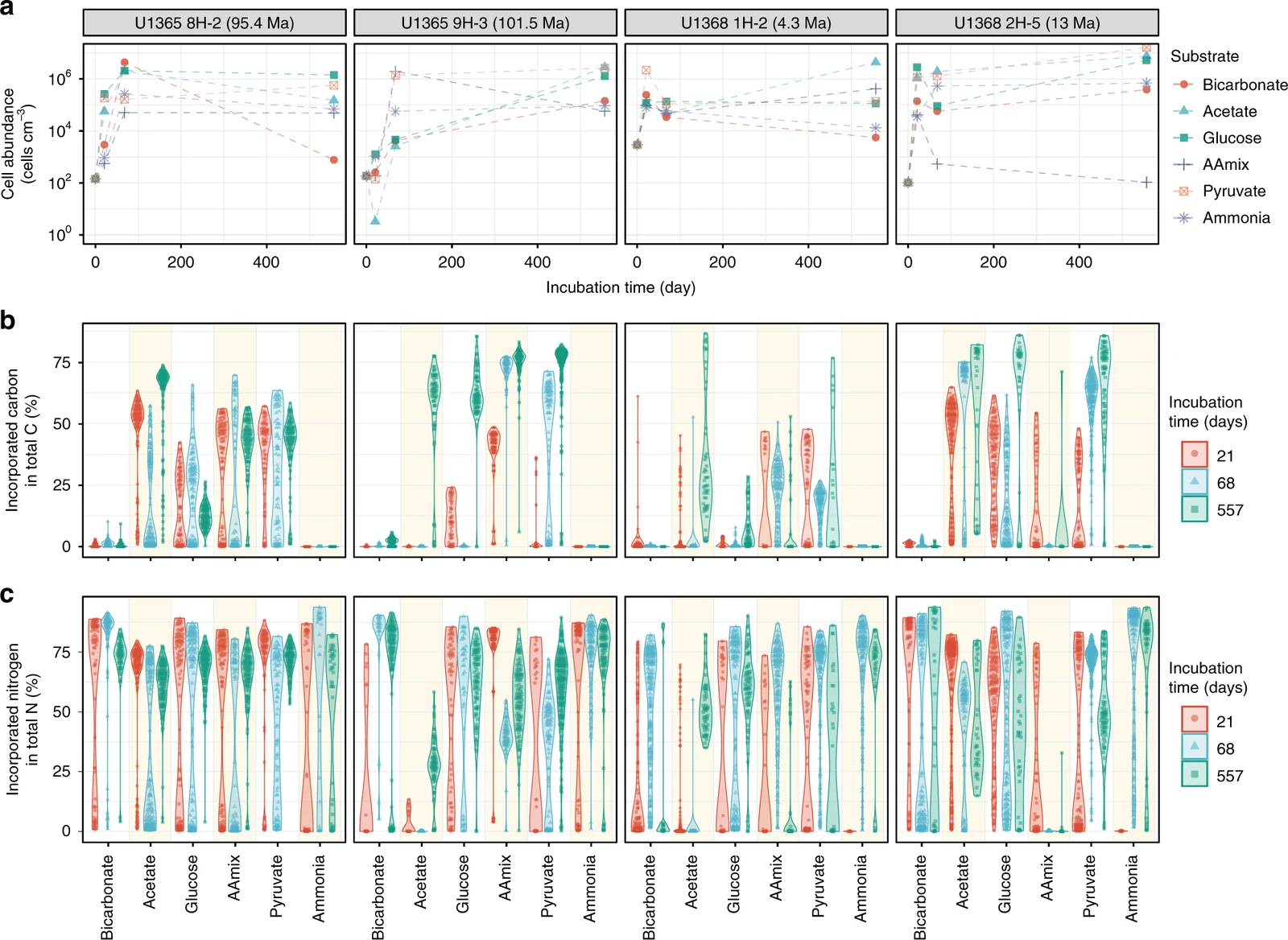
Image credit
Original microbial incubation study figure 2
Morono et al. (2020) · CC BY 4.0Resized and encoded as WebP; no semantic alteration.
Morono et al. (2020), CC BY4.0, Figure2. Original axes and legends retained.
Watching Cells Take Up Labelled Nutrients
Using nanometer-scale secondary ion mass spectrometry, or NanoSIMS, the team examined 6,986 individual cells. Most incorporated isotope-labelled substrates during the experiments.
Many responded rapidly under incubation conditions. In some incubations, cell numbers increased by four orders of magnitude, while uptake of labelled carbon and nitrogen was observed within 68 days. That is a roughly ten-thousandfold increase in the relevant cell counts, not a claim that every sample grew at the same rate or that every organism behaved identically.
The response also suited the original environment. Aerobic organisms, which use oxygen, responded much more readily than anaerobic organisms. The experiment was not a universal revival treatment applied to any ancient sediment. It investigated communities from oxygen-containing sediments using conditions that could support those communities.
The figures accompanying the paper provide two complementary views. Images and isotope maps show activity in individual cells; population measurements show how abundance changed during incubation. Together they connect an observed cellular response to growth of the communities being studied.
It is tempting to imagine one dramatic instant in which a completely dormant organism "wakes up." The measurements support a less cinematic but richer story about metabolic potential, nutrient uptake and division. Exactly what life had been doing before the incubation is a separate question.
Why Contamination Is the Critical Objection
Any claim involving ancient life must confront a simple alternative: perhaps the organisms arrived recently.
Drilling, handling and laboratory incubation can introduce microbes. A tiny contaminating population can become conspicuous once it receives nutrients. The older and more astonishing the claimed environment, the more seriously that possibility must be considered.
The researchers evaluated drilling contamination and used controls in their experimental design. They also considered the physical properties of the sediment. Its extremely small pores make migration by whole cells difficult, supporting the interpretation that the organisms had remained in the sediment since soon after deposition rather than recently traveling down from the seafloor.
That does not turn a geological date into a direct measurement of an organism's uninterrupted lifespan. Cells can divide; populations can persist while individuals change. The evidence concerns communities retained within very old sediment and their continuing biological potential.
Nor is the finding adequately summarized as ancient spores germinating. Known spore-forming organisms made up only a small fraction of the communities. The result raises broader questions about how ordinary microbial cells maintain the structures and processes necessary for survival when the energy budget is extremely small.
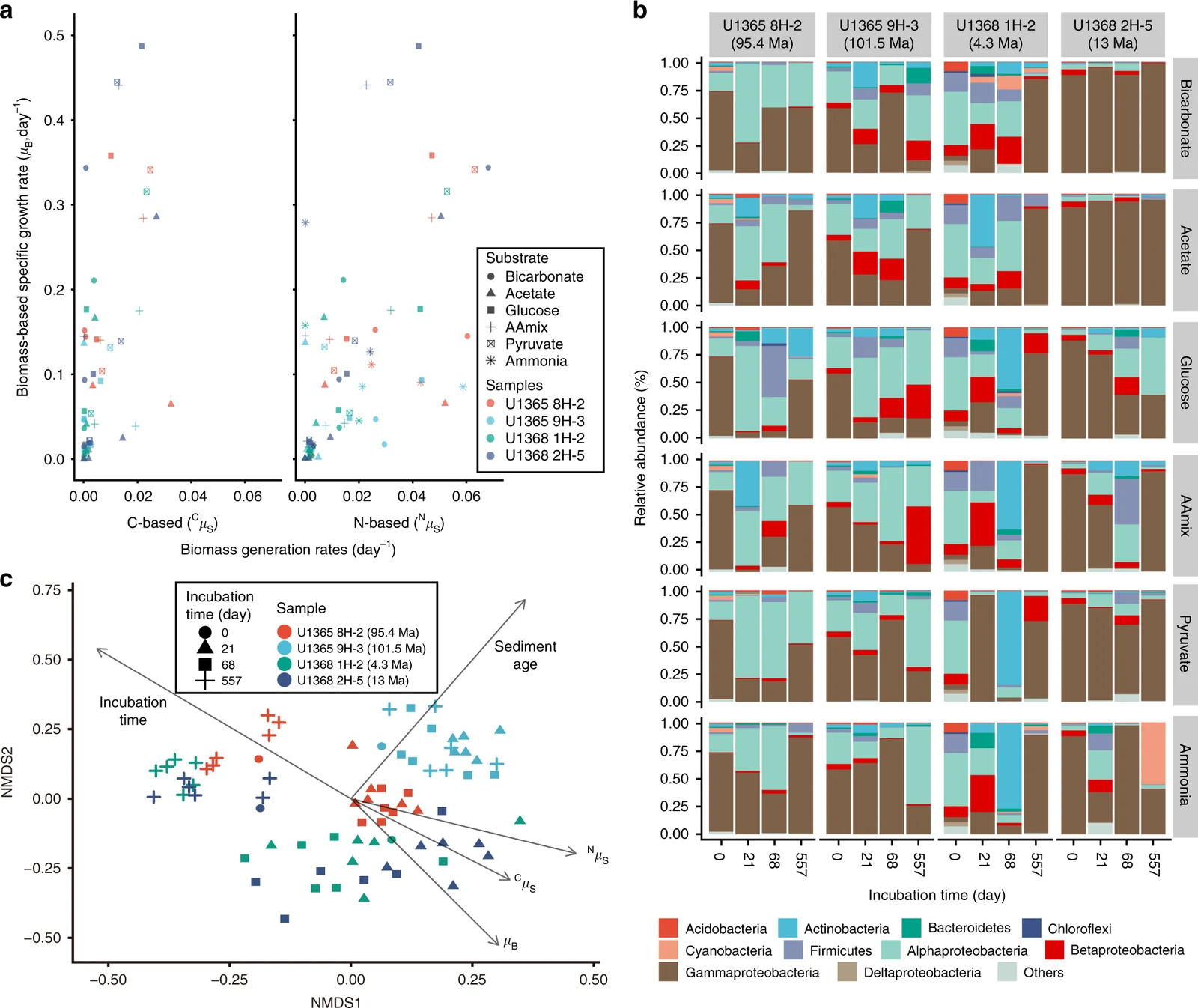
Image credit
Original microbial incubation study figure 3
Morono et al. (2020) · CC BY 4.0Resized and encoded as WebP; no semantic alteration.
Morono et al. (2020), CC BY4.0, Figure3. Not a direct measurement of individual cell age.
What Survival Means on Geological Time
In everyday biology, growth is often the obvious signal that a living system is doing well. A garden fills in, a culture becomes cloudy, a population expands. The deep biosphere forces a different perspective: persistence can matter more than visible productivity.
This experiment does not demonstrate that life can operate indefinitely without energy. It suggests that some communities can preserve metabolic potential under conditions where the available energy is astonishingly limited. Providing a more favorable laboratory environment then reveals capacities that are difficult to infer from the original sediment alone.
That makes the work relevant to discussions of habitability beyond Earth, but it does not establish life on another planet. The transferable lesson is methodological. A quiet environment is not necessarily a sterile one, and the absence of rapid growth does not settle whether biological potential remains.
The most arresting part may be the mismatch in timescales. The geological setting accumulated over millions of years; the laboratory response appeared over weeks. Neither timescale cancels the other. Together, they expose a form of persistence that is almost impossible to picture using only the rhythms of familiar plants and animals.
How should scientists distinguish a living community barely maintaining itself from one that is simply waiting for better conditions? Discuss it in the comments below.
Comments
Member comments are temporarily unavailable.
Log in to join the discussion.