
This Soft Sheet Knows Its Own Shape, Even When Some Sensors Fail
Published October 11, 2026
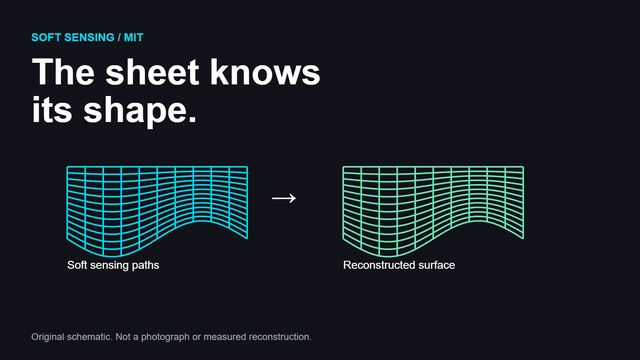
Explanatory schematic, not a photograph or a measured reconstruction.
MIT engineers use light inside soft waveguides to reconstruct a bending sheet, pointing toward more comfortable motion sensing.
Bend a sheet of rubber and it becomes a complicated shape almost immediately. A corner lifts. A crease travels. A curved surface becomes a saddle. Now ask the sheet to describe all of that without looking at itself.
That is the problem behind a soft sensor developed by MIT researchers Qifan Yu, Nina Cao, and Kaitlyn Becker. Their sheet uses light moving through embedded optical waveguides to reconstruct its surface. MIT presented the work on October 8; the underlying open-access study was first published in July. This is a newly explained research demonstration, not a product launch or a newly invented form of clinical treatment.
The appeal is immediate. Instead of attaching a collection of hard measuring devices to something soft, make the measuring surface soft too.
A Deliberately Imperfect Light Path
An optical waveguide carries light from one end to another. For communication, losing light along the way is usually undesirable. For this sensor, a controlled change in transmitted light is the measurement.
The researchers make flexible waveguides with a transparent elastomeric core. One side is rougher than the other. Bending toward one surface affects transmission differently from bending toward the opposite surface, so the output carries information about bending direction, not just the fact that something moved.
That distinction matters. A sensor that merely reports less light cannot necessarily tell an upward curl from a downward curl. A direction-sensitive response gives the reconstruction software a more useful constraint. It is a small material decision with a large effect on what the system can infer.

There is something satisfying about that reversal. The surface irregularity is not a manufacturing defect to polish away. It is part of the instrument.
Fourteen Paths Are Not Fourteen Pixels
The paper describes fourteen waveguides in two layers inside a roughly 16-by-16-centimeter sheet, half a centimeter thick. Their zig-zag arrangement is chosen to distinguish shapes that might otherwise produce similar readings.
Each guide supplies an aggregate light measurement. It does not deliver a photograph of the material along its length. Several different local bends can contribute to the same final reading, which makes the layout and reconstruction assumptions important.
The algorithm combines the measurements and searches for a surface consistent with them. In effect, the paths interrogate the sheet from several directions. More paths can add redundancy, but they also mean more fabrication, connections, and computation. The interesting design question is not simply how many sensors fit. It is which arrangements make the missing information recoverable.
This is a useful lesson for makers working with any indirect measurement: place sensors to resolve ambiguity, rather than treating sensor count as a substitute for an observability problem.
Accuracy Needs a Test Shape
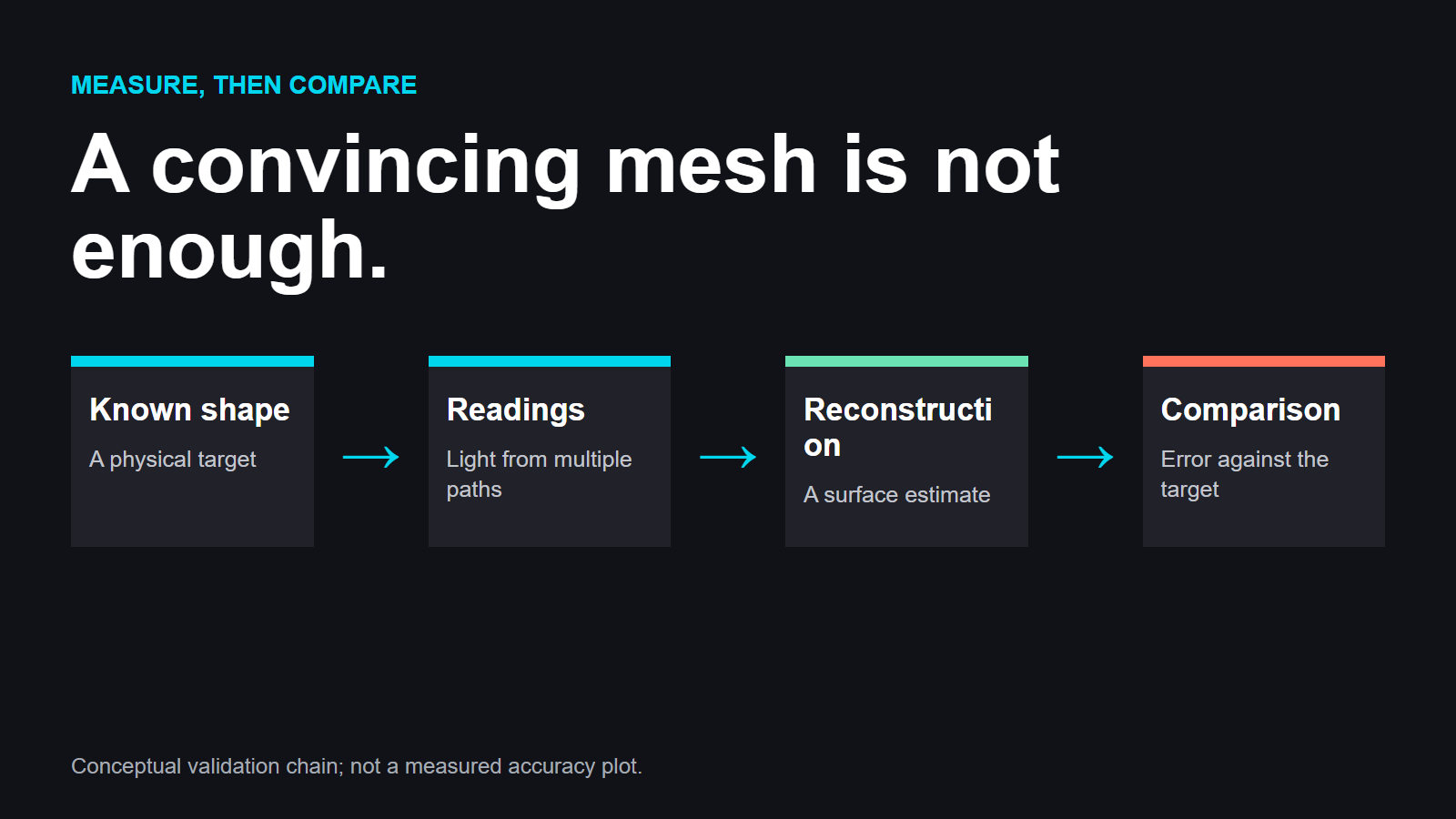
MIT reports reconstruction errors below 0.4 centimeters in the described comparisons. The work includes shaped molds that let the reconstructed surface be compared with a known physical target. The paper also distinguishes simulation results from experiments on a fabricated sheet.
That is more informative than a digital surface that merely appears to follow a hand. A convincing animation can hide a systematic error. A known target provides a way to ask how far the reconstruction has actually wandered.
A surface error is not automatically a joint-angle error, however. Nor does a good reconstruction establish that the device can diagnose a patient's condition. Those questions involve placement, repeated measurements, interpretation, and validation in the intended setting.
A Sheet That Can Degrade Gracefully
The study also investigates damaged waveguides. Redundant information can keep the reconstruction useful after some paths fail. That is not a promise that an arbitrary tear or any number of broken guides will leave the system unchanged. It is a bounded demonstration of damage resilience.
For a wearable, that is an unusually practical research question. Soft devices get handled, folded, attached, removed, and stored. A design that reports plausible but wrong measurements after damage is much less helpful than one whose limits can be understood.
Future development therefore needs more than thinner material. It needs ways to recognize failing channels, track baseline changes, and decide when a measurement should no longer be trusted. Those are engineering implications of the sensing approach, not features established by the demonstration.
The Garment Comes Later
Physical therapy, virtual reality, and soft robotics are possible applications. They make sense because the same surface could follow a body that changes shape without requiring rigid measuring nodes across the sensing area. MIT also describes thinning the current waveguides as a next step.
The open questions are ordinary and substantial: comfort, repeatable attachment, sweat and cleaning, cable management, long-term drift, and usable feedback. None disappears because the surface reconstruction looks elegant.
Still, this is a strong idea to watch. The sheet is not just flexible packaging around a conventional sensor. Its changing geometry is the thing being measured, and its material structure helps make that geometry legible.
Would you use a soft sensing surface to track movement, or to let a robot understand its own body? Tell us what you would measure in the comments below.
Sources: MIT's October 8 demonstration and Yu, Cao, and Becker's study.
Comments
Member comments are temporarily unavailable.
Log in to join the discussion.