
Japan's Next Mars Mission Wants to Bring a Piece of Phobos Home
Published October 17, 2026
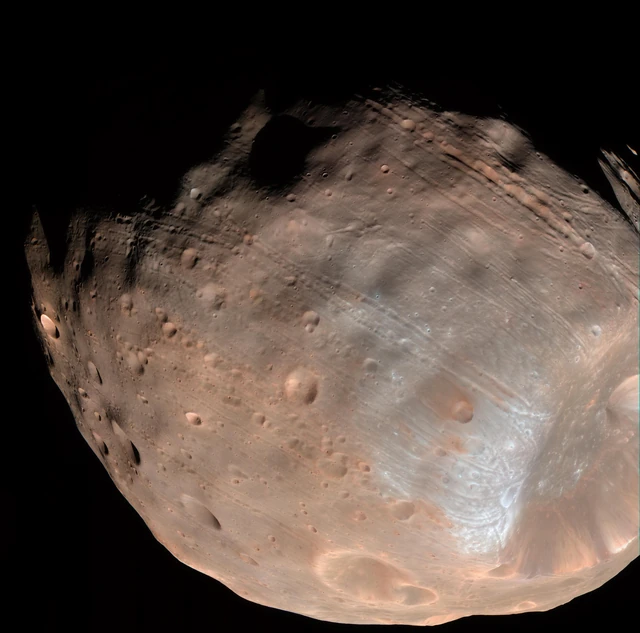
An archival Mars Reconnaissance Orbiter photograph of Phobos, MMX's intended sampling target. No MMX sample has been collected yet.
NASA's October 15 MMX update details a neutron-and-gamma-ray instrument, a gas-powered sampler and plans to curate part of the returned material.
Phobos is a small moon with a large unresolved question attached: where did it come from? Japan's Martian Moons eXploration mission, MMX, is designed to investigate that question by doing something photographs cannot do alone: returning material to laboratories on Earth.
NASA's October 15 update details its contributions to the JAXA-led mission, including instruments, sampling hardware, communications support and a share of the eventual sample. The spacecraft is targeting launch on October 19 at 19:41 UTC, which is October 20 at 04:41 in Japan. As of October 17, launch remains ahead, not accomplished. NASA mission update.
The plan reaches well beyond one landing. MMX will investigate both Phobos and Deimos, study Phobos closely enough to select sampling operations, and bring the collected material home. The sampling, return and laboratory work are separate parts of that chain.
The Origin Question
One possibility is that the moons are captured asteroids. Another is that a large impact on Mars placed material into orbit, eventually producing the moons. Those possibilities imply different histories for the material the mission will encounter.
Shape and appearance are useful clues, but they do not settle every origin question. A returned sample can be studied for properties and relationships that are difficult to establish from a distant view alone. Its value comes partly from combining those laboratory measurements with the geological context recorded at the moon.
NASA's account connects that question to the early history of the inner solar system. Understanding how the moons formed could help scientists reconstruct the circumstances in which planets were acquiring water and organic material. That is a research motivation, not a promise that one grain will resolve every part of planetary history.
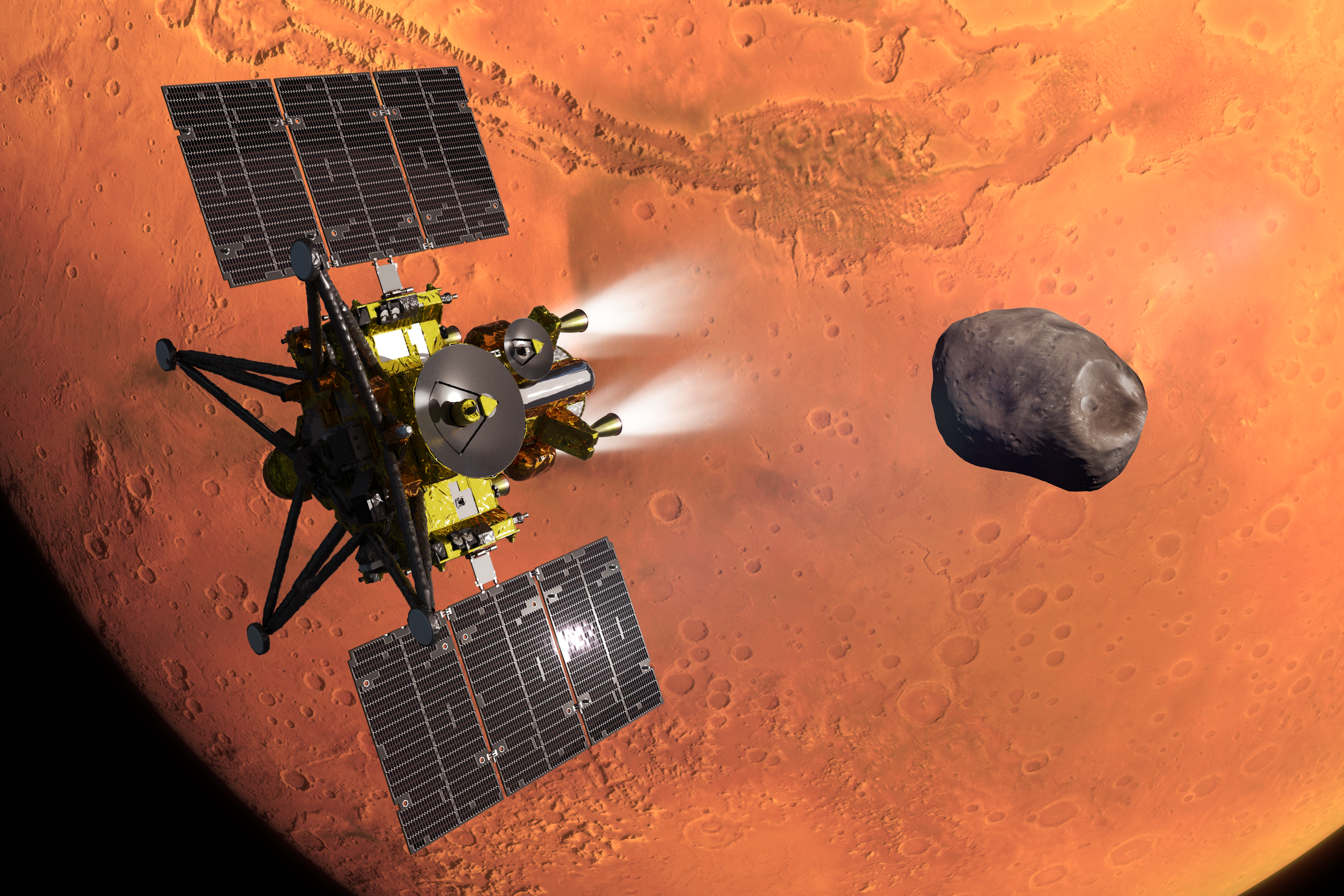
Image credit
mmx-concept.png
JAXA · JAXA immediate news useOriginal image downloaded without semantic alteration; responsive copies resized and encoded as WebP.
Mission concept artwork: (c) JAXA. Used for this mission-news report; not a photograph of flown MMX hardware at Mars.
Read the Surface Before Bringing It Home
NASA's MEGANE instrument measures gamma rays and neutrons from the surface to investigate elemental composition. The instrument was developed by the Johns Hopkins Applied Physics Laboratory. Its name is also the Japanese word for eyeglasses.
The engineering attraction is that a remote measurement and a physical sample can answer complementary questions. A map can show how a sampling location fits into a larger surface. A returned specimen can then be examined with laboratory tools not carried by the spacecraft. NASA's MMX mission overview.
The measurements should not be confused with an ordinary color photograph. Gamma rays and neutrons provide compositional information through different physical signals. A visually distinctive patch is not automatically a chemically distinctive patch, and a chemical difference is not automatically a different origin.
The point is to bring the types of evidence together. Remote sensing guides an understanding of the site; sampling adds material that can be examined in much finer detail. Neither should be presented as a replacement for all the other observations.
Two Ways to Collect Material
The U.S. P-Sampler is a technology demonstration mounted on a landing leg. NASA describes a mechanism that uses bursts of high-pressure nitrogen to collect surface material. JAXA's C-Sampler complements that approach by taking cores from deeper in the ground.
Those are different ways of interacting with the surface. A gas-driven collection process depends on how nearby particles respond to a burst. Coring depends on contact with the material below. The mission's inclusion of both is more informative than describing an unspecified spacecraft scoop.
NASA expects to obtain and curate about 15 percent of the total returned sample at Johnson Space Center. That percentage is a planned allocation, not material already delivered to the United States.
Sample curation also belongs in the engineering story. Collection is not the end of the measurement problem. Material has to retain a documented identity and history so later results can be related to what the mission actually sampled. A spectacular return would be much less useful if that context were lost.
The Calendar Is Still a Plan
NASA's published timeline targets arrival at Mars in August 2027, Phobos sampling no earlier than December 2028, and return to Earth in 2031. These dates describe the mission architecture as announced, not milestones already passed.
That leaves several events worth watching separately: launch, travel, arrival, the moon survey, collection and the return. A successful first step will matter without proving the success of every later one.
For readers who follow mechanisms, MMX has a particularly tangible hook. It has to turn measurements into a choice of location, bring hardware into contact with an unfamiliar surface, collect something useful, and preserve that material through a long return. Each transition connects a scientific question to a physical operation.
Which part would you most like to see explained in detail, the gas-powered sampler or how a sample can distinguish the moons' possible origins? Leave your questions in the comments below.
Comments
Member comments are temporarily unavailable.
Log in to join the discussion.