Naked Mole-Rat Queens Rule Their Colonies With a Single Scent
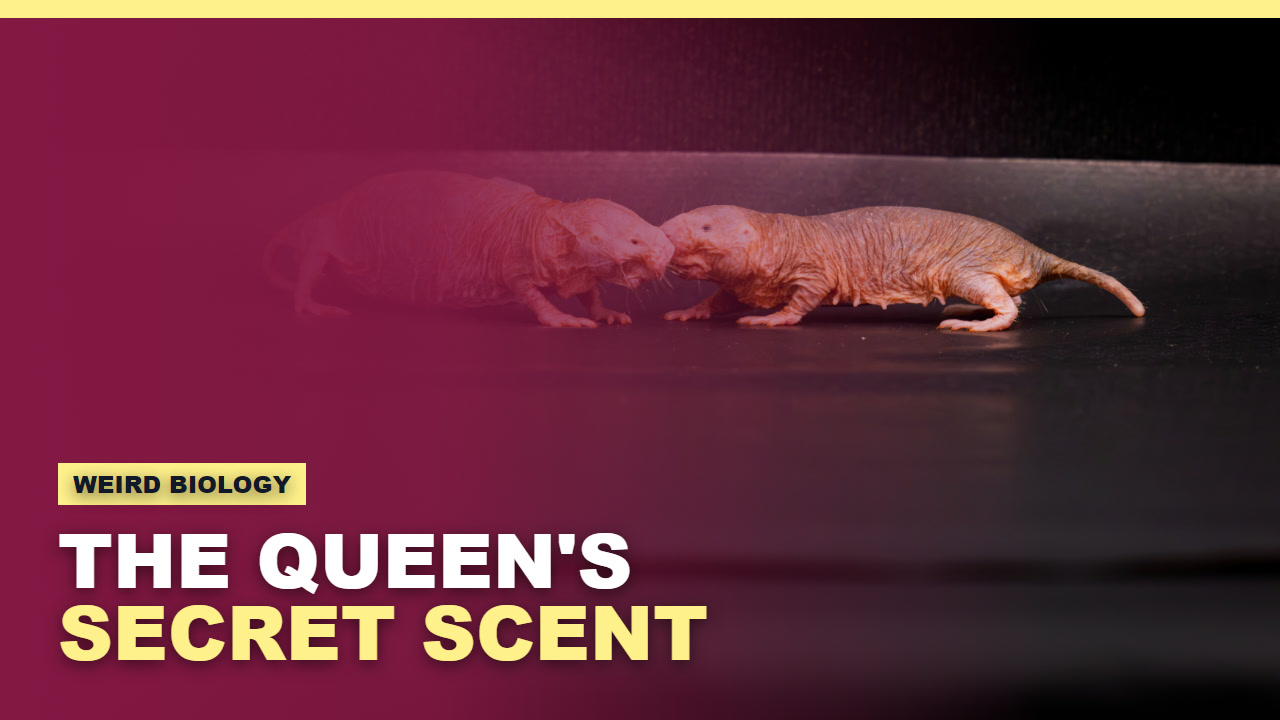
Researchers found that pregnant naked mole-rat queens release one odorless chemical that suppresses fertility and conflict throughout the colony.
A naked mole-rat queen does not need to be in the room to keep control of her colony. Her scent can do it for her.
Researchers led by Gary Lewin at the Max Delbrück Center report that pregnant queens produce isopropyl myristate, a single volatile compound that temporarily suppresses fertility in other females and reduces the conflicts that erupt when a colony loses its queen. The work was published in Nature on July 15, 2026.
The molecule is common enough to sound almost ordinary. It is used in cosmetics as a solvent and moisturizing agent, and humans cannot smell it. To naked mole-rats, it is a powerful social signal.
A mammal colony organized like an insect society
Naked mole-rats are among the few eusocial mammals. A colony has one breeding queen, a small number of breeding males, and many workers that gather food, care for young, and maintain the tunnel system.
That arrangement requires a way to stop other animals from reproducing. Researchers already knew the queen's presence mattered, but the biological mechanism remained uncertain. Lewin's team suspected smell because naked mole-rats use odor to distinguish members of their colony from outsiders.
Using mass spectrometry, the researchers compared volatile compounds and identified isopropyl myristate as a chemical emitted exclusively by queens. Electrophysiology and functional ultrasound imaging then showed that the animals detect it through their olfactory system and process the signal in smell-related regions of the brain.
Higher-ranking animals avoided the scent when given a choice, suggesting that the odor carries information about dominance as well as reproduction.
The queen can be absent while her signal remains
When a queen dies or is removed, fights and new mating behavior can begin within days. Once a female becomes pregnant and assumes the queen role, the colony stabilizes again.
The researchers tested whether the queen's body was necessary for that effect. It was not. Spraying isopropyl myristate into the colony each day was enough to maintain order. When the added scent stopped, conflict returned.
The chemical also changed behavior in paired animals. A male and female from the same colony normally become sexually active after spending several days together away from the queen. Daily exposure to bedding carrying her scent prevented that shift. Applying isopropyl myristate directly to the cage produced the same result.
One odor changes the hormone balance
The team found that exposure to isopropyl myristate raised prolactin, a hormone associated with reduced fertility in mammals, while keeping the fertility-promoting hormone progesterone low.
That hormone pattern offers a mechanism for the colony-wide effect. The scent is not simply making workers avoid the queen. It changes their reproductive state.
The timing is equally revealing. Queens produced the compound only during pregnancy. When a queen can no longer reproduce, progesterone rises in the other animals, prolactin falls, and the struggle to establish a successor begins again.
A surprisingly simple control system
Insect colonies often use blends of pheromones to coordinate complicated social behavior. The researchers were surprised that a mammal society this organized appears to rely so heavily on one chemical signal.
That does not make every interaction in the colony simple. Naked mole-rats still recognize individuals, respond to rank, and react to physical conditions. But isopropyl myristate connects three major outcomes at once: reproductive suppression, reduced rivalry, and continued order when the queen is physically absent.
The result is vivid because it sounds invented: a pregnant queen releases a human-odorless chemical that keeps rivals infertile and the colony calm. In naked mole-rats, that is not science fiction. It is social infrastructure carried through the air.
Comments
Member comments are temporarily unavailable.
Log in to join the discussion.