
NASA Announces X-70, a Reconfigurable Flying Lab Rather Than a New Fighter
Published November 8, 2026

NASA-issued generated visualization of X-70, not a photograph of its first flight.
Image credit
NASA-issued X-70 generated visualization
NASA · NASA factual editorial useResized and encoded as WebP; no semantic alteration.
NASA describes X-70 Fractal as a crewed experimental platform. First NASA operation is still ahead, and its published image is a visualization.
NASA has announced a new X-plane, but this is not a first-flight report. The X-70 Fractal is a crewed research aircraft intended to let engineers change experiments more readily between flights. NASA expects its first flight under agency operation within two years.
The November 4 announcement describes a rapidly reconfigurable platform for flight-control and maneuverability research. That makes it a flying experimental tool, not a new fighter, passenger jet or already-proven set of aerodynamic results.
NASA's published lead image is a generated visualization of the aircraft. It should not be mistaken for a photograph of an X-70 flight.
What the Numbers Describe
NASA lists a 10,000-pound takeoff weight, a design cruise speed of Mach 0.75, a ceiling of up to 45,000 feet and a range exceeding 1,500 nautical miles. It also describes capacity for as much as 2,000 pounds of experimental payloads, installed internally or externally.
These are stated platform capabilities and design figures. They are not a measurement of one completed NASA research flight, and they should not be combined into an invented performance scenario in which every maximum is achieved at once.
The payload provision is particularly relevant. A research aircraft is valuable because it can carry equipment into the conditions an experiment needs. Space, mass, placement and access all matter when the aircraft is being used to investigate something rather than transport passengers.
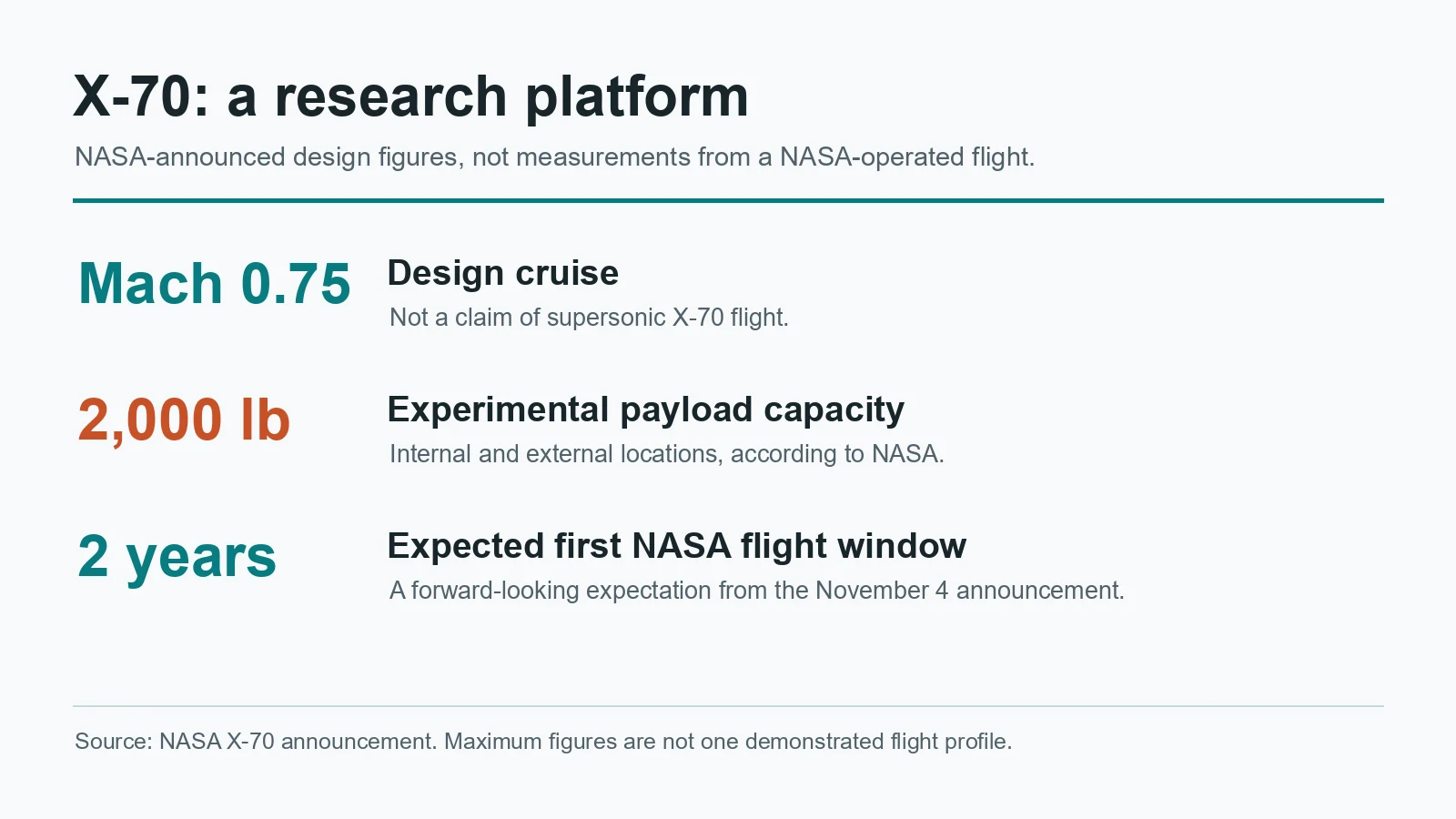
Original diagram based on NASA-announced design figures, not measured flight results.
Reconfigurable Does Not Mean Shape-Shifting
The interesting word in NASA's description is reconfigurable. The agency emphasizes flight-control technology and the ability to swap experimental payloads. It does not announce an aircraft that transforms its entire airframe in flight.
That distinction changes the story. An adaptable research platform is about making successive experiments practical. A spectacular-looking aircraft can be less useful as a laboratory if installing a new instrument or changing a test arrangement becomes a project of its own.
It is reasonable to ask how a platform will shorten that cycle. It is not reasonable to invent an answer: the announcement does not establish a measured reduction in experiment turnaround time or publish results from a NASA-operated X-70 campaign.
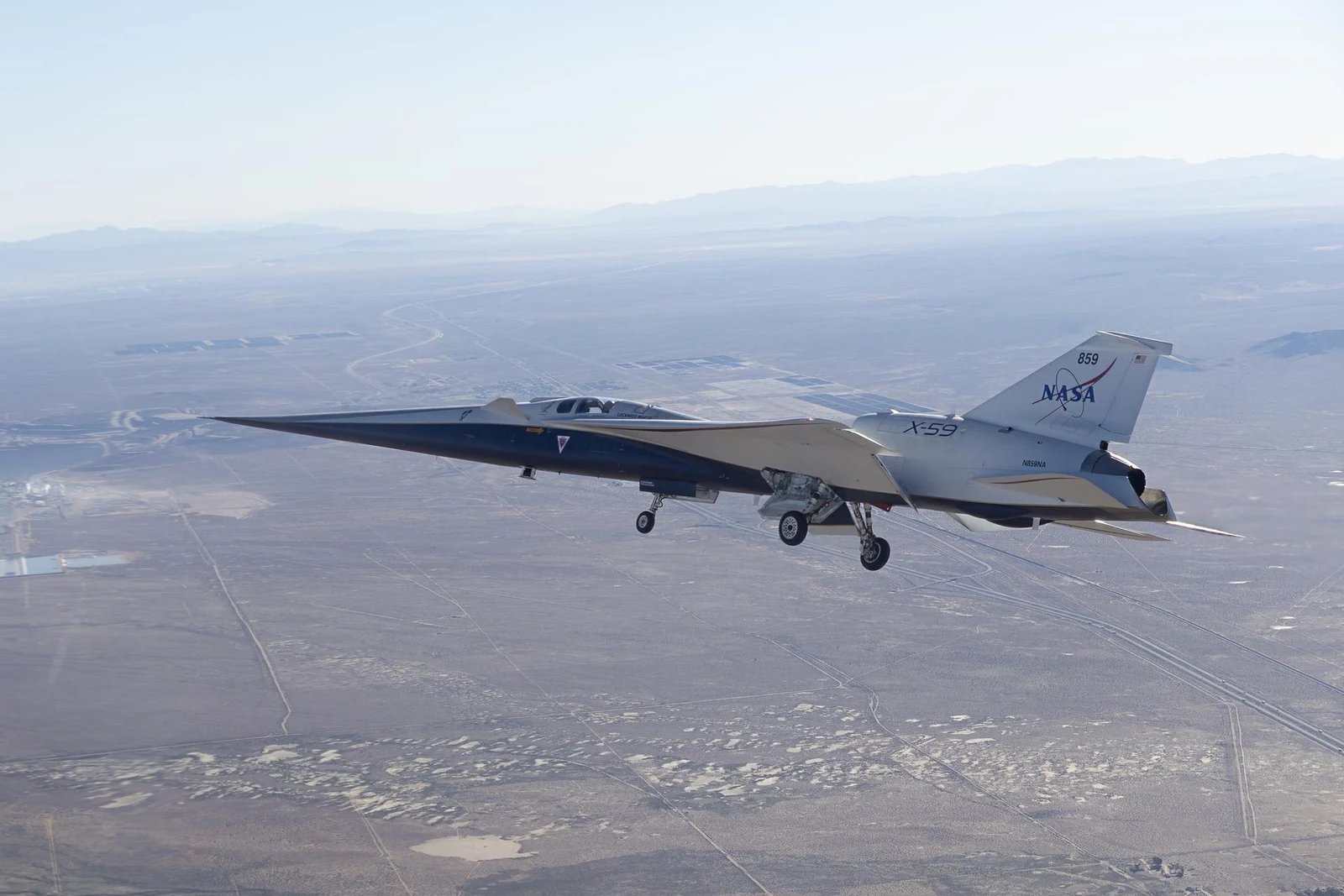
Image credit
X-59 first flight, October 28 2025, historical X-plane context
NASA/Lori Losey · NASA factual editorial useResized and encoded as WebP; no semantic alteration.
NASA/Lori Losey: X-59 during its October 28, 2025 first flight. Historical research-aircraft context, not X-70.
An X-Plane Is a Question, Not a Product Promise
NASA places X-70 in the history of experimental aircraft, alongside programs such as X-1, X-15 and X-59. These are not interchangeable aircraft or successive versions of the same design. Their common thread is using flight to investigate a defined technical problem.
The distinction is useful when looking at the supporting historical imagery. An older NASA research aircraft illustrates the agency's flying-laboratory approach; it does not show X-70 hardware or prove anything about the new aircraft's performance.
For now, the appropriate checkpoints are preparation and research readiness: what equipment can be installed, what flight-control questions can be investigated, and what the first NASA operations actually demonstrate. Those future results deserve their own coverage when they happen.
The announcement is exciting because NASA is adding an adaptable instrument for asking aviation questions in the real atmosphere. Keeping that purpose in view is more informative than treating every X designation as a promise of a faster production airplane.
What experiment would you most want to see a reconfigurable aircraft carry? Share it in the comments below.
Comments
Member comments are temporarily unavailable.
Log in to join the discussion.