
A Fab Lab That Can Build Its Own Machines
Published October 25, 2026
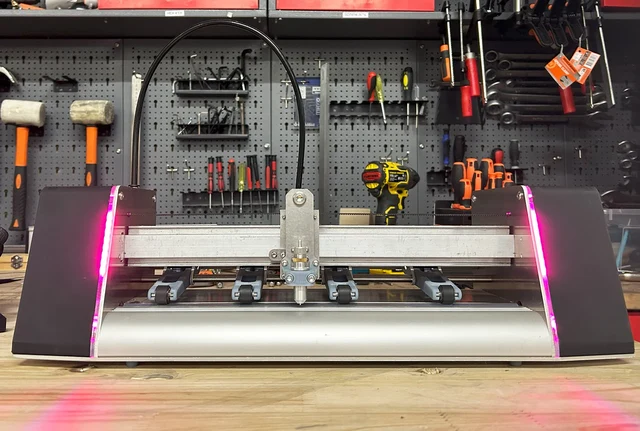
An actual Open Lab Starter Kit machine, not Piccola: the OLSK Vinyl Cutter V3. Project documentation photograph.
Image credit
OLSK Vinyl Cutter V3 detail
Daniele Ingrassia / InMachines Ingrassia GmbH; Tobias Redlich / Helmut-Schmidt-Universitat Hamburg · CC BY-SA 4.0Resized and encoded as WebP; no semantic alteration.
InMachines brings open fabrication hardware to Maker Faire Rome, from documented lab machines to experimental metal printing and the forthcoming Piccola CNC.
An open machine should stay useful after its manufacturer stops answering questions. That requires more than an exposed API or a downloadable enclosure. Someone needs to be able to inspect the mechanics, source replacement parts, understand the wiring and work out why the machine stopped halfway through a job.
At Maker Faire Rome, InMachines is presenting three different versions of that proposition: a kit of machines for equipping a fabrication lab, an experimental metal-printing platform, and a small CNC mill being prepared for a commercial launch. The October 20 presentation is the current news. The Open Lab Starter Kit machines themselves were developed over several years, not invented for this weekend's exhibition.
The interesting test is whether the published material helps a workshop maintain and reproduce actual hardware. For the established Open Lab machines, there is more to inspect than a promotional claim.
Start With What Is Actually Published
The Open Lab Starter Kit, or OLSK, was developed with Helmut Schmidt University through the dtec.bw FabCity project between 2022 and 2025. Its eight-machine collection covers large and small 3D printers, laser cutters and CNC mills, plus a vinyl cutter and a scanner. OLOS, the Open Lab Operating System, provides web-based control software.
The project's public organization links the individual repositories. Looking inside the Small CNC repository reveals a bill of materials, wiring schematic, CAD, firmware and an assembly manual. That matters because these documents answer different questions. A CAD model explains geometry; it does not, by itself, tell a builder which connector to use or the order in which a hard-to-reach part must be installed.
The Small CNC V3 documentation also names concrete mechanisms: an automatic tool changer, tool measurement and cleaning, a coolant system, and a liftable enclosure. Those are documented features of that machine, not specifications borrowed from the separate Piccola product.
A useful inspection checklist is short:
- Can the mechanical files be edited, not merely viewed?
- Does the bill of materials identify parts that can actually be sourced?
- Are electronics and firmware documented alongside the frame?
- Does the assembly sequence explain access, tools and adjustments?
- Are software, hardware and documentation permissions stated separately?
The repositories do make that last distinction. For the inspected CNC and vinyl-cutter releases, technical designs use CERN's weakly reciprocal open-hardware license, while pictures, manuals and other media use CC BY-SA 4.0. That is a more precise claim than declaring everything in an organization to have one license.
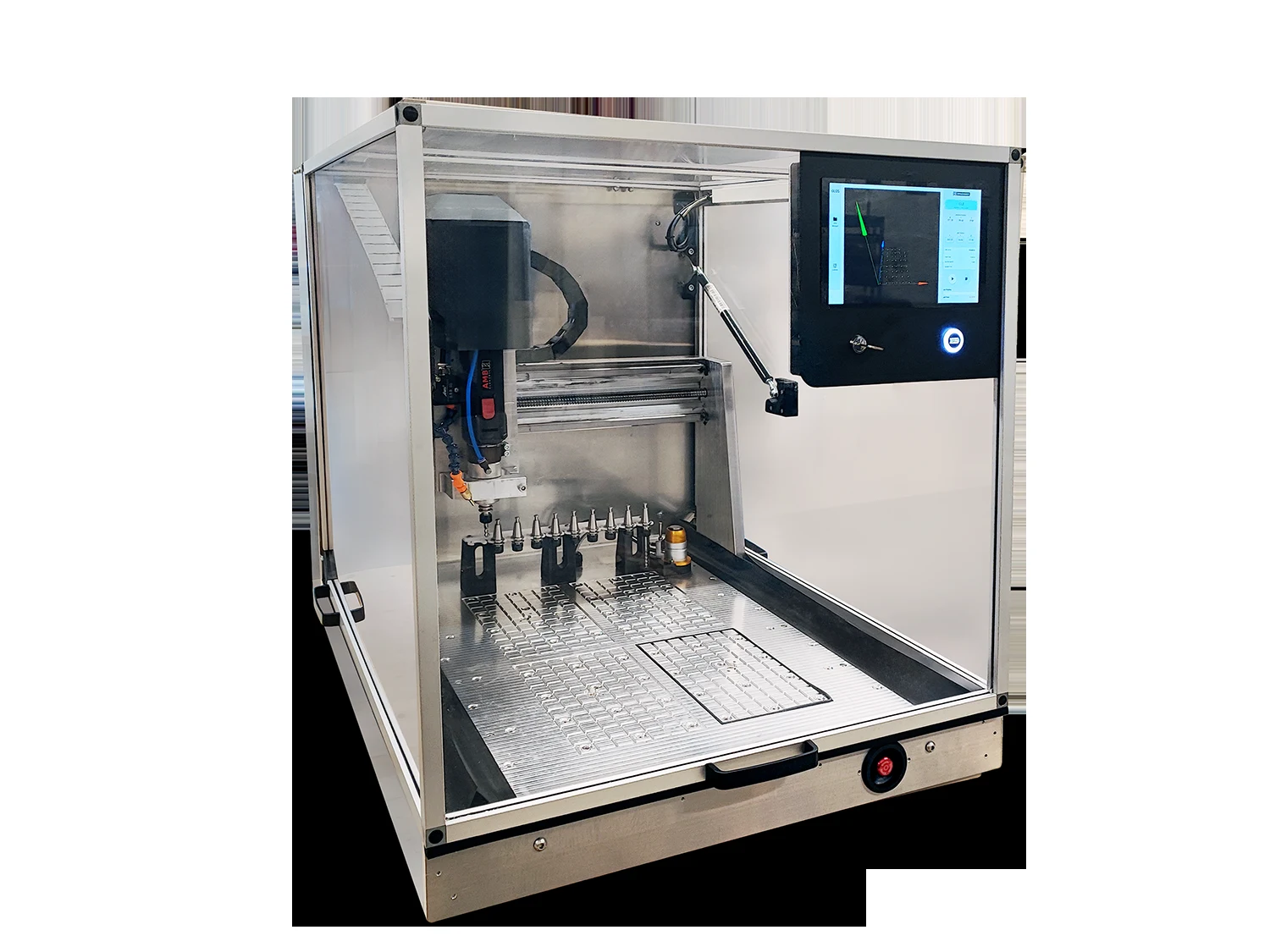
Image credit
OLSK Small CNC V3
Daniele Ingrassia / InMachines Ingrassia GmbH; Tobias Redlich / Helmut-Schmidt-Universitat Hamburg · CC BY-SA 4.0Resized and encoded as WebP; no semantic alteration.
OLSK Small CNC V3. This is a different machine from the forthcoming Piccola product.
A Machine Collection Is Also a Maintenance Strategy
An eight-machine lab is not just eight purchases. It is a collection of consumables, moving parts, controllers and operating knowledge that somebody must keep working. Published build information can make a broken machine less dependent on one vendor's memory.
The vinyl-cutter repository provides another concrete example of the approach. Its photographs and technical files let a prospective builder inspect the apparatus rather than infer it from a feature list. The existing designs also preserve earlier versions, which matters when the machine on a workshop floor is not the latest revision.
Openness does not remove the work. A fabrication lab still needs suitable tools, trained operators, safe procedures and a realistic parts budget. Nor does a published drawing prove that a locally substituted component will perform identically. The advantage is that the questions can be investigated in the open, instead of stopping at a sealed replacement module.
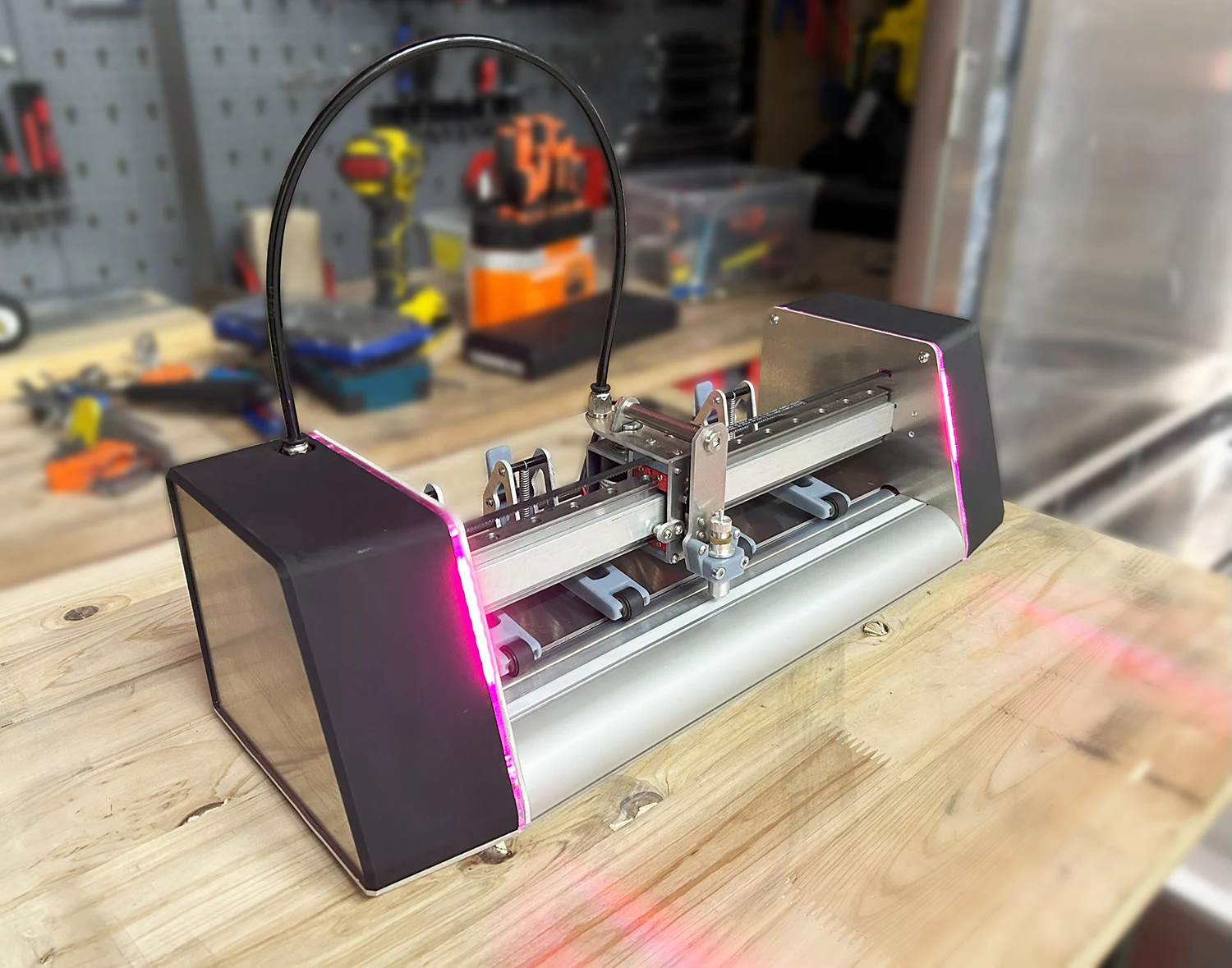
Image credit
OLSK Vinyl Cutter
Daniele Ingrassia / InMachines Ingrassia GmbH; Tobias Redlich / Helmut-Schmidt-Universitat Hamburg · CC BY-SA 4.0Resized and encoded as WebP; no semantic alteration.
OLSK Vinyl Cutter V3, photographed for its own open documentation; not a metal printer or a Piccola machining demonstration.
Piccola Is a Different, Smaller Proposition
Piccola CNC is InMachines' desktop product, with a stated working area of 150 by 150 by 70 millimetres and ball screws on all three axes. The company claims repeatability below 10 micrometres and describes machining wood, plastics, circuit boards, brass and aluminium.
Those are the company's claims, not results from a Meteor Makers machining test. Repeatability also is not the same as absolute accuracy, surface finish or the ability to cut every listed material at the same rate. A buyer would still need cutting conditions, tooling and measured parts to judge a particular job.
The presentation says full CE certification is in progress. It describes an enclosure interlock and a safety-performance claim for enclosed versions; neither should be rewritten as an independently verified approval of every configuration. Its announced crowdfunding start is November 2026, so the product launch remains ahead of the October fair.
Integrated CAM based on EasyTrace5000 and Kiri:Moto, together with tool measurement, edge finding and height mapping, points toward a familiar goal: reduce the setup friction between drawing a part and cutting it. The product site is the place to check what eventually ships. The photographed OLSK CNC in this article is not Piccola.
Metal Printing Raises the Stakes
The Open Industrial Starter Kit, or OISK, extends the idea toward laser powder-bed-fusion metal printing. InMachines describes publishing a machine architecture reaching from laser optics to control electronics. In Rome, it is being presented as a research platform, not a finished consumer printer.
That distinction matters. Access to a design does not make high-power lasers or fine metal powders appropriate for an ordinary home workshop. It can, however, let suitably equipped research groups inspect and modify systems that are normally sold as closed industrial equipment.
Across the three projects, the most compelling promise is not that open hardware makes fabrication effortless. It is that machines can come with enough information for the next person to understand them. Which document do you most often wish a tool manufacturer had published? Share it in the comments below.
Comments
Member comments are temporarily unavailable.
Log in to join the discussion.