
A Stationary Particle Can Appear to Shift. Scientists Measured Why.
Published November 17, 2026
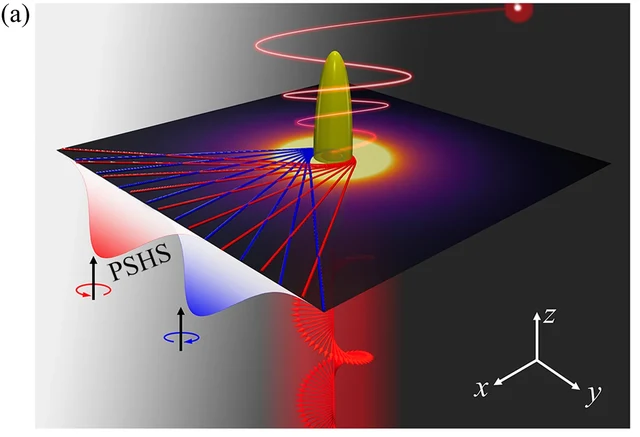
Study concept illustration of scattered-pattern displacement; not a visible-light photograph.
Image credit
Conceptual red and blue intensity patterns displaced to opposite sides of a stationary elongated particle.
Khan et al. (2026) · CC BY 4.0Panel-boundary crop, then lossless RGB PNG encoding. No retouching, recoloring, data modification, label removal or resampling of the native derivative.
A ceramic spheroid made a tiny polarization-dependent shift measurable in microwaves. The apparatus explains both the result and the limits of optical promises.
The ceramic particle stays put. Change the polarization of the radiation illuminating it, however, and its apparent position shifts sideways.
That is the useful strangeness of an experiment reported in Advanced Photonics: the location suggested by scattered radiation need not quite match the location of the object producing it. The researchers made this normally difficult signal strong enough to measure from a single specially shaped particle.
There is an important distinction before the light-show imagery takes over. This was a microwave experiment, not a demonstration with visible light. The journal paper appeared online on November 3, 2026, following a public preprint submitted on July 4, 2025. Skoltech highlighted the work on November 16. This is a closer look at that research, not a new experiment performed this week.
A Shift in Appearance
Circular polarization describes an electromagnetic wave whose electric field rotates as the wave travels. That rotation can have either handedness. When the wave encounters matter, its polarization and spatial behavior can become coupled: the interaction called spin-orbit coupling.
One consequence is the photonic spin Hall shift. In this experiment, opposite incident polarizations produce sideways displacements of the scattered intensity pattern in opposite directions. The effect changes where the particle seems to be when its location is inferred from the scattered signal.
Nothing has pushed the ceramic sideways. Nor have the researchers photographed two particles where there was one. They compared scattering measurements made under the two illumination conditions.
The distinction matters for precise measurements. A position inferred from radiation carries information about the interaction that produced that radiation, not just the physical coordinates of its source.
Shape Makes the Signal Usable
The obstacle was not simply making the shift larger. Conditions that enhance it can leave almost no scattered signal in the direction where it should be observed. A large displacement is of limited use if the detector receives too little radiation to locate it.
The team's answer was an elongated, high-index particle operating in a superscattering regime. Its shape allows different scattering channels to exchange energy. Together with overlapping resonances, this strengthens the outgoing signal while preserving strong spin-orbit interaction near the particle.
The paper's calculations compare a silicon spheroid with conventional scatterers. At a wavelength of 890 nanometers, the useful scattering direction moves to about 124 degrees, rather than roughly 160 degrees, where the radiation source can obstruct detection. The calculated intensity at the maximum shift is nearly two orders of magnitude above that of the conventional spherical comparison.
That is a particular modeled comparison, not a hundredfold improvement in every optical instrument. And 890 nanometers is near-infrared radiation, not visible light.
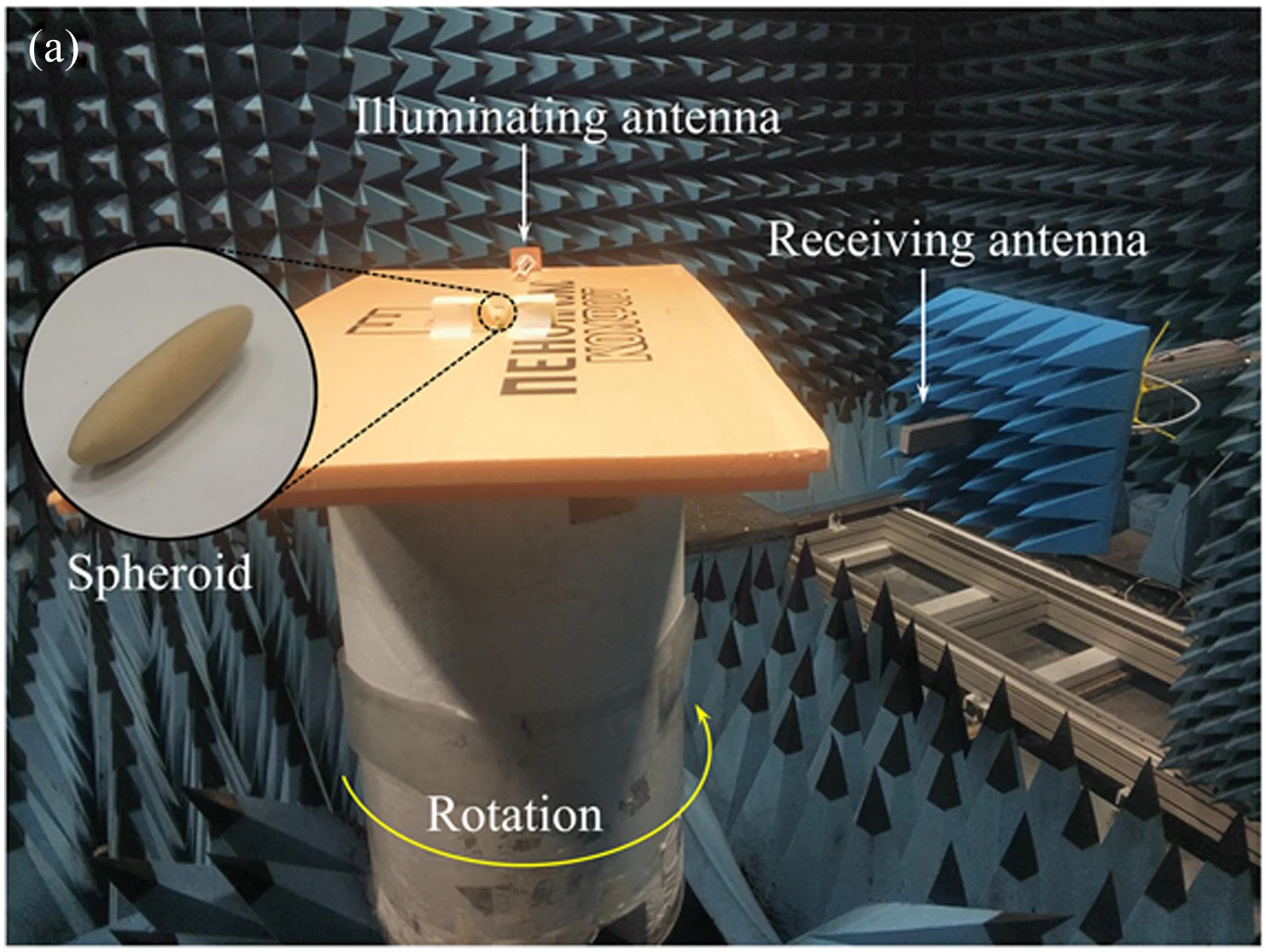
Image credit
Ceramic spheroid on a rotating support between microwave antennas, with a close-up inset of the particle.
Khan et al. (2026) · CC BY 4.0Panel-boundary crop, then lossless RGB PNG encoding. No retouching, recoloring, data modification, label removal or resampling of the native derivative.
Actual microwave apparatus, Figure 5A; inset enlarges the particle. Panel extracted without retouching.
The Actual Object and Apparatus
The apparatus photograph and experimental results show a more tangible version: a ceramic spheroid about 52 millimeters long and 10 millimeters across, surrounded by antennas and microwave-absorbing material.
Its illuminating antenna sat 50 centimeters away. A receiving waveguide antenna collected scattered radiation about 1.2 meters from the particle. The measurements examined the shift around 6 GHz; the methods specify extracting the peaks at 6.02 GHz.
The team measured the response with and without the particle, then subtracted the background. They combined measurements of perpendicular electric-field components and averaged repeated readings to reduce noise. Comparing the peak positions for opposite circular polarizations gave twice the apparent-position shift, so that separation had to be halved.
This avoided the post-selection procedure used in weak-measurement approaches. It did not eliminate ordinary measurement work. Background subtraction, time gating and averaging remained part of extracting the result.
The uncertainties deserve room beside the attractive curves. Transverse sampling used 10-millimeter increments, and the estimated angular uncertainty was plus or minus 2 degrees. The authors report agreement with theory and simulation; their experimental points also carry appreciable error bars.
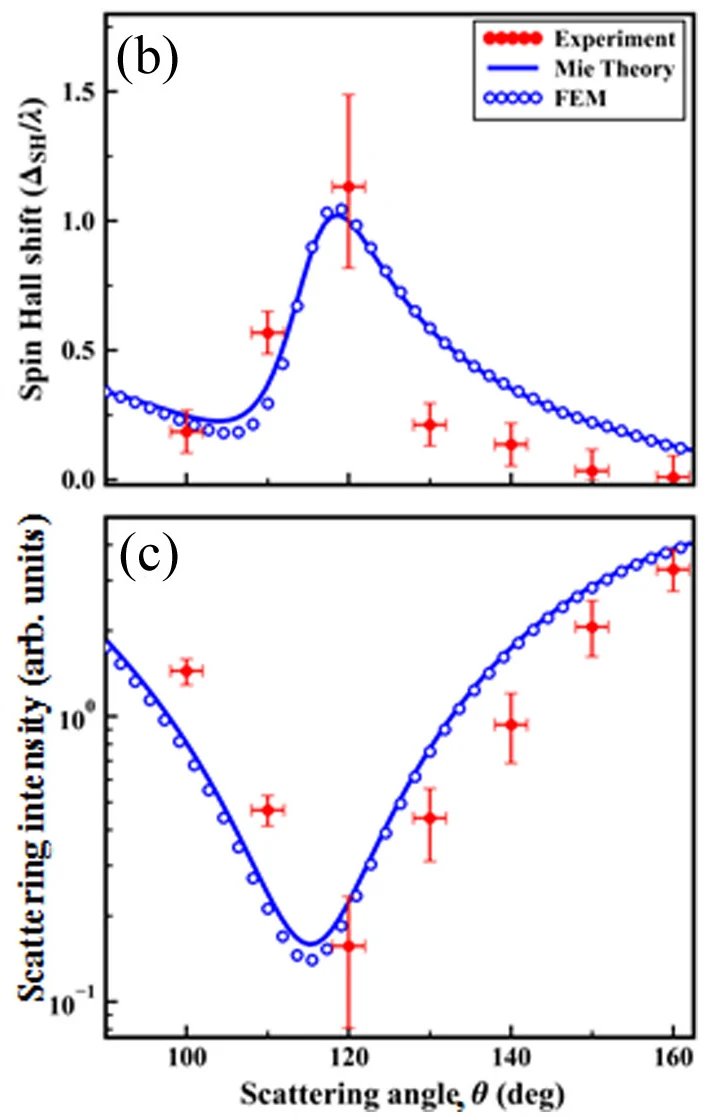
Image credit
Two complete plots with axes, legends and experimental error bars, comparing measured shift and scattering intensity with theory and simulation.
Khan et al. (2026) · CC BY 4.0Panel-boundary crop, then lossless RGB PNG encoding. No retouching, recoloring, data modification, label removal or resampling of the native derivative.
Original experiment compared with theory and simulation, Figure 5B-C; panels extracted without changing data.
What Transfers to Smaller Scales?
Microwaves and optical radiation obey the same Maxwell equations, allowing a larger laboratory object to test a mechanism intended for much smaller structures. The researchers chose ceramics with electromagnetic properties sufficiently close to their silicon model to make that comparison meaningful.
Scaling the equations is not the same as fabricating and testing an optical device. Material dispersion, absorption and particle geometry still matter. The paper models silicon nanoparticles but does not report an equivalent visible-light experiment, a working lidar upgrade or a deployed photonic circuit.
The achievement is narrower and more interesting than those promises: a carefully shaped object made a polarization-dependent error in apparent position accessible to direct measurement. Sometimes understanding light means learning exactly how it can make a stationary object appear somewhere else.
Which would you want to examine first: the particle's shape or the measurement that locates it? Share your thoughts in the comments below.
Comments
Member comments are temporarily unavailable.
Log in to join the discussion.