
Animal Cells Inherited Almost an Entire Algal Genome. Most of It Stayed Silent.
Published November 13, 2026
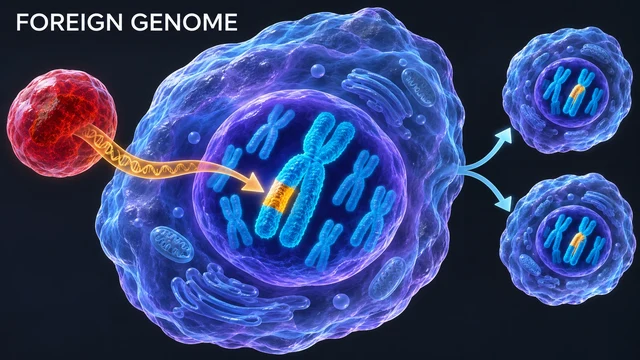
AI-generated editorial illustration of genome transfer and inheritance, not microscopy or evidence of photosynthesis.
A planimal cell line retained algal DNA for more than 150 generations. The surprise is how the host kept most foreign genes quiet, not a photosynthesizing animal.
A laboratory cell can acquire an extraordinary amount of foreign DNA without acquiring the abilities that made that DNA interesting in the first place.
That is the surprise inside a Japanese team's new "planimal" experiment. Researchers fused material from a tiny red alga with cultured mammalian cells. One hamster-derived cell line retained approximately 16.3 million base pairs of algal nuclear DNA, nearly the alga's entire nuclear genome. Algal DNA remained in dividing cells for more than 150 cell generations.
This is not a photosynthesizing hamster. It is something more precise, and potentially more useful to cell engineering: evidence that an animal cell can accommodate chromosome-scale genetic material from a very distant organism, pass it through repeated divisions, and largely keep it quiet.
The University of Tokyo's November 13 account describes research published in Nature Communications on November 12. The achievement concerns laboratory-grown cells, not a new animal species or reproduction between plants and animals.
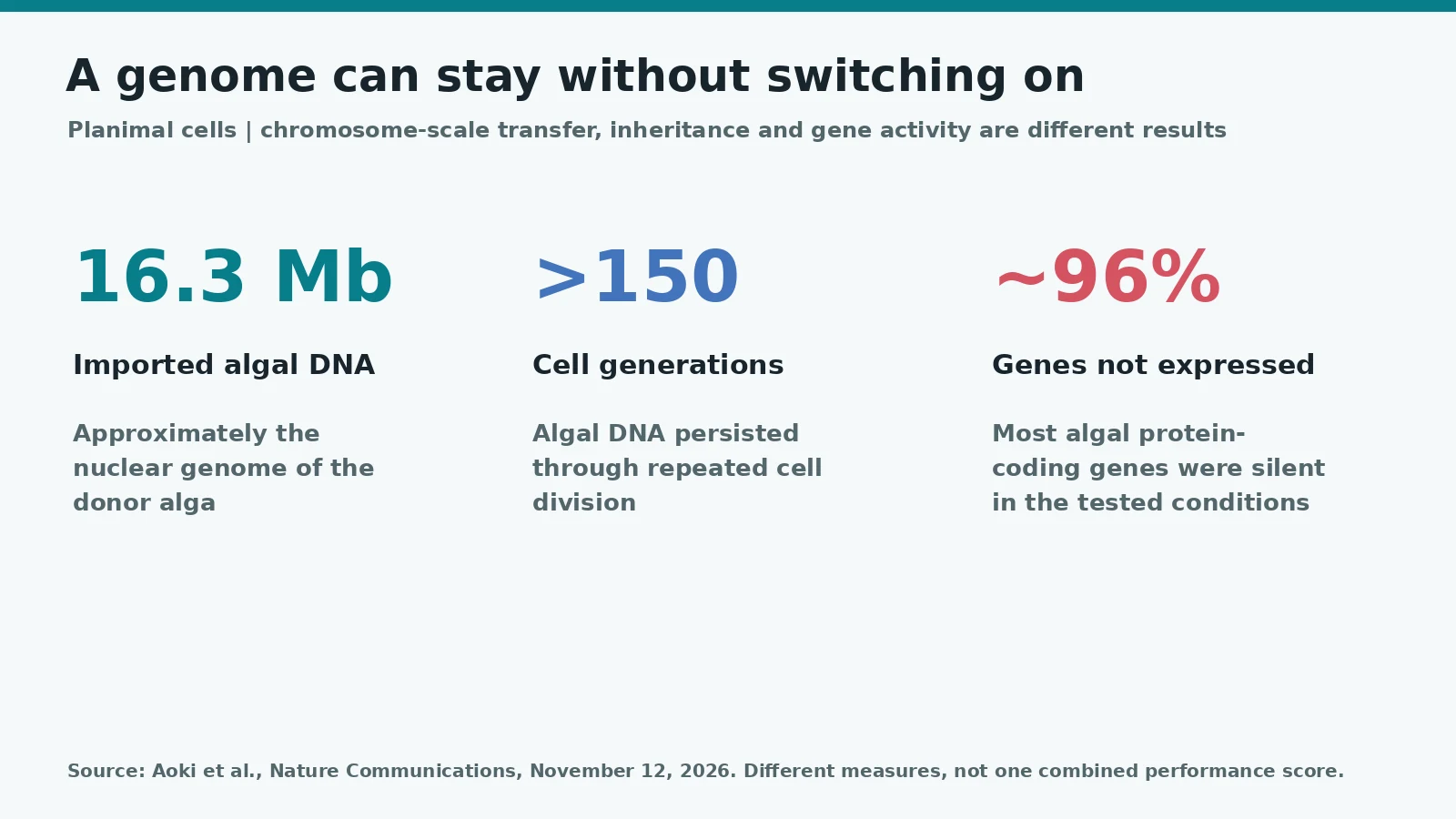
Original source-mapped explanatory diagram; these are different measures, not one combined performance score.
An Entire Genome Is a Different Engineering Problem
Introducing a useful gene into a cell and persuading that cell to retain a whole foreign genome are very different tasks. A genome brings a large collection of sequences, regulatory instructions and chromosome structures. Keeping that material around is not the same as persuading it to operate correctly.
The donor here was Cyanidioschyzon merolae, a minute red alga with a compact nuclear genome organized into 20 chromosomes. Its relatively small genome made an otherwise daunting transfer a tractable experiment. The researchers used cell fusion, principally mediated by polyethylene glycol, to introduce algal material into cultured mammalian cells.
They then followed the imported DNA using sequencing and fluorescence-based microscopy. The evidence went beyond finding an algal cell sitting beside an animal cell. Algal DNA appeared in the mammalian nuclear environment and became physically associated with mammalian chromosomes, including a region near the end of a hamster X chromosome.
Those observations matter because an impressive-looking cell immediately after fusion could be temporary. The real question is what survives after the recipient has divided again and again.
One line was maintained through its 155th cell generation while retaining much of the transferred material. Substantial portions of algal DNA were also detected after 95 generations without antibiotic selection. That second result is important: selection can reward cells that retain particular material, so persistence after removing that pressure is a more demanding test.
Different lines did not behave identically. Some regions changed in relative copy number during continued culture. This is a study of how an unfamiliar genome settles into a host, not a claim that every transferred chromosome remained untouched forever.
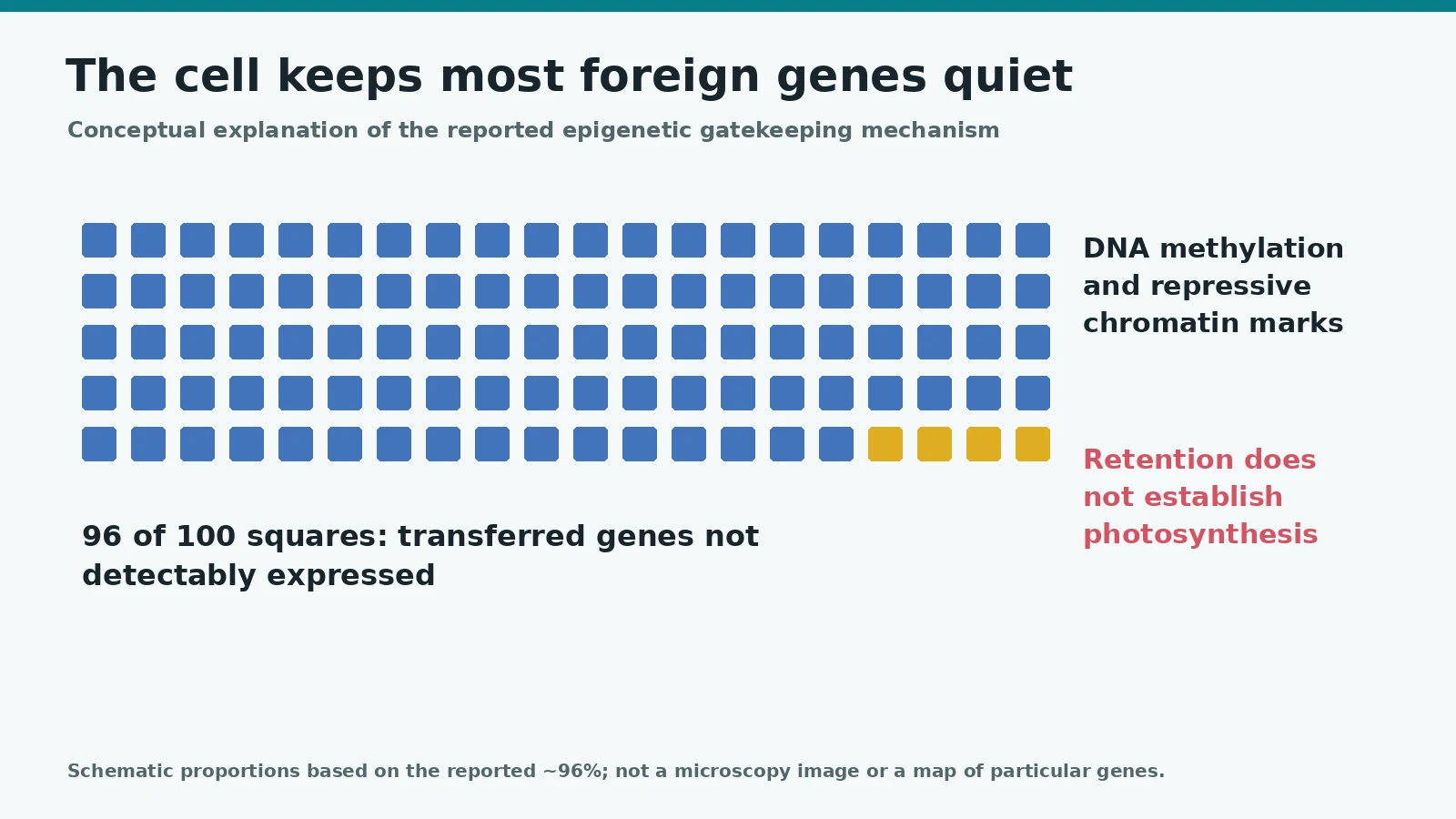
Original schematic of the reported proportion, not a gene map or microscope image.
Keeping the New Genes Quiet
The most revealing number may be the least spectacular one. Approximately 96% of the transferred algal protein-coding genes were not detectably expressed under the tested conditions.
The foreign DNA acquired increased methylation and repressive changes to the proteins around which DNA is packaged. It became associated with relatively inactive, tightly packaged regions. The team describes this as epigenetic gatekeeping: accommodation and silencing happening together.
That does not make the experiment a failure. A large imported genome expressing its instructions indiscriminately might be much harder for a recipient cell to tolerate. The ability to stabilize the material while suppressing most of its activity may help explain why the hybrid cells could keep growing.
The researchers also disrupted DNMT3A, an enzyme involved in establishing DNA methylation. Stable establishment and long-term maintenance of algal DNA were impaired. That experiment connects the proposed gatekeeping mechanism to an intervention, rather than merely observing that silent DNA and methylation happened to occur together.
DNA Is Not a Working Solar Power System
The obvious ambition is to activate useful functions that mammalian cells do not normally have. The obvious temptation is to jump straight to photosynthesis.
But photosynthesis is not a single switch hidden in an algal chromosome. A sustained working system would also need appropriate cellular machinery, functional chloroplasts, regulation and compatibility between the host and its imported components. Possessing nuclear DNA alone does not establish those capabilities.
The team previously investigated the separate transplantation of photosynthetically active chloroplasts into cultured animal cells. That earlier work should not be folded into this result as though the present cell lines already combine both achievements into a lasting solar-powered system. The new study did not demonstrate new photosynthetic or other metabolic abilities.
What it does establish is a substantial intermediate step. If engineers can first retain a large genetic repertoire, they can investigate which parts might later be activated, how the host suppresses them, and what other components a desired function would require. Each of those is an experimental question, not an application already delivered.
The compelling part of planimal cells is not that the plant-animal boundary has disappeared. It is that researchers can now study a very unusual encounter between genomes over many generations of cell division, rather than only during the brief aftermath of fusion.
What would be the most useful foreign cellular function to investigate next? Discuss it in the comments below.
Comments
Member comments are temporarily unavailable.
Log in to join the discussion.