
Psyche's Blue Ion Engine Is Settling In for a Years-Long Push
Published October 25, 2026
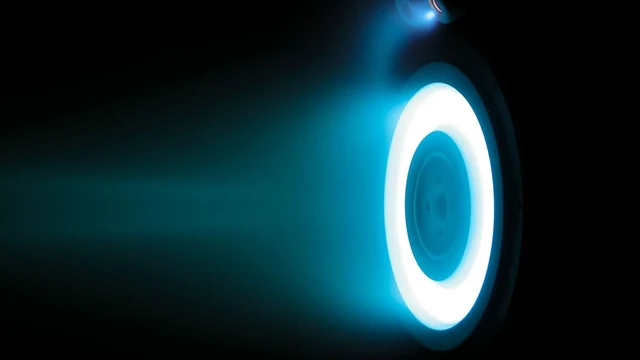
NASA / JPL-Caltech. An identical thruster in prelaunch laboratory testing, not a camera view from Psyche in space.
Image credit
Psyche-type Hall thruster firing in a vacuum chamber
NASA / JPL-Caltech · NASA factual editorial useResized and encoded as WebP; no semantic alteration.
NASA's asteroid-bound spacecraft plans to thrust nearly 90 percent of the time. Tiny forces, fading sunlight and a subtle torque make the cruise anything but passive.
The blue engine glow looks energetic. The push is small enough to compare with the weight of an AA battery. Psyche's route to the asteroid belt depends on accepting that apparent mismatch: a little thrust, applied for a very long time.
In its October 22 update, NASA says the spacecraft has entered a nearly continuous propulsion phase. That operating pattern began on September 28, after its Mars gravity assist; the October report explains the new cruise regime rather than dating the engine switch-on to this week.
The team expects the thrusters to operate nearly 90 percent of the time until arrival at asteroid Psyche in summer 2029. Communications and necessary engineering activities interrupt that long, patient push.
That percentage describes the intended operating schedule, not an efficiency measurement or a guarantee that every future week will look identical. The engineering team still has to make the trajectory, spacecraft attitude and available electrical power agree.
A Small Force With a Long Working Day
Psyche's Hall-effect thrusters use xenon propellant and electromagnetic fields to produce thrust. NASA gives a maximum force of 250 millinewtons. That is a quarter of a newton, not the forceful shove normally associated with a rocket launch.
The spacecraft does not need to lift itself off a planet at this stage. It is already travelling through space. Repeatedly expelling propellant changes its motion a little at a time, and those changes accumulate across a long cruise. The thrust should not be confused with its speed: a spacecraft can be moving quickly while a small force continues to alter its trajectory.
Only one of the four thrusters operates at a time. NASA says the spacecraft can exceed 100,000 miles per hour relative to an observer on Earth during cruise. The reference frame matters; it is not a separate claim about speed relative to every planet or the target asteroid.
The photograph here shows an identical Hall thruster operating in a vacuum chamber before launch. It is actual propulsion hardware, but not a live camera view of Psyche's engine in interplanetary space.
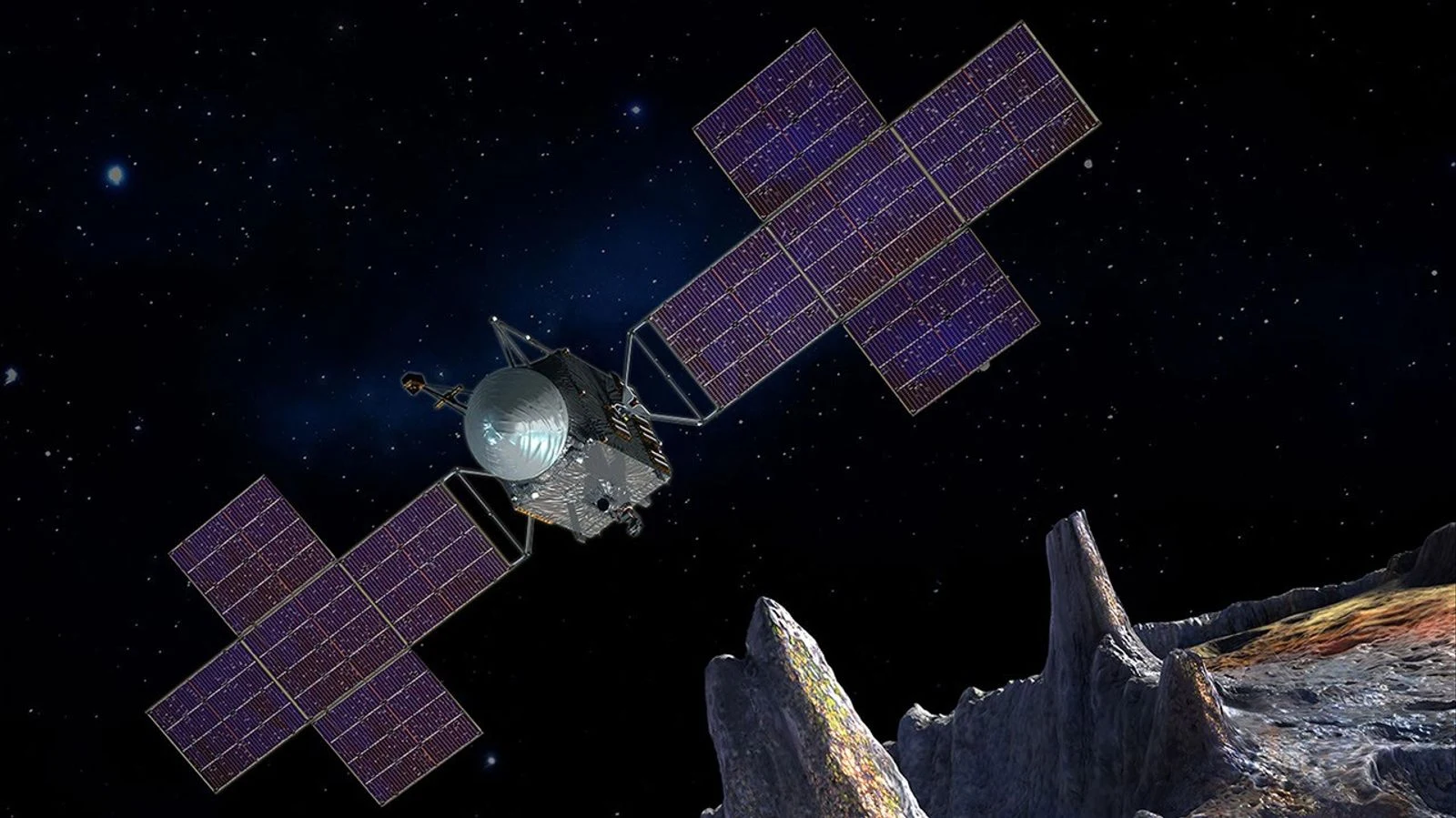
Image credit
Psyche spacecraft and target asteroid, artist's concept
NASA / JPL-Caltech · NASA factual editorial useResized and encoded as WebP; no semantic alteration.
Artist's concept of the planned encounter. NASA / JPL-Caltech.
Sunlight Sets the Available Power
Two cross-shaped solar arrays, each with five panels, provide roughly 800 square feet of collecting area. They supply the spacecraft's electrical systems, including propulsion. Solar-electric flight therefore has a constraint a propellant tank alone cannot explain: available sunlight changes along the route.
NASA says the spacecraft will thrust at full power for the next few months before gradually reducing operation toward approximately half power as it moves farther from the Sun. The plan changes the operating point instead of assuming that an engine can draw the same electrical power everywhere.
Psyche launched with about 1,090 kilograms of xenon in seven tanks. Approximately one-third has been used over three years. The remaining supply must support both the journey and the planned work around the asteroid; it is not all reserved for getting there.
Even Gentle Propulsion Needs Steering Work
The ion flow also produces a slight twisting effect that engineers must manage. Reaction wheels absorb the accumulated angular momentum. Periodically, the operating thruster is switched off, the spacecraft rotates, and a different thruster runs briefly at low power in another direction to unload that momentum.
This is the less photogenic part of long-duration electric propulsion. Keeping an engine firing is not simply a matter of leaving a switch on. The spacecraft must preserve its pointing and power balance while managing a small effect that builds up over hours.
NASA says the mission has enabled unusually long in-space measurements of this Hall-thruster torque across power levels and operating time. That engineering opportunity sits alongside the scientific destination.
Psyche, the asteroid, may contain material related to an early planetary body's metallic core. That is a hypothesis for the mission to investigate, not a confirmed origin story. The spacecraft's two-year prime science mission is planned to examine the object from a series of orbits.
For now, sunlight, xenon and time are doing the work of getting it there. What would you like explained next about electric propulsion? Leave your questions in the comments below.
Comments
Member comments are temporarily unavailable.
Log in to join the discussion.