
His Teeth Recorded a Life at the Edge of the Farming Revolution
Published November 17, 2026
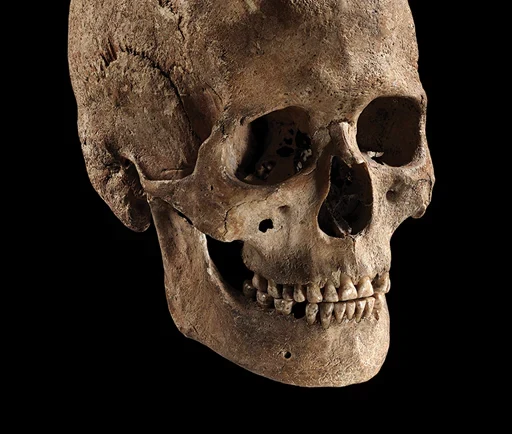
The actual cranium, cropped to the lower face and teeth. No facial reconstruction.
Image credit
The lower face and teeth of Rodhals Man
John Lee, Danish National Museum and Anders Fischer; Fischer et al. (2026) · CC BY 4.0Cropped to the lower face/teeth for a legible landscape card, then resized and WebP encoded; no anatomy reconstructed.
Rødhals Man lived about 6,000 years ago. New work follows his changing diet across one lifetime, without pretending food chemistry proves he became a farmer.
A tooth does not record a conversation with a new neighbour. It can, however, preserve traces of what someone ate while their world was changing.
A new study follows those traces through the life of Rødhals Man, a coastal forager buried on the Danish island of Sejerø about 6,000 years ago. His childhood diet drew heavily on the sea. Terrestrial food became more important during adolescence and adulthood, around the period when farming was arriving in the region.
The paper, published in Antiquity on November 16, is not announcing a newly excavated skeleton. The remains were found in 1956. The new work brings several kinds of evidence together to investigate a single life.
One Body, Several Clocks
The researchers combined ancient DNA, skeletal examination, radiocarbon dating and isotope measurements from teeth and bones. Those methods do different jobs. DNA informs ancestry; chemistry helps reconstruct diet; neither is a diary of a person's decisions.
Successive dentine samples from a premolar provide evidence from different stages of childhood. Bone measurements add information about later life. Comparing them lets the team ask how food sources changed rather than treating the entire skeleton as one undifferentiated sample.
Dating required another correction. A person who eats substantial marine food can produce a radiocarbon result that appears misleadingly old. The researchers modelled that dietary reservoir effect instead of taking the raw dates at face value. Their estimated death interval is 3930-3710 calibrated BC at 95% probability, not a precise known year.
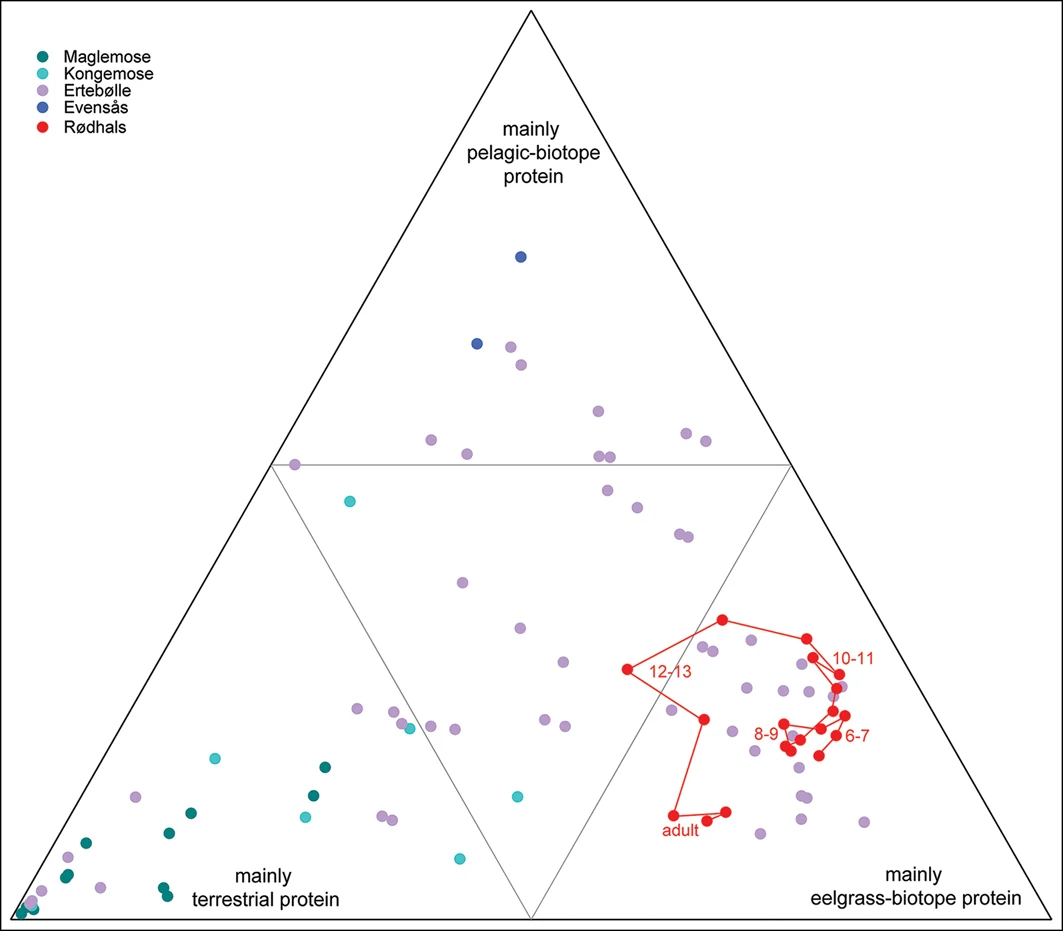
Image credit
Modelled protein sources across one life
John Meadows; Fischer et al. (2026) · CC BY 4.0Resized and WebP encoded without semantic alteration.
Modelled protein-source contributions across one life. Food chemistry does not directly identify farming.
A Change in Food, Not a Recorded Profession
The genetic evidence places Rødhals Man within the Western Hunter-Gatherer ancestry group. His diet remained substantially marine, but the later samples show a greater terrestrial contribution.
That is the intriguing combination: continuity in ancestry alongside a change in food, during a much wider cultural transition. It is also where the easiest headline would go too far.
The paper explicitly says the isotope evidence cannot establish whether the terrestrial food came from more hunting and gathering or from farming and herding. The authors consider contact with farmers a plausible interpretation, drawing on the wider archaeological context. They do not chemically identify a moment when this man became a farmer.
The University of Gothenburg announcement presents him as a witness to the Neolithic transition. Read that as a way of describing the period he lived through, not evidence that researchers know what he thought about it.
A Revolution at Human Scale
An ancestry label is not a set of instructions for how someone must live. Nor does a dietary change automatically mean that an earlier way of life ended overnight.
The value of this study is its scale. Instead of describing change only through broad population categories, it examines shifts within one person's lifetime. That brings the transition closer without making the evidence more complete than it is.
One individual cannot stand in for every island community. But one carefully investigated individual can reveal a question that a broad label hides: how did people already living there respond to a changing world?
Discuss the evidence and its limits in the comments below.
Comments
Member comments are temporarily unavailable.
Log in to join the discussion.