
Rubin Found Hidden Neighbors: a Galaxy Candidate and a Star Cluster
Published November 8, 2026
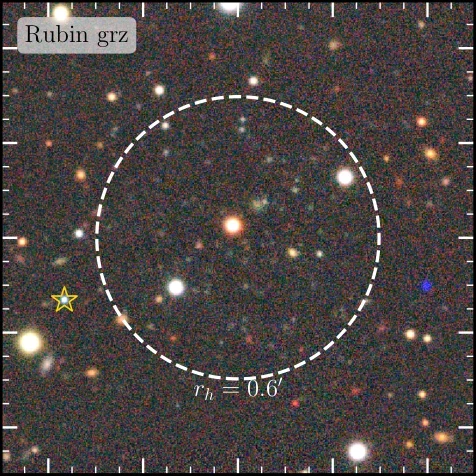
William Cerny et al., CC BY 4.0: actual Aquarius IV g/r/z image. Dashed circle marks the half-light radius; the faint galaxy is a stellar grouping, not an obvious spiral.
Image credit
Aquarius IV and Rubin-GC1 came from early Rubin data, but they are different objects. Their studies predate November coverage and are not two new galaxies.
One faint collection of stars is a candidate dwarf galaxy. Another is a star cluster on the dusty far side of the Milky Way. Rubin's early data has brought both hidden neighbors into view, by revealing very different stellar populations.
Aquarius IV and Rubin-GC1 emerged from early Rubin Observatory data. Yale described the pair on October 28, before the University of Washington's November 5 account. The discoveries were not made this week merely because coverage reached another institution's news page.
A Galaxy That Does Not Look Like a Galaxy
Aquarius IV is not a bright spiral with an obvious outline. The published image shows a sparse scattering of stars. Its identification depends on finding a statistically meaningful stellar population against the surrounding field, rather than spotting a miniature version of a familiar galaxy photograph.
The discovery paper places it among the Milky Way's extremely faint satellites. Its study was already public before the October news release. Its classification and properties should remain tied to that evidence and subsequent observations, not exaggerated into a resolved picture of a distant city of stars.
That is why catalog quality matters. An automated search needs reliable distinctions between stars, background galaxies and spurious detections. A few misleading points can make an apparent grouping less meaningful than it looks.
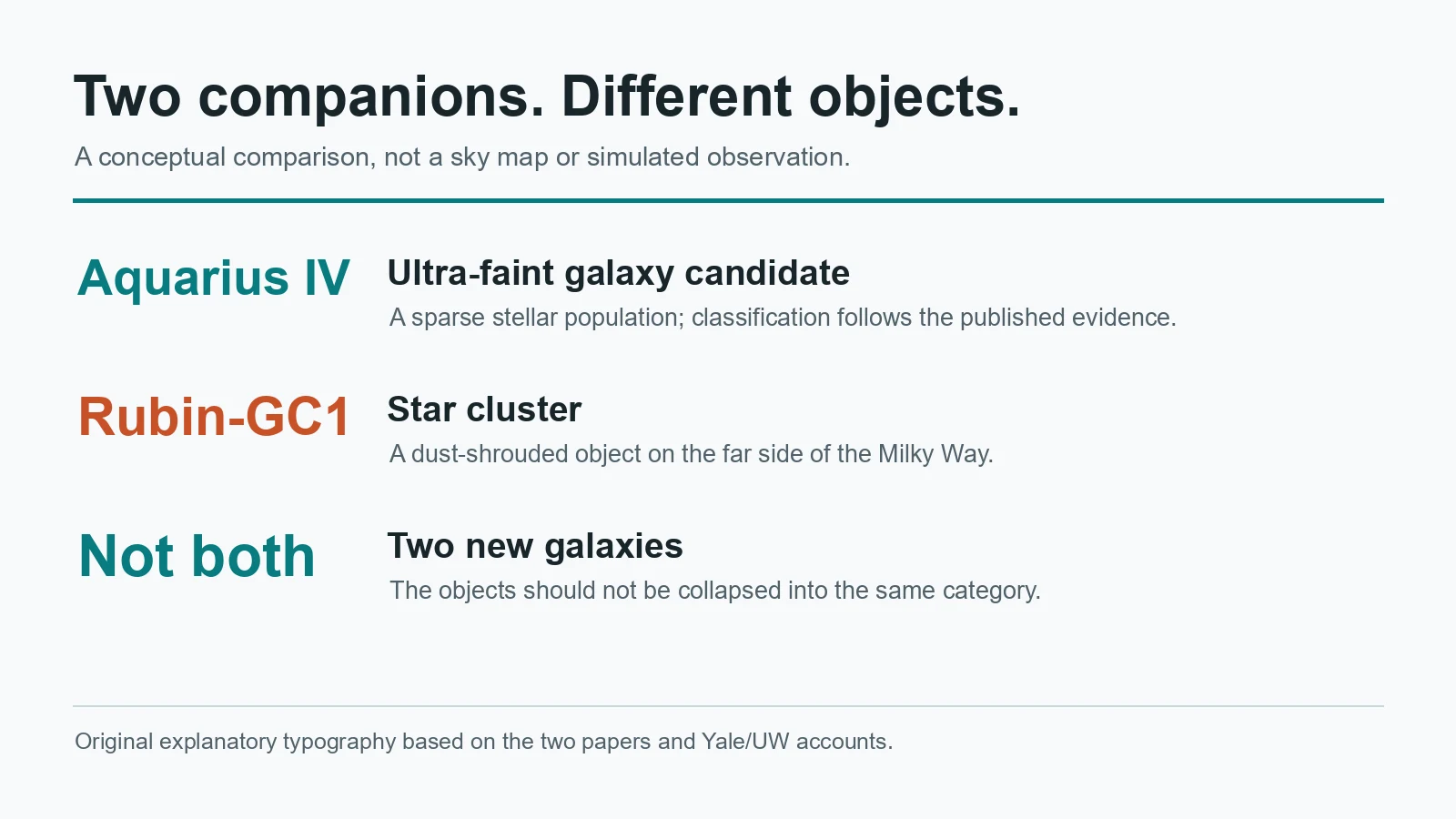
Original conceptual comparison, not a sky map or simulated observation.
The Other Companion Is a Cluster
Rubin-GC1 is a stellar cluster, not a second dwarf galaxy. Its paper investigates an object obscured by dust on the far side of our galaxy. The observational challenge is different from simply finding another bright object in an empty patch of sky.
Keeping the two categories separate is also important when discussing dark matter. A claim made about ultra-faint galaxies should not automatically be transferred to every star cluster appearing in the same press release.
The Survey Is More Than a Camera
The institutions say the work used preview observations taken between April 2025 and January 2026, covering about 15 percent of the eventual LSST footprint. Those dates describe when the underlying light was recorded; the paper and news dates describe when results became public.
Finding useful science in preview data is encouraging, but it does not justify multiplying the number of discoveries by the remaining sky area. Dust, background populations, exposure depth and the type of object being sought all affect what a search can find.
The broader promise is a better census of the Milky Way's surroundings. Even nearby structures can be difficult to recognize when their stars are sparse or hidden behind dust. More observations help, but so do clean catalogs and careful comparisons.
Which is more surprising: a galaxy faint enough to look like scattered stars, or a star cluster hidden on the far side of our own? Tell us in the comments below.
Comments
Member comments are temporarily unavailable.
Log in to join the discussion.