
Ryugu Contains Life's Five Genetic Letters, Not DNA or Alien Life
Published November 8, 2026
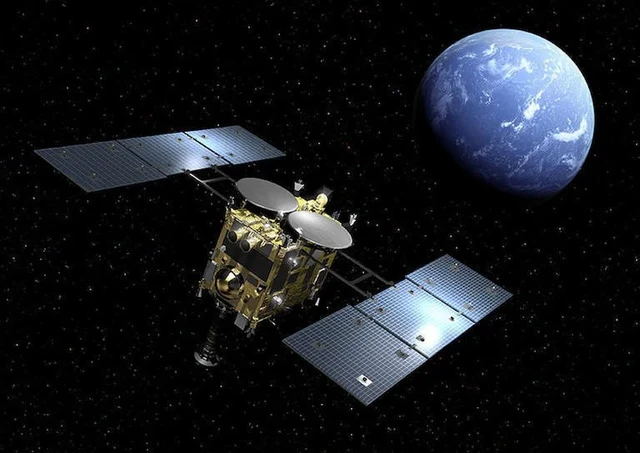
JAXA artist concept of Hayabusa2, issued by NASA Science. Mission context, not a photograph of nucleobases or evidence of life.
Image credit
Hayabusa2 near Earth, mission artist concept
JAXA, as issued by NASA Science · NASA factual editorial useResized and encoded as WebP; no semantic alteration.
The March Ryugu study found all five canonical nucleobases. Returned asteroid samples inform prebiotic chemistry, not a discovery of DNA or organisms.
An asteroid sample can contain the ingredients used in genetic material without containing genetic material itself. That distinction is the heart of the Ryugu result: researchers identified all five canonical nucleobases, not DNA, organisms or evidence that life once lived on the asteroid.
This is earlier science worth explaining, not a November discovery. The Nature Astronomy paper was published on March 16, and the institutional announcement followed on March 17. Later coverage does not change those dates.
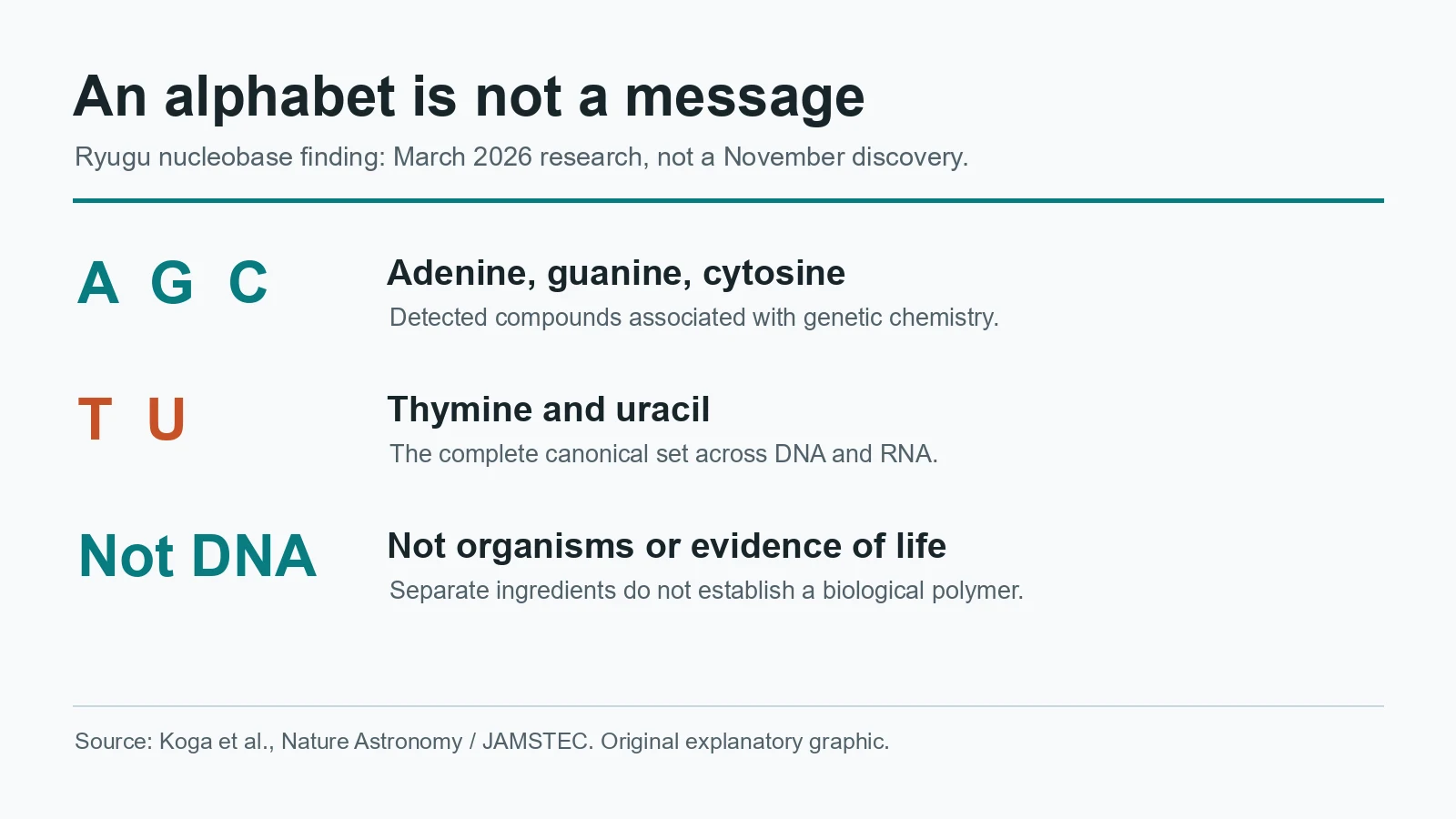
Original explanatory graphic based on the March research. Separate chemical ingredients are not genetic instructions.
Five Letters, Not a Written Message
The compounds are adenine, guanine, cytosine, thymine and uracil. They are the five canonical bases associated with DNA and RNA. Finding them together fills out a chemical alphabet that is familiar on Earth, in material collected from another world.
The alphabet analogy helps only up to a point. A collection of letters is not a sentence. Likewise, detecting separate nucleobases does not establish that they were joined into a biological polymer, used by an organism or arranged as genetic instructions.
That is not a technicality added to make the story less exciting. It tells us which scientific question the samples can actually address: the chemistry available in early Solar System material, rather than the existence of an extraterrestrial organism.
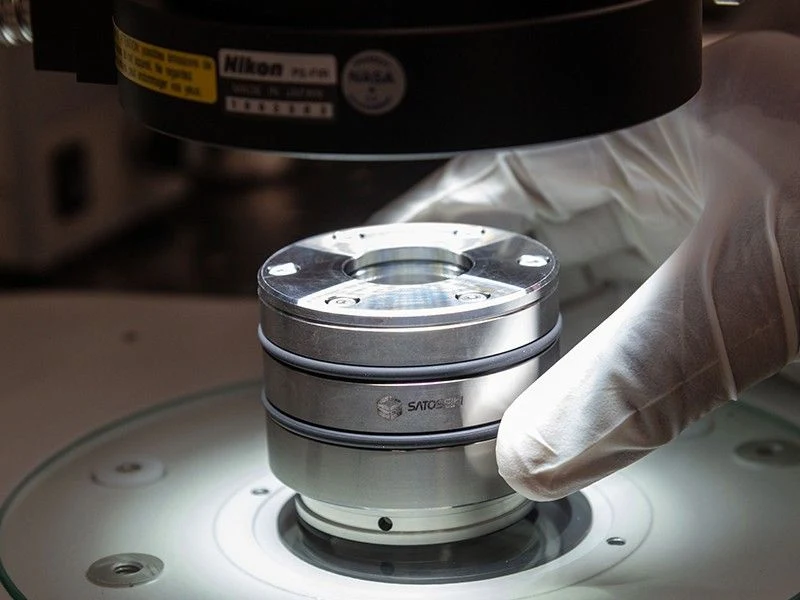
Image credit
Hayabusa2 sample container, mission context
NASA Science/JAXA · NASA factual editorial useResized and encoded as WebP; no semantic alteration.
NASA Science/JAXA mission-context image of a sample-return container, not a photograph of the 2026 molecular analysis.
Why Returned Samples Matter
Hayabusa2 studied Ryugu, collected material and returned samples to Earth. NASA's mission overview provides the broader mission context. The scientific finding comes from laboratory analysis of returned material, not an image in which a spacecraft camera could recognize a molecule.
The institutional report describes the identification of all five bases in Ryugu samples and compares their distributions with related carbonaceous-asteroid chemistry. It also reports a relationship between purine-to-pyrimidine ratios and ammonia abundance, proposing a possible indicator of non-biological chemical evolution.
The distribution matters alongside the list of detected compounds. A chemical inventory asks what is present. Comparing abundances asks how those compounds might have formed or changed. Neither step requires assuming a biological origin.
What the Result Suggests
The authors interpret the presence of these compounds in carbon-rich asteroidal material as evidence that important prebiotic chemistry was available during Solar System formation. Such material could have contributed ingredients to the early Earth.
"Could have contributed" is different from proving a complete origin-of-life pathway. A supply of molecules does not, by itself, explain how a living system emerged. Delivery, survival, concentration and the reactions that follow are distinct questions.
It is also different from claiming every asteroid contains the same mixture. Specific returned samples offer unusually valuable evidence about particular material. The strength of that evidence should not become a license to assign an identical chemical history to every space rock.
The More Interesting Boundary
The result makes the boundary between ordinary cosmic chemistry and the chemistry used by life more tangible. Ingredients associated with biology are not necessarily made by biology. Their presence can tell a rich story without a hidden organism being involved.
That is why the accurate headline is strong enough on its own. Ryugu contains the complete set of canonical nucleobases used across DNA and RNA. It does not contain a demonstrated genome, and this study is not a detection of life.
The supporting spacecraft and sample-return imagery illustrates how material reached laboratories. It is not a photograph of the nucleobases or a reconstruction of an organism. Keeping those layers separate lets the chemistry remain the remarkable part.
Which next step interests you more: finding where these compounds formed, comparing more returned samples, or understanding how separate ingredients could participate in prebiotic reactions? Tell us in the comments below.
Comments
Member comments are temporarily unavailable.
Log in to join the discussion.