
Sending a Smell Still Takes Molecules: Inside the Scentronic Prototype
Published November 8, 2026
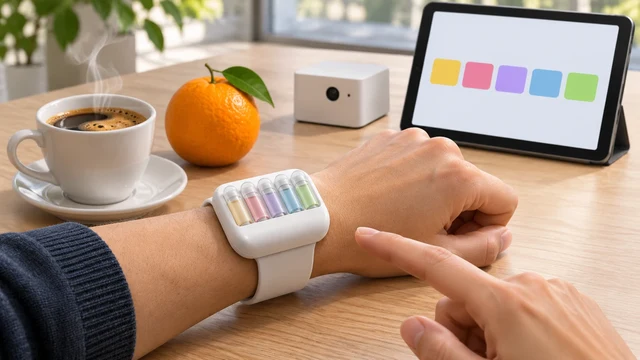
AI-generated conceptual illustration of a smell interface, not a photograph or exact design of Scentronic.
An electronic nose and wearable scent receiver connect recognition with odor delivery. The October prototype does not transmit molecules through a network.
Sending a photograph does not send the photographed object. Scentronic applies a related distinction to smell: a system identifies an odor, transmits information, and asks hardware at the receiving end to release a corresponding scent.
That last step still needs physical material. The prototype is not sending scent molecules through a network or synthesizing any imaginable aroma from nothing.
Ohio State's November 5 research account describes the work. The underlying Science Advances paper appeared in October, so this is coverage of an earlier prototype rather than a newly launched consumer product.
Recognition Is Only Half the Device
The research combines an artificial-intelligence-assisted electronic nose with controlled odor delivery. The sensing side classifies inputs; the receiving hardware releases selected odorants. Wearable implementations include a wrist-worn design and a necklace.
The separation is important. Correctly recognizing coffee does not, by itself, create a coffee smell at another location. The receiver needs an appropriate supply and a mechanism for releasing it. A programmable command changes what happens to physical materials already available there.
The researchers worked with five food-associated odors: coffee, beer, red wine, orange and chocolate cake. That is an understandable demonstration set, not an unlimited smell vocabulary.
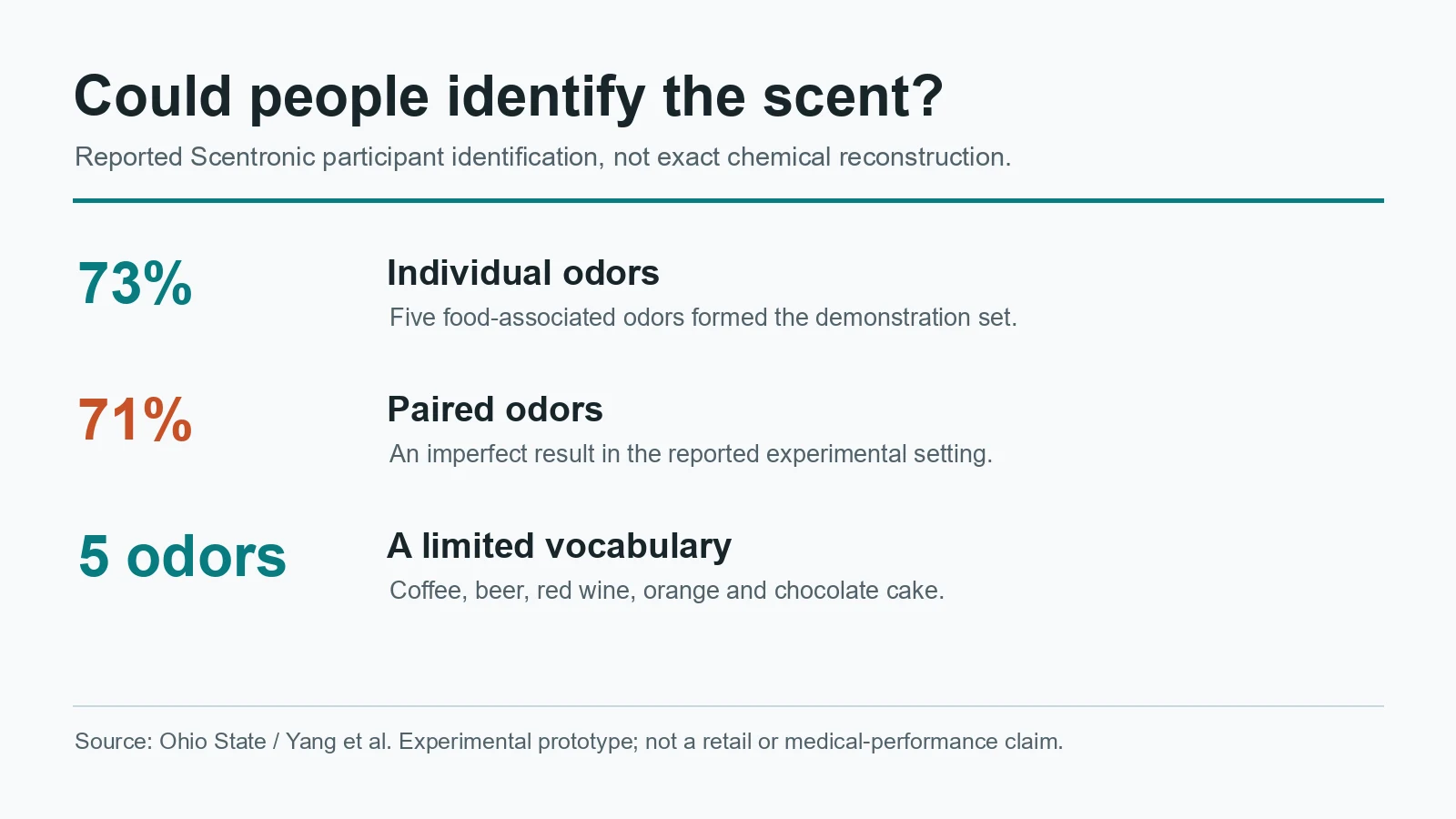
Original graphic based on the reported participant identification results. It does not claim exact chemical reconstruction or medical performance.
The Human Result Is Imperfect
In the reported testing, participants identified individual delivered odors about 73 percent of the time and paired scents about 71 percent of the time. These are identification results in the described tests, not proof that every transmitted scent is an exact chemical or perceptual copy.
The university account also notes variation in how intensely individuals experienced odorants. A setting that produces a clear result for one person may not feel identical to another.
Those limits are central to the engineering. A successful digital instruction is not the same as a consistent sensory experience. The device must contend with the sensing system, release hardware and human perception, rather than only a communications link.
A More Physical Kind of Interface
The prospect is genuinely interesting for multisensory interfaces: an experience could coordinate what someone sees with a controlled scent cue. The research does not establish a retail launch, a universal remote-smell service or a medical benefit.
The article's conceptual lead image is not a photograph of Scentronic. The original paper's device photographs are linked above; its noncommercial image license is why they are not republished here.
The useful question is what a small, predictable odor vocabulary can add to an interface. That is a more practical starting point than declaring the entire internet capable of smell.
Would scent improve a digital experience you actually use, or become another notification to switch off? Tell us in the comments below.
Comments
Member comments are temporarily unavailable.
Log in to join the discussion.