
A Real Science Tricorder, Complete With an Honest List of Bugs
Published October 25, 2026
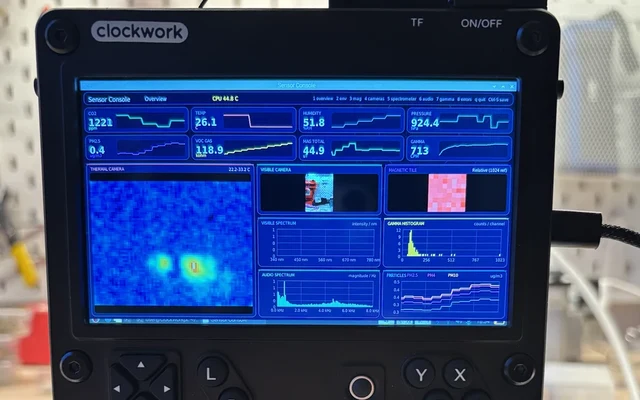
Close-up of Jansen's documented prototype and interface, not a generated device or a Meteor Makers measurement. Fuller device views appear below.
Image credit
Science Tricorder Cyberdeck main interface
Peter Jansen / The Tricorder Project · CC BY 4.0Cropped to the actual sensor console and controls for a readable thumbnail; resized and encoded as WebP. No scene alteration.
Peter Jansen's open handheld combines visible spectroscopy, thermal imaging, magnetic sensing and more. Its documented limitations make the prototype worth studying.
The most convincing thing about Peter Jansen's handheld science tricorder may be its list of unfinished jobs. The magnetic imager updates too slowly. Cooling needs more work. A connector choice can let someone make an expensive electrical mistake. This is a device that has been built far enough to reveal its problems, not just rendered convincingly enough to hide them.
Jansen's Open Source Science Tricorder Cyberdeck puts a broad collection of sensors around a ClockworkPi uConsole and a Raspberry Pi compute module. He published the repository's initial build on September 27, 2026.
The result is part portable Linux computer, part instrument case. The interesting question is not whether it resembles a science-fiction prop. It is what each sensor can tell its user, and how much of that capability the current prototype actually exposes.
Open Source Science Tricorder Cyberdeck
Jansen's own functionality demonstration, linked from his repository. These are the creator's demonstrations, not testing performed by Meteor Makers.
A Spectrum Is More Than a Colour Name
The visible-light instrument uses a Hamamatsu C12666MA microspectrometer. Jansen lists 256 spectral channels across 340 to 780 nanometres, with practical spectral resolution of about 15 nanometres. Those numbers describe different things: channel count is not a promise that the device can separate every pair of wavelengths falling in adjacent channels.
That distinction is important for a handheld instrument whose screen can make a spectrum look impressively detailed. The optical response and calibration determine what the curve supports. A plotted peak is not automatically a unique identification of a substance, and this build is not presented with a general-purpose chemical-identification validation.
The hardware still offers a useful way to look beyond what ordinary vision collapses into a colour. A light source's distribution across wavelengths can be more informative than whether it looks white or purple. Jansen's actual interface photograph shows that measurement-oriented approach: the spectrum is something to inspect, rather than a fictional scanner declaring a complete answer.
There is an unfinished optical feature too. The ESP32 board has provision for a transmission-spectroscopy light source, but Jansen has not settled on a satisfactory mounting arrangement. That leaves a gap between having a spectral sensor and having every desired illumination and sample-handling mode built into the instrument.
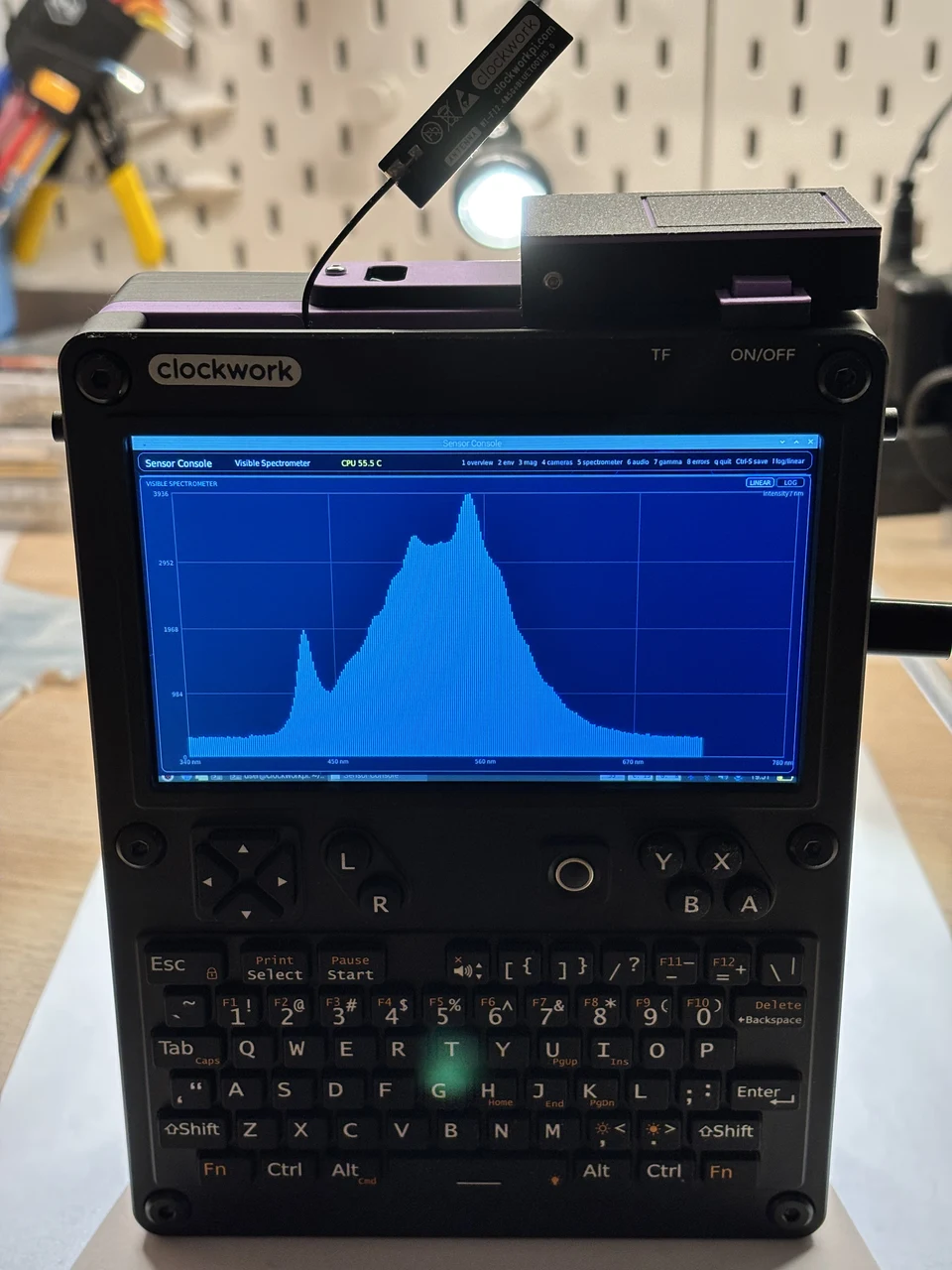
Image credit
Tricorder visible spectroscopy display
Peter Jansen / The Tricorder Project · CC BY 4.0Resized and encoded as WebP; no semantic alteration.
The creator's spectroscopy demonstration. Channel count alone does not establish spectral resolution or identify an arbitrary substance.
The Magnetic Camera Has Two Very Different Speeds
The magnetic imaging tile is an 8-by-8 array: 64 spatial samples, not a conventional photograph. It sits alongside a separate magnetometer for field strength and direction. Jansen designed the tile for potentially fast acquisition, around 20 kilohertz, but the current interface refreshes at approximately one frame per second.
That is not a small footnote. A component's potential acquisition rate does not tell you the end-to-end frame rate of a computer, microcontroller and interface polling several instruments. The present ESP32 firmware visits the sensors in a round-robin sequence. A dedicated mode concentrating on high-speed magnetic capture has not been implemented.
The documentation's demonstration photographs are therefore evidence of the current magnetic-imaging function, not proof that this assembled cyberdeck records 20,000 usable magnetic images each second. Keeping both numbers visible makes the project more useful to another builder: the bottleneck is identified instead of being quietly folded into the headline specification.
The same caution applies when interpreting the picture. A 64-pixel field map can reveal spatial structure, but it does not turn the handheld into a high-resolution camera that sees through arbitrary objects. Its result depends on the sensing arrangement and the magnetic source being examined.
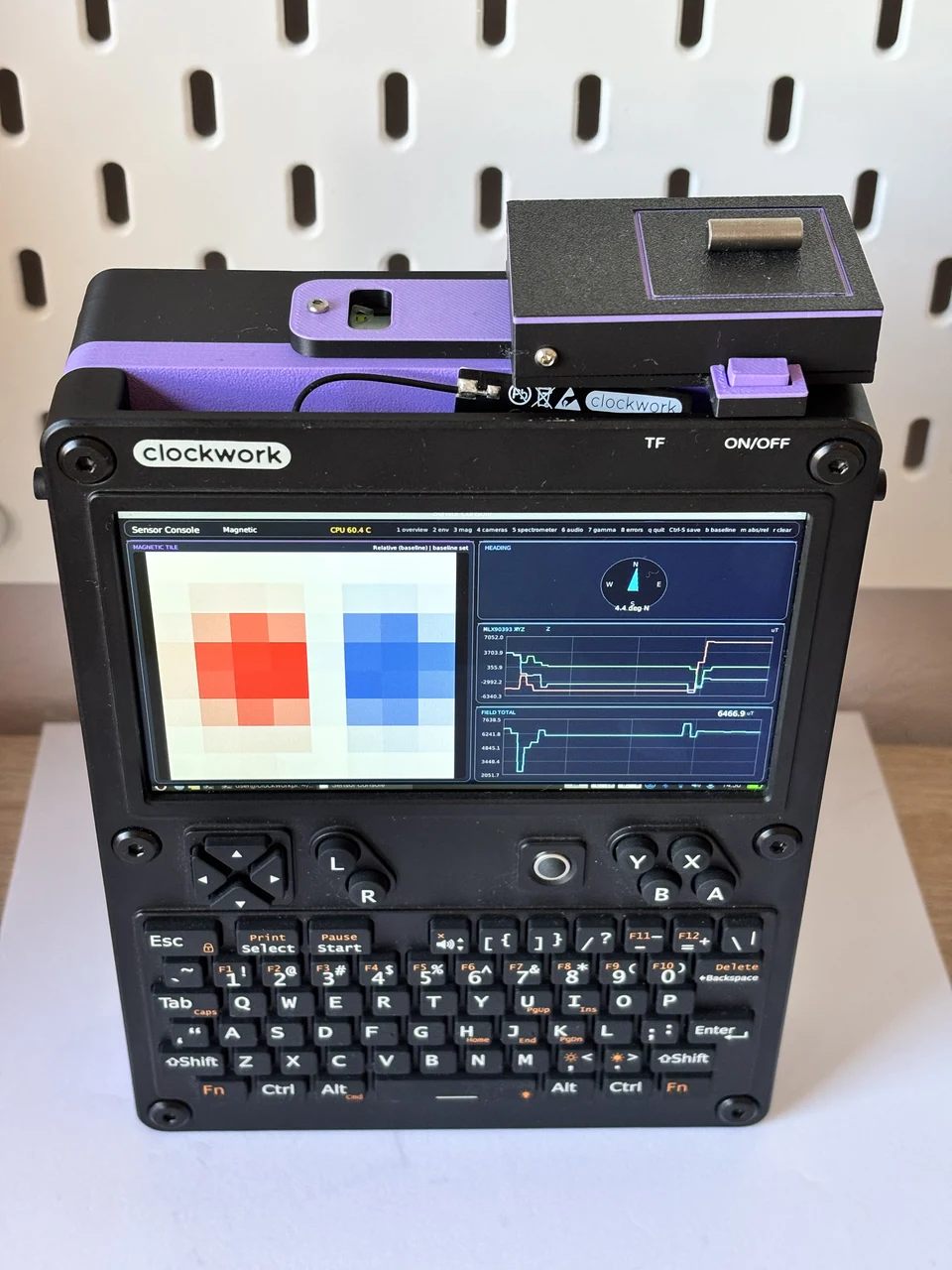
Image credit
Tricorder magnetic imaging tile in use
Peter Jansen / The Tricorder Project · CC BY 4.0Resized and encoded as WebP; no semantic alteration.
Actual documented magnetic-imaging output, not a 20 kHz capture.
A Sensor Collection With Real Integration Work
The other instruments include an 80-by-62 thermal imager, a conventional 12-megapixel camera, a scintillation-based radiation spectrometer, and environmental sensing for carbon dioxide, volatile organic compounds, particles, temperature, pressure and humidity. A radiation spectrum concerns detected energy levels; it is not a blanket promise of material identification or a replacement for a certified safety instrument.
Custom boards handle the microspectrometer, ESP32 connections and a compact USB hub. Published OpenSCAD files define the enclosure and backplate. These are the less cinematic parts of a tricorder build, but they explain why fitting several commercially available sensors into one object becomes a substantial engineering project.
Power, heat, space and connectors all compete. Jansen reports perhaps an hour or two of battery operation and identifies thermal throttling as a problem needing a better cooling solution. Neither figure should be treated as a standardized runtime or thermal benchmark; they are the creator's observations about his prototype.
The connector warning is especially practical. The design uses the same connector style for some 5-volt USB connections and 3.3-volt Qwiic connections. Jansen explicitly calls this a poor choice because a mistaken connection could damage a part. The errata also describe a swapped silkscreen label on an earlier board. Someone reproducing the build needs the current files and corrections, not just a photograph of the first working assembly.
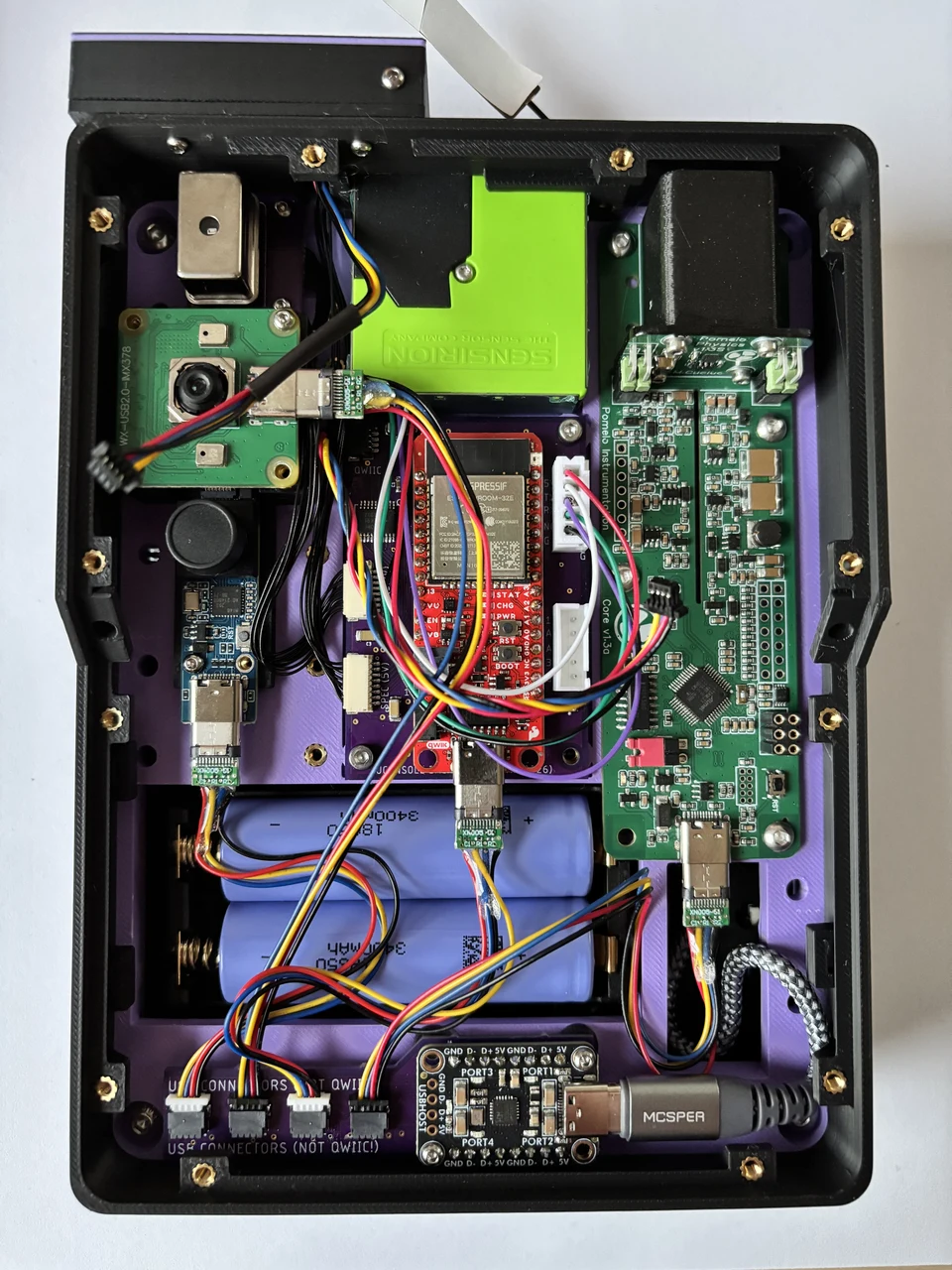
Image credit
Tricorder main body with sensor boards installed
Peter Jansen / The Tricorder Project · CC BY 4.0Resized and encoded as WebP; no semantic alteration.
The creator's internal-construction photograph. Read the current errata before attempting reproduction.
Open Documentation Does Not Mean an Easy Kit
Jansen estimates roughly $300 to $400 for the uConsole, compute module and related boards, plus around $1,000 for sensors and associated components. These are his approximate costs, not a current shopping quote. The visible microspectrometer and radiation spectrometer account for much of the expense.
He also describes the project as a prototype rather than a product and warns that reproducing it may be difficult. That is consistent with the integration work visible in the internal photographs: custom boards, a densely occupied printed body and several different interfaces. It is a project to study before treating it as a weekend parts order.
The non-code physical designs and documentation have an explicit CC BY 4.0 license. The software discussion is separate. Jansen says the firmware is primarily human-written and the Python interface mostly AI-generated, and offers his own view of the latter's copyright status. That is not a conventional, comprehensive software-license declaration for every dependency in the build.
The reason to follow this project is its unusually inspectable combination of ambition and limits. It turns the fantasy of carrying a small instrument lab into specific boards, measurements and unresolved jobs. Which single instrument would earn a place in your own handheld? Tell us in the comments below.
Comments
Member comments are temporarily unavailable.
Log in to join the discussion.