
A New CRISPR Check Connects Unwanted Edits to Their Effects in Cells
Published November 17, 2026
Concept illustration of CRISPR-Cas9 DNA editing, not a microscope image or a Superb-seq experiment.
Superb-seq links actual DNA edits with single-cell gene activity. The method improves what researchers can inspect; it does not certify CRISPR safety.
A CRISPR guide is an instruction. It is not a receipt showing exactly what happened to a cell's DNA.
Superb-seq is designed to close that gap. Researchers at the Salk Institute have developed a method that connects detected genome edits with gene activity in individual cells. Their November 16 announcement describes a research tool for investigating both intended changes and unintended ones, rather than assuming that delivering a guide produced the desired result.
The Nature Methods paper appeared on November 16, 2026. The work itself is older: the bioRxiv version record dates its first preprint to February 8, 2025, followed by revisions. The news is the peer-reviewed publication, not a claim that the underlying method first became public this week.
Instructions, Edits And Effects Are Different Things
In CRISPR-Cas9 editing, a guide RNA directs a DNA-cutting enzyme towards a chosen sequence. As the National Human Genome Research Institute explains, researchers can use the system to make changes including deletions or insertions. It is a way to alter DNA, not simply a label attached to an otherwise untouched cell.
That leaves three questions worth keeping separate:
- Which editing instruction reached the cell?
- Which DNA sites were actually edited?
- How did that cell's gene activity differ?
An experiment answering the first and third questions can still be ambiguous about the second. If an unexpected site changed as well as the intended target, assigning the resulting gene-expression pattern to the intended edit alone could give the wrong explanation. The distinction is between knowing what was requested and measuring what occurred.
A clean delivery record cannot resolve that ambiguity. It documents one stage of the experiment; the evidence needed to interpret the biological outcome belongs to a different stage.
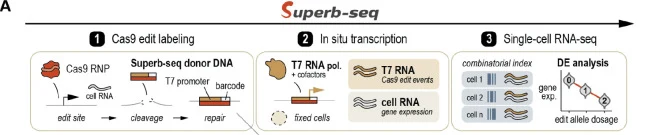
Image credit
Superb-seq three-stage method, preprint Figure 1A
Michael H. Lorenzini, Brad Balderson, Karthyayani Sajeev, Aaron J. Ho and Graham McVicker; bioRxiv preprint v2 (August 28, 2025), Figure 1A; CC BY 4.0; cropped. · CC BY 4.0Keep complete panel A, its panel letter, title, arrow, three numbered stages and all boxes. Exclude panels B-F. Native pixel crop to PNG; no resizing, recolouring, sharpening or generative alteration.
Method diagram from the August 28, 2025 preprint, Figure 1A; cropped. Not the final journal figure.
Make The Edit Readable
The authors' archived preprint describes the central approach in three stages. During editing, a short piece of donor DNA containing a T7 promoter is inserted at DNA breaks. After the cells are fixed, T7 RNA polymerase uses those inserted promoters to produce RNA that marks edit locations. Single-cell RNA sequencing then captures those edit-reporting molecules alongside the cell's own RNA.
This is a deliberately engineered experiment. Superb-seq does not look at an arbitrary finished sample and reconstruct every edit that ever happened to it. Its readout depends on introducing the reporter and successfully recovering its signal.
The useful combination is location plus cellular context. An edit can be linked to a particular cell's expression profile instead of disappearing into an average across a mixed sample. That makes it possible to ask whether apparently similar cells actually experienced different combinations of edits.
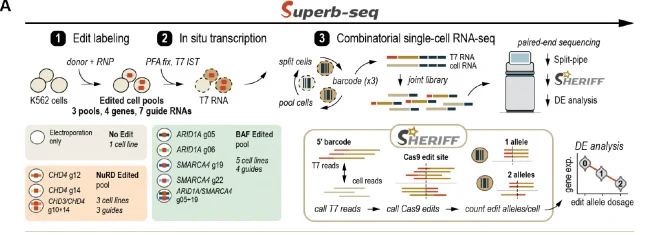
Image credit
Superb-seq and Sheriff workflow, preprint Figure 3A
Michael H. Lorenzini, Brad Balderson, Karthyayani Sajeev, Aaron J. Ho and Graham McVicker; bioRxiv preprint v2 (August 28, 2025), Figure 3A; CC BY 4.0; cropped. · CC BY 4.0Keep complete panel A with sample-pool boxes, three-stage workflow and Sheriff inset through its bottom divider. Exclude lower panels B-E, UMAPs and older result-count plot. Native pixel crop to PNG; no resizing, recolouring, sharpening or generative alteration.
August 28, 2025 preprint, Figure 3A; cropped to the method workflow, excluding superseded result panels.
The Software Has To Separate The Signals
The companion program, Sheriff, processes aligned sequencing data to identify edit sites and quantify gene expression. Its documentation specifies an annotated alignment file produced by Split-pipe, a reference genome, cell barcodes and gene annotations. This is an analysis workflow, not a single-button safety certificate.
Its documented filters are revealing. Candidate edit calls can require evidence from opposite orientations and a minimum number of cells. Other settings address misleading sequence matches and reads near inferred edit sites. Those details matter because the reporter RNA is something the experiment creates; it must not simply be counted as ordinary cellular expression.
The conceptual output has two connected parts: a record of detected edits and a record of gene activity for the same cells. Neither is useful merely because it is large. The value is being able to compare them without silently treating the editing instruction as proof of the outcome.
What The Published Experiment Found
The final paper reports experiments involving 35,000 cells from three cell lines. In a 10,000-cell K562 experiment using seven guides against four chromatin-remodelling genes, the method identified 5,761 edited cells, all intended target sites and 36 off-target sites. Those are results for these experiments, not a universal off-target rate for CRISPR.
One appealing implication is better interpretation of basic research. Salk also identifies possible uses in evaluating therapy candidates and generating better training data for models of cellular responses. Those are development directions. They should not be rewritten as demonstrated improvements in patient outcomes or a guarantee that a particular treatment is safe.
Keep A Checkable Trail
The study has a public sequencing-data trail. Its GEO SuperSeries, GSE314191, groups Superb-seq, targeted validation and bulk RNA-sequencing datasets. The archive records public availability in December 2025, another reason not to present every component as newly released in November 2026.
Versions need attention, too. The older Superb-seq dataset summary and archived preprint contain an earlier edited-cell count. The figures above use the final journal paper's count. An archive is valuable evidence, but an older number does not become current merely because its download still works.
What It Does Not Establish
The paper says the complete protocol has not yet been validated in primary cells, including important blood and liver cell types relevant to therapy. Detection depends on reporter labelling, transcription and sequencing, and other methods found edits it missed. A negative result is therefore not proof that no off-target edit occurred.
The sensible ambition is narrower than perfect editing: make experimental outcomes easier to inspect, connect them to a cellular response, and expose assumptions that a guide-only readout can hide. Better measurement can improve a decision without making the decision automatic.
Which would you want to know first: where an edit occurred, or how it changed the cell? Discuss it in the comments below.
Comments
Member comments are temporarily unavailable.
Log in to join the discussion.