
A Nuclear Clock Can Now Steer Its Own Laser. That Is the Milestone.
Published October 11, 2026
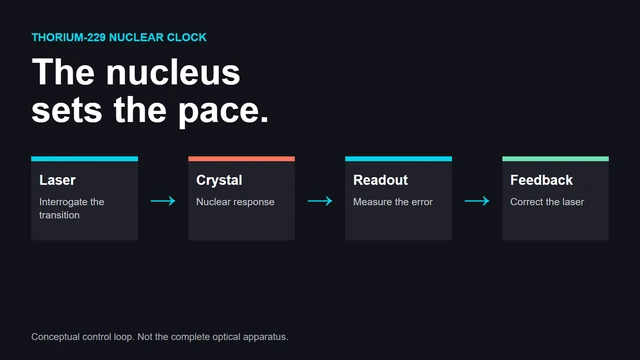
Conceptual feedback-loop illustration, not a photograph of the apparatus.
An operational thorium-229 clock closes the feedback loop around a nuclear transition. It is a new reference, not a claim to beat every atomic clock.
Measuring a promising frequency is not the same as building a clock around it. The reference has to tell the oscillator how to behave.
A Nature paper published October 7 describes a thorium-229 nuclear clock in which a continuous-wave laser is stabilized to the nuclear transition itself. The distinction is a feedback loop: the nuclei do not merely appear in a measurement made by an already stabilized laser. Their response steers the laser.
The work was discussed in earlier preprint form. The October news peg is its journal publication, not a claim that no one heard about nuclear-clock operation before this week. Nor does "nuclear clock" mean a miniature reactor or a clock ticking to random radioactive decays.
The experiment interrogates a transition between nuclear energy states. That is a different reference from the electronic transitions used by conventional atomic clocks.
A Reference Is Only Part of a Clock
Start with a simple control problem. An oscillator drifts. A reference tells you which direction it has drifted. A controller applies a correction. The resulting output is useful because it stays tied to the reference over time.
For an optical clock, the oscillator is a laser. The feedback system compares its frequency with a narrow physical transition and nudges it back toward the right value. A nuclear clock changes the transition being interrogated; it does not abolish the rest of that engineering.
In this experiment, the thorium nuclei are embedded in a room-temperature calcium fluoride crystal. The interrogating radiation is near 148 nanometers, in the vacuum-ultraviolet. The publication describes absorption measurements that supply the feedback signal.
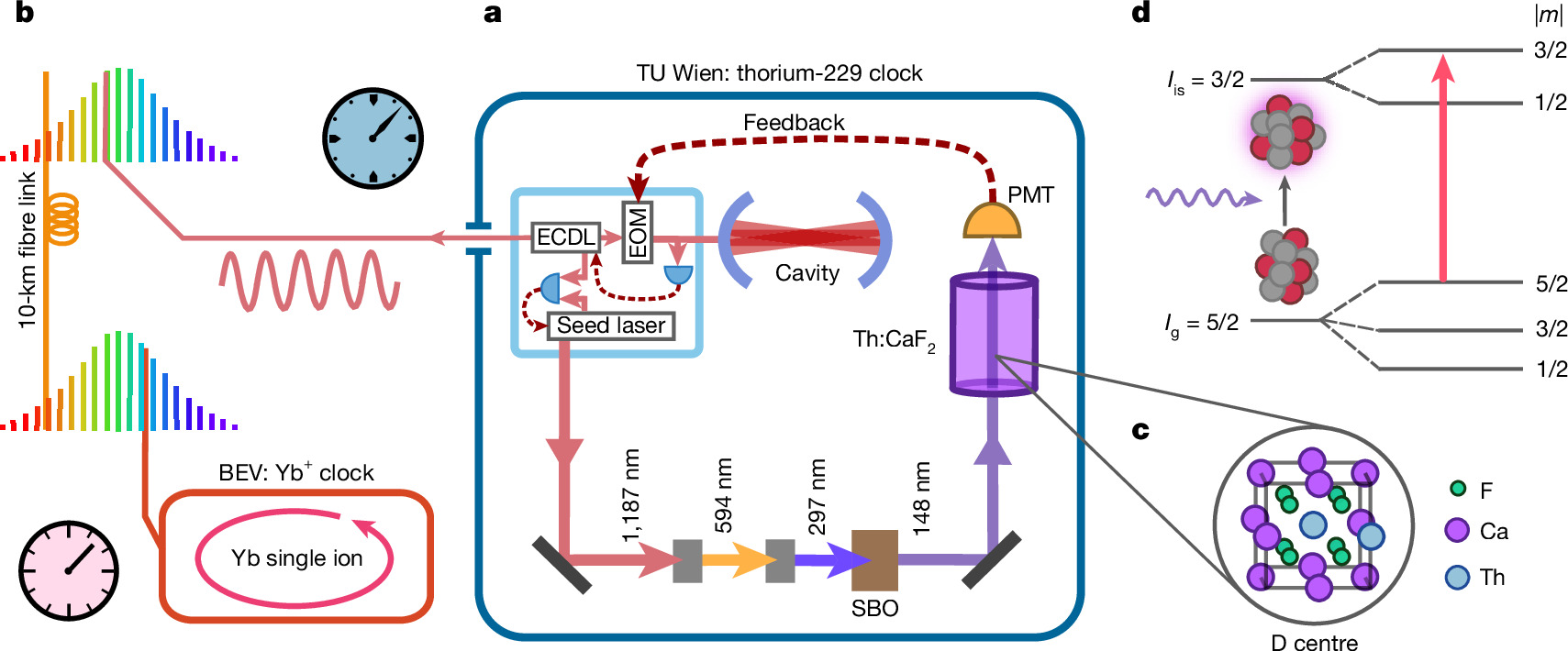
Photo credit
clock figure 1
L. Toscani De Col, T. Riebner, I. Morawetz, and colleagues · CC BY 4.0Source image downloaded without semantic alteration; responsive copies resized.
Resized for display; composition unchanged.
The figure is useful precisely because it does not resemble a consumer clock. Lasers, frequency conversion, stabilization, detection, and comparisons all have jobs to do. "The reference fits in a crystal" is not equivalent to "the entire clock fits in that crystal."
Why Thorium-229 Is Unusual
Most nuclear transitions are far beyond the energy range of ordinary optical control. Thorium-229 has an exceptionally low-energy nuclear transition that makes laser interrogation possible. Its nucleus is also interesting as a reference because its response to external disturbances differs from the response of electrons.
That creates two possible benefits. One is timekeeping. Another is using the reference to test whether the quantities governing physical interactions remain constant. Those benefits are related, but they should not be treated as the same performance claim.
The new paper reports an operating system and uses it in tests of models involving ultralight dark matter. It is not a report that dark matter has been discovered. A constraint limits what a model can plausibly do under the measured conditions; it does not establish that the proposed phenomenon exists.
For readers who make instruments, the appealing part is the combination of an unusual reference and a familiar discipline. The physics is exotic. The need to identify noise, control drift, and validate a signal is not.
Closing the Loop Changes the Experiment
An externally stabilized laser can probe a transition. In that arrangement, the external reference is still doing the work of keeping the laser on target. A nuclear-controlled loop puts the transition in charge of the correction.
That does not mean external standards become irrelevant. Comparisons are still necessary to characterize what the clock does. The reported system is continuously compared with a single-ion ytterbium clock through a subharmonic of the ultraviolet radiation.
It helps to separate operation from evaluation. One asks whether the nuclear reference can sustain a clock loop. The other asks how stable and accurate the resulting output is, and what explains its remaining variations.
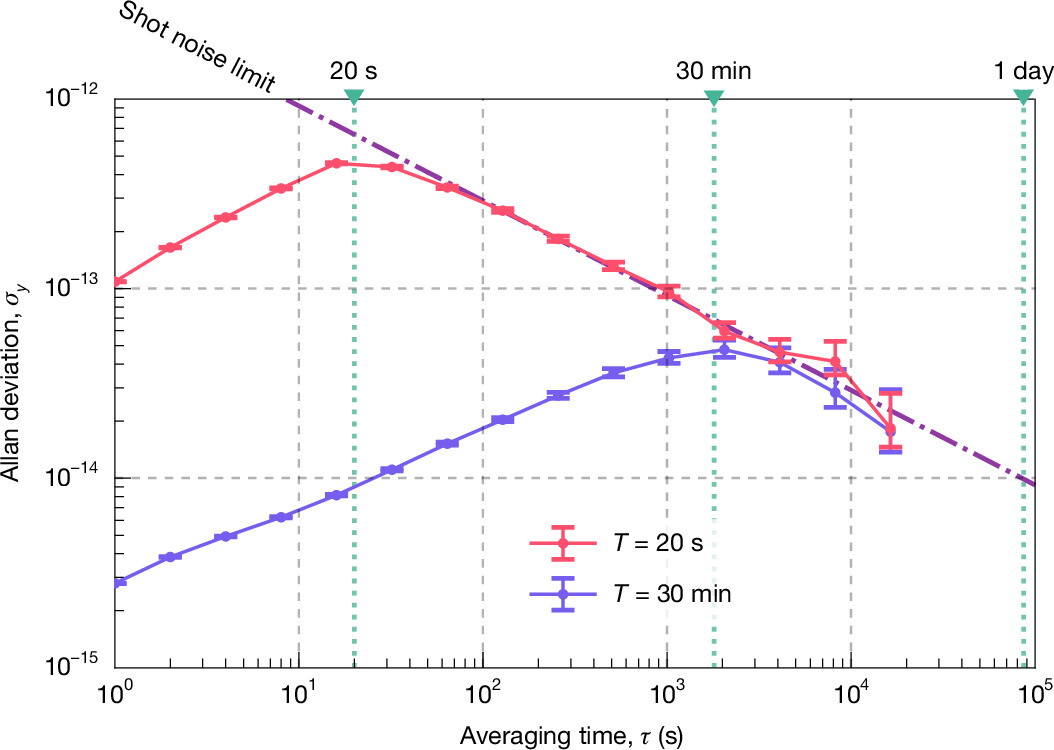
Photo credit
clock figure 2
L. Toscani De Col, T. Riebner, I. Morawetz, and colleagues · CC BY 4.0Source image downloaded without semantic alteration; responsive copies resized.
Resized for display; composition unchanged.
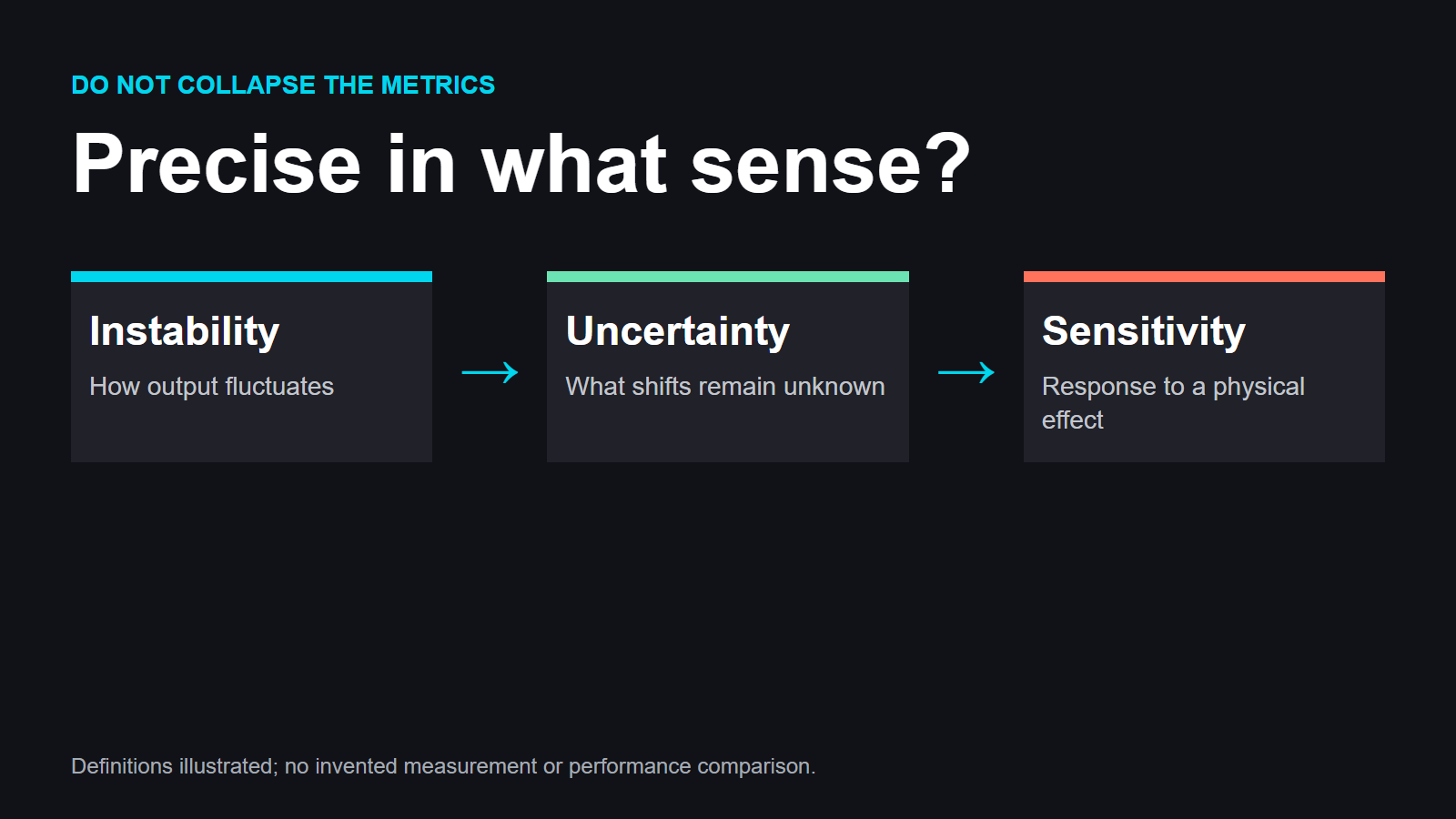
If an experimental clock is described only as "more precise," ask which metric is meant. Short-term instability, long-term behavior, systematic uncertainty, and sensitivity to a particular physical effect are different measures. A result can improve one while leaving others unresolved.
Better Than Atomic Clocks? Not That Simple
The paper reports fractional frequency instability approaching the 10^-15 range over a day of operation and projects substantial improvement in future devices. The projection is not achieved performance.
The strongest existing optical atomic clocks are demanding comparison targets. The significance here is not a blanket declaration that a new clock has surpassed them. It is an operational architecture with a different physical reference and a path toward further development.
That is already a substantial result. A technology can deserve attention before winning every benchmark. For a new measurement system, demonstrating a functioning feedback loop often turns a conceptual advantage into something that can be improved experimentally.
The useful follow-up questions concern noise sources, control bandwidth, repeatability between devices, and systematic shifts. A stable output from one apparatus is not automatically a reproducible frequency standard across independently built apparatuses.
The Crystal Does Not Eliminate the Environment
Embedding nuclei in a solid creates a practical route to many interrogated nuclei at once. It also gives the surrounding material a role in the measurement. Temperature, crystal properties, and optical behavior still require careful characterization.
The fact that a nuclear transition may couple less strongly to some external perturbations should not be expanded into "immune to the environment." Every physical instrument has a measurement path. The laser and the detector can introduce limitations even when the underlying reference is unusually attractive.
This is where precision engineering becomes more interesting than the name. A clean result depends on the whole system, including elements that do not sound nuclear at all.
A Different Kind of Probe
A clock can be a scientific sensor because a changing reference frequency would carry information about the physics behind it. Two different clocks need not respond identically to the same hypothetical change in a fundamental interaction.
Comparing references therefore creates a way to look for patterns that a single clock could not identify by itself. The researchers use the thorium transition's sensitivity to test particular dark-matter couplings. Their exclusion results belong to the models and timescales they evaluated, not to every possible form of dark matter.
That is a more useful story than "a clock that will make your phone more accurate." The immediate value is a laboratory instrument and an experimental capability. Everyday applications require additional engineering and a reason to use this reference rather than another one.
For Meteor Makers, the result is a reminder that a major invention sometimes arrives as a new feedback relationship. The object at the center is small. The architecture around it is what lets it become a tool.
Which part would you want explained in a follow-up: ultraviolet generation, the feedback signal, or what comparing two clocks can reveal? Tell us in the comments below.
Source: Toscani De Col, Riebner, Morawetz, and colleagues, Nature, published October 7, 2026. Research figures are reused under CC BY 4.0 with source and license available in their credit details.
Comments
Member comments are temporarily unavailable.
Log in to join the discussion.