
Webb Found the Tiny Galaxy Behind an Enormously Distant Radio Flash
Published October 11, 2026
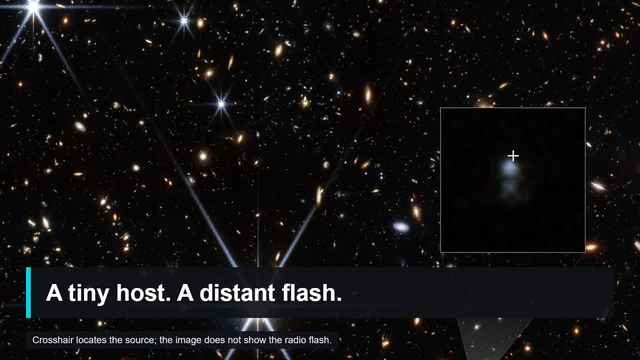
The cross marks the burst's location in the host image; this is not a photograph of the radio flash.
Photo credit
frb hero.png
NASA, ESA, CSA, STScI, Themiya Nanayakkara (USYD); image processing: Joseph DePasquale (STScI) · STScI/NASA informational-use policySource photograph cropped for a 16:9 layout, editorial headline added; image itself not regenerated. Crosshair locates the source; the image does not show the radio flash.
Resized for display; composition unchanged.
The host of FRB 20240304B is a small, star-forming galaxy at redshift 2.148. Its age helps test what could have made the burst.
The flash was brief. Finding the place it came from took a different kind of telescope.
NASA's October 8 account describes Webb observations of the galaxy hosting FRB 20240304B, reported as the most distant known fast radio burst. NIRCam detected the host; NIRSpec measured a redshift of 2.148. That places the event at an epoch when the universe was about three billion years old. The host is a small dwarf galaxy actively forming stars, not the large galaxy the team expected. NASA's report.
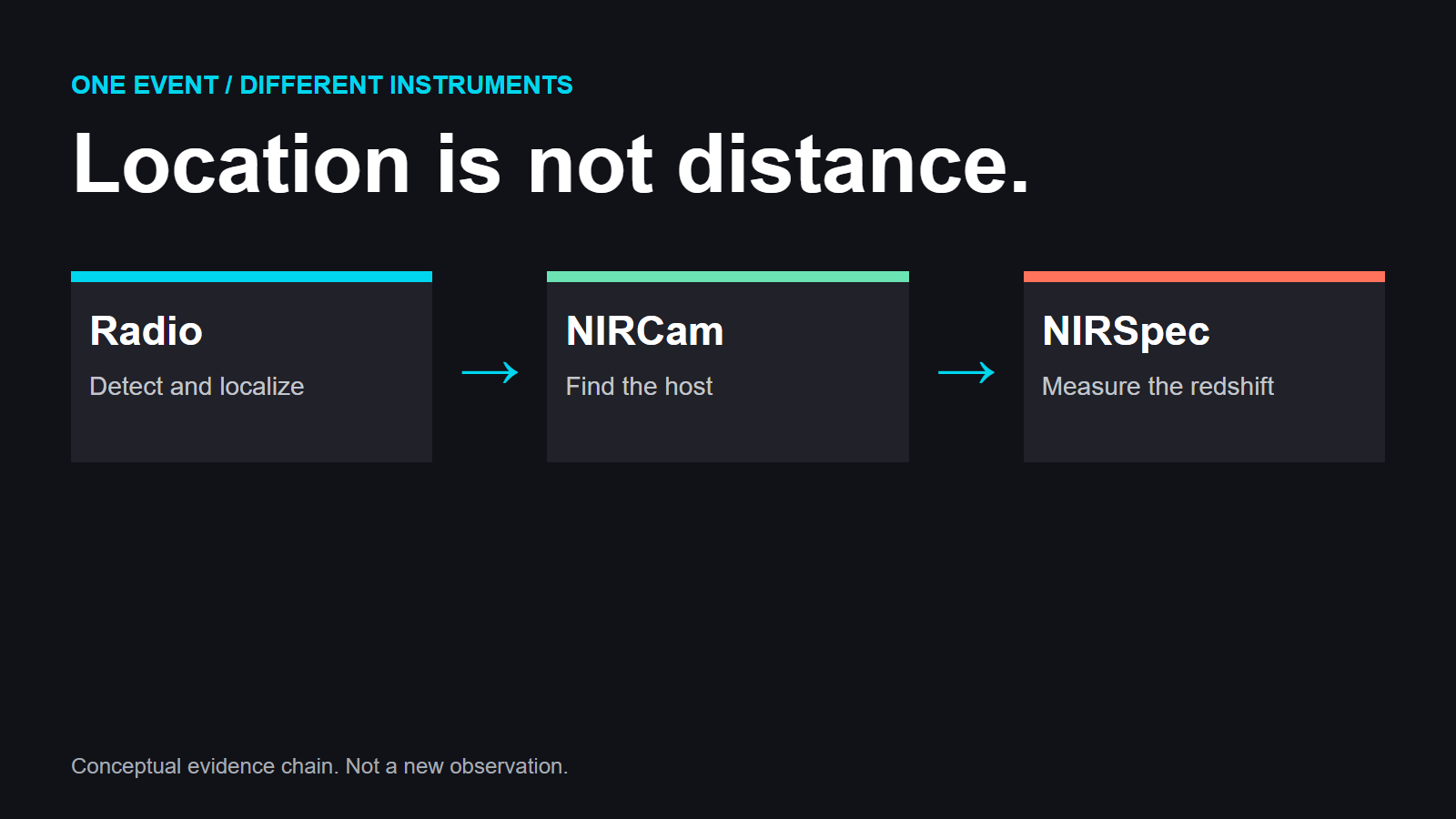
The finding is not that Webb photographed a radio flash in visible colors. Radio observations identified and localized the burst. Webb supplied information about the much fainter galaxy associated with it.
That division of labor is the real story: a momentary signal becomes more interpretable when another instrument can inspect its surroundings.
A Crosshair Is a Location, Not the Event
The released image marks the source location. Without that marker, the host can disappear among the field's many faint galaxies. The enlargement is not cosmetic. It helps a reader see the actual object being discussed.
Still, a location alone is not a distance. An image can show a galaxy on the sky without telling us which epoch of cosmic history it belongs to. Spectroscopy adds a different kind of evidence by separating the light into wavelengths and identifying shifted features.
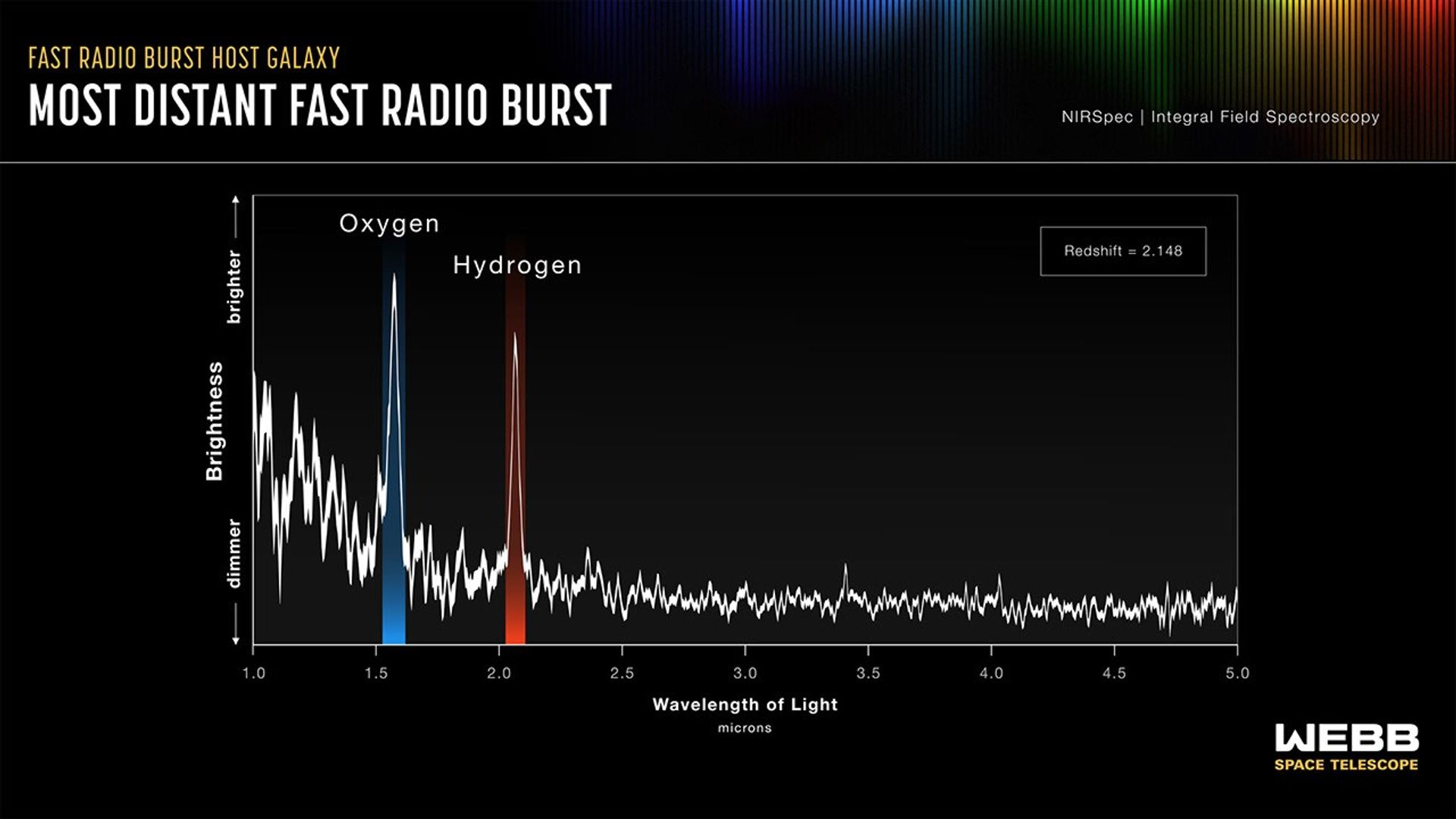
Photo credit
frb spectrum
NASA, ESA, CSA, Joseph Olmsted (STScI); science: Manisha Caleb (SIfA) · STScI/NASA informational-use policySource image downloaded without semantic alteration; responsive copies resized.
Resized for display; composition unchanged.
That is why the photograph and the spectrum make a good pair. One answers "where is it?" The other helps answer "how far back are we looking?" Neither replaces the radio detection.
What Does the Galaxy's Age Change?
A young, star-forming host supplies context for proposed explanations. NASA describes the result as favoring a rapidly available source, such as a young magnetar, over a slow route involving a pair of neutron stars merging after a long inspiral.
That is a constraint, not a close-up identification of the exact object. The host's properties help compare formation histories. They do not mean a camera saw the proposed magnetar making the burst.
This is a useful distinction across astronomy. An environment can make one explanation more plausible than another while leaving questions about the individual source unresolved. A strong inference does not need to become an absolute claim to be interesting.
Distance Is Also a Path Through Matter
A radio pulse crosses material between its source and Earth. Its travel can carry information about that intervening material. NASA reports that this signal also provided evidence involving structures along its path, including the nearby Virgo Cluster.
The attractive analogy is a probe sent through the universe. But it is not a spacecraft visiting the intervening structures. The information is encoded in what propagation does to the signal, and interpreting it requires a model of that journey.
For makers, this is familiar in smaller instruments. A sensor reading is a combination of the source, the path, and the measurement system. If you know enough about some of those elements, you can use the signal to investigate the others. If you collapse them together, it becomes easier to mistake an effect along the path for a property of the source.
Why the Small Host Is Worth the Attention
The beautiful Webb images are often large, bright structures. Here the important object is faint and relatively unassuming. It matters because it completes an evidence chain around an exceptional transient.
That is a different sort of visual payoff. The headline points to a radio event; the picture points to a host; the spectrum points to an epoch. Together they make a fleeting observation part of a physical story.
The record-holder language should stay dated to this report. New instruments and new detections can change the farthest-known example. The durable question is what a distant burst can tell us about its origin and the material between galaxies.
Would you like a follow-up on reading a redshift spectrum, or on how a radio burst helps trace intervening matter? Tell us in the comments below.
Comments
Member comments are temporarily unavailable.
Log in to join the discussion.