
Scientists Read Whale Genomes From Drone-Collected Snot
Published November 17, 2026
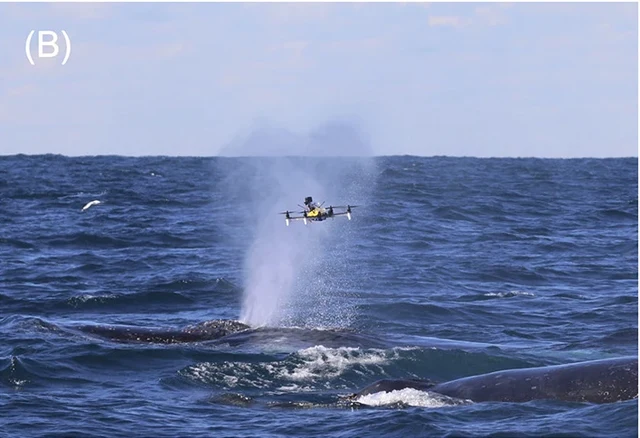
Archival method photograph, Sydney, 2017; a different aircraft and campaign from the 2026 study.
Image credit
An archival research drone crosses a humpback whale's plume above the sea.
Pirotta, Smith, Ostrowski, Russell, Jonsen, Grech and Harcourt · CC BY 4.0Exact integer source-pixel crop; RGB output; lossless PNG. 320px preview uses Lanczos downsampling. No upscaling, compositing, enhancement, invented content or generative editing.
Drones collected 58 breath samples from 26 humpbacks. Genome comparisons test whether whale blow can provide dependable DNA without taking skin.
A whale does not need to lose a piece of skin to provide useful genetic information. Its breath can carry enough of its own DNA to support genome-wide analysis. The difficult part is showing that the material collected above a moving animal really produces dependable measurements.
A study in Molecular Ecology Resources reports that demonstration using 58 blow samples from 26 Northeast Pacific humpback whales. DNA collected by drone produced low-coverage nuclear genomes and much more deeply sequenced mitochondrial genomes, with comparisons against repeat collections and tissue samples to check reliability.
The journal publication is dated November 17, 2026. The results were already public in a preprint posted March 10. This is the journal-publication update to that work, not a discovery first disclosed today.
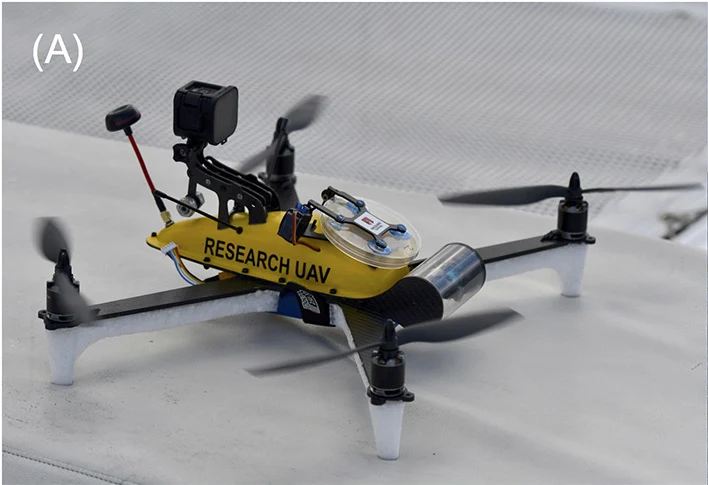
Image credit
An archival yellow research drone with a sampling dish, four propellers and white flotation supports.
Pirotta, Smith, Ostrowski, Russell, Jonsen, Grech and Harcourt · CC BY 4.0Exact integer source-pixel crop; RGB output; lossless PNG. 320px preview uses Lanczos downsampling. No upscaling, compositing, enhancement, invented content or generative editing.
Earlier custom sampling aircraft, Pirotta et al., 2017. Not the 2026 commercially available drone.
1. Put the Collector Where the Sample Is
The collection equipment was straightforward: sterile petri dishes attached to a commercially available drone. Researchers flew through one whale's exhalations, typically collecting from one to six breaths during a surfacing. More than a third of the samples were collected using flights launched from land, according to the University of St Andrews account.
That changes the sampling problem. Instead of obtaining a tissue biopsy, the team intercepted material the animal expelled naturally. It still required identifying the target and positioning equipment near it. A less intrusive collection method is not the same as research without operating constraints.
The work took place in Gitga'at First Nation territory in northern British Columbia, under research agreements and a Canadian fisheries research permit, with university animal-welfare approval. Researchers did not sample resting whales and stopped flights when an animal reacted. Those safeguards are part of the method, not an optional addition for people wishing to imitate it.
2. Check Whose DNA Arrived
The whale supplied an average of 84% of the DNA in the blow samples. That is a sample average, not a promise that any dish flown through a spout will contain the same proportion.
More importantly, the researchers compared repeat blow samples and paired tissue samples from a subset of the whales. Those comparisons supported the reliability of the blow-derived genomes. A striking collection technique would be less useful if it could not return consistent information about the same animal. The published abstract makes these checks central to the result.
There are also two different sample counts to keep straight. Fifty-eight collections do not mean 58 different whales. Repeat collections are useful evidence precisely because some came from animals sampled more than once.
3. Keep the Coverage Qualification
The nuclear genomes averaged 2.3-fold sequencing coverage, ranging from 0.2-fold to 3.5-fold. Mitochondrial coverage averaged 94-fold. The authors explicitly describe the former as low coverage and the latter as high coverage.
Genome-wide information and a completely resolved genome are different claims. The reported result is useful for population-genetic analysis; it should not be retold as a flawless, gap-free reconstruction of every whale's chromosomes. The qualification does not make the result disappointing. It identifies what kind of measurement the collection technique actually delivered.
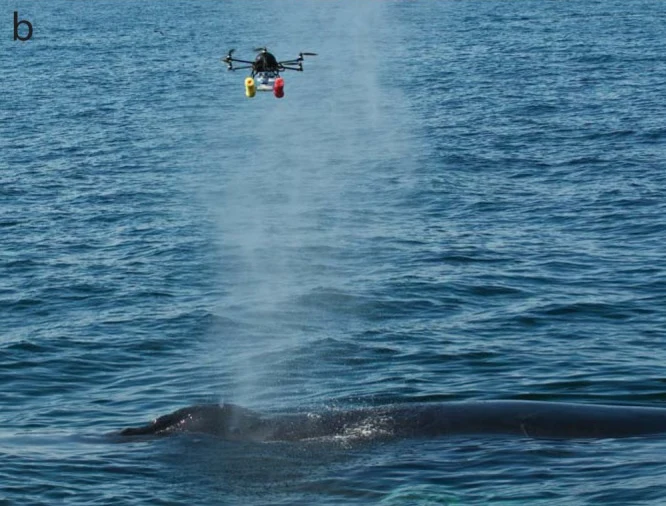
Image credit
A hexacopter hovers beside a plume from a humpback whale during earlier sampling research.
Apprill, Miller, Moore, Durban, Fearnbach and Barrett-Lennard · CC BY 4.0Exact integer source-pixel crop; RGB output; lossless PNG. 320px preview uses Lanczos downsampling. No upscaling, compositing, enhancement, invented content or generative editing.
Archival microbiome-sampling context, Apprill et al., 2017; not the new genome campaign.
A Better Sample, Not the First Whale Breath Study
Drone collection itself has a longer history. A 2017 Australian study used a custom-built aircraft and a remotely closing dish to investigate microbes in humpback blow. Its photographs and collection demonstration show an earlier method, not this British Columbia campaign.
An O'Mahony-led paper first published in April 2024 also examined drone-collected blow, analysing 88 samples with microsatellite markers, sex identification and mitochondrial haplotypes. That is not interchangeable with the newer 58-sample whole-genome result. These reports establish methodological progress, not proof that their sample sets were identical or entirely separate.
The latest study's authors caution that other species will present different challenges, including body size, elusiveness and time at the surface. A successful humpback method is not automatically a validated method for every whale.
The useful advance is specific: a non-contact source of DNA can support repeatable genome-wide measurements in the studied animals. Conservation research gains another way to obtain information without treating every biological question as a reason to collect tissue.
What would you most want researchers to learn from repeat breath sampling? Share your thoughts in the comments below.
Comments
Member comments are temporarily unavailable.
Log in to join the discussion.