
A Dead Star's Eight-Minute Radio Pulse Reveals Its Sun-Like Companion
Published November 13, 2026
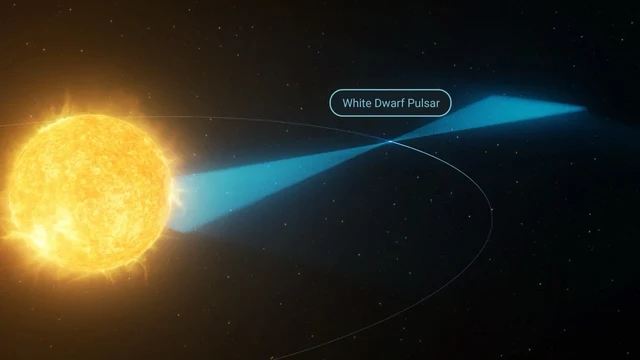
N. Hurley-Walker / ICRAR: explanatory illustration, not a resolved photograph of the binary.
Image credit
Explanatory illustration of the white-dwarf binary
N. Hurley-Walker / ICRAR · ICRAR factual editorial useResized and encoded as WebP; no semantic alteration.
Astronomers traced a long-period radio transient to a white-dwarf binary and used its signal to investigate stellar weather more than 5,000 light-years away.
For years, astronomers have been finding radio sources that behave like a cosmic blinking light: detectable, then quiet, then detectable again on a schedule of minutes or hours. The intervals are much slower than the familiar picture of a rapidly spinning neutron-star pulsar.
Now one of those sources has provided an unusually revealing clue. Researchers linked its pulses to a white dwarf orbiting a star similar to our Sun, and followed the timing closely enough to locate the emission near the white dwarf as it moved around its companion.
The system, GPM J071507-114153, is described in a November 12 release from the International Centre for Radio Astronomy Research. The study appeared in Nature Astronomy. It is the first reported detection of this kind of radio pulsation from a white dwarf paired with a Sun-like star, rather than the smaller, cooler red-dwarf companions found in related systems.
Two Clocks in One System
A white dwarf is a compact stellar remnant: the dense core left after a star's earlier life. It is not a neutron star, although both kinds of remnant can produce striking astronomical behavior.
In this system, the white dwarf spins about once every 7.9 minutes, while the two stars complete an orbit in roughly 1.3 days. Those are different clocks. The shorter interval is associated with the repeated radio pulses; the longer describes the pair's motion around their common center of mass.
The system belongs to the broader family called long-period transients. Around a dozen had been detected since the first discovery in 2021, according to ICRAR. Finding a repeating source is only a beginning, because a radio signal alone does not necessarily identify which object in a close pair is producing it.
That is what makes the timing result valuable. As the source moves around its orbit, the path its signal takes to reach Earth changes. The pulse pattern was clear enough for the researchers to trace that motion and associate the emitting region with the vicinity of the white dwarf.
The distinction remains deliberate: near the white dwarf, possibly on the white dwarf itself. The observation is not a detailed photograph of the radio-emitting machinery or a complete explanation of the emission mechanism.
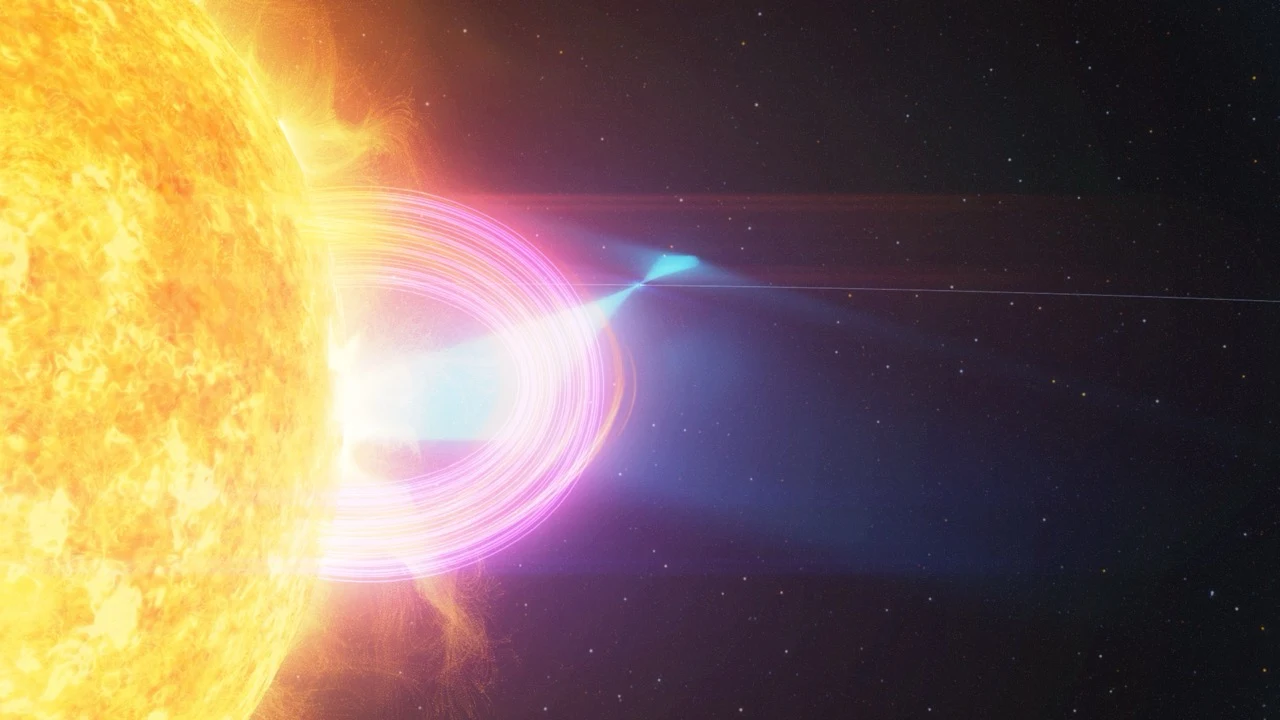
Image credit
Explanatory illustration of the white-dwarf binary
N. Hurley-Walker / ICRAR · ICRAR factual editorial useResized and encoded as WebP; no semantic alteration.
N. Hurley-Walker / ICRAR: explanatory artwork showing how plasma can affect the signal.
The Companion Becomes Part of the Experiment
The radio beam does more than announce the spinning remnant's presence. Passing through the environment of the companion star, it also encounters plasma and magnetic structures.
The team reports evidence of stellar flares and a strong magnetic region consistent with a prominence, a large loop of plasma associated with the star. Changes to the signal therefore provide clues about an environment more than 5,000 light-years away.
That is a particularly satisfying astronomical trick. A source that initially presents as a mystery can become a probe of something else. Once its timing is understood, interruptions and alterations to the signal stop being mere complications and become measurements of the material along its route.
The accompanying illustrations make this geometry easier to picture: a small remnant, a much larger companion and radio beams interacting with the companion's surroundings. They are explanatory artwork, not resolved optical photographs of the two stellar surfaces.
A Discovery Built Across Telescopes
The system was first detected in a survey with the Murchison Widefield Array in Western Australia. MeerKAT in South Africa helped determine its precise position. Optical observations with the W. M. Keck Observatory then confirmed its association with a G-type star.
The analysis involved more than 100 hours of radio data processed at the Pawsey Supercomputing Research Centre. Those details matter because the result is not based on recognizing a suggestive shape in one image. It combines repeated radio observations, localization and an optical counterpart.
It also shows why different instruments complement one another. A wide-field survey can find unusual behavior across large areas of sky. Follow-up observations narrow the location and identify the kind of object associated with it. Detailed timing can then test where the radiation originates.
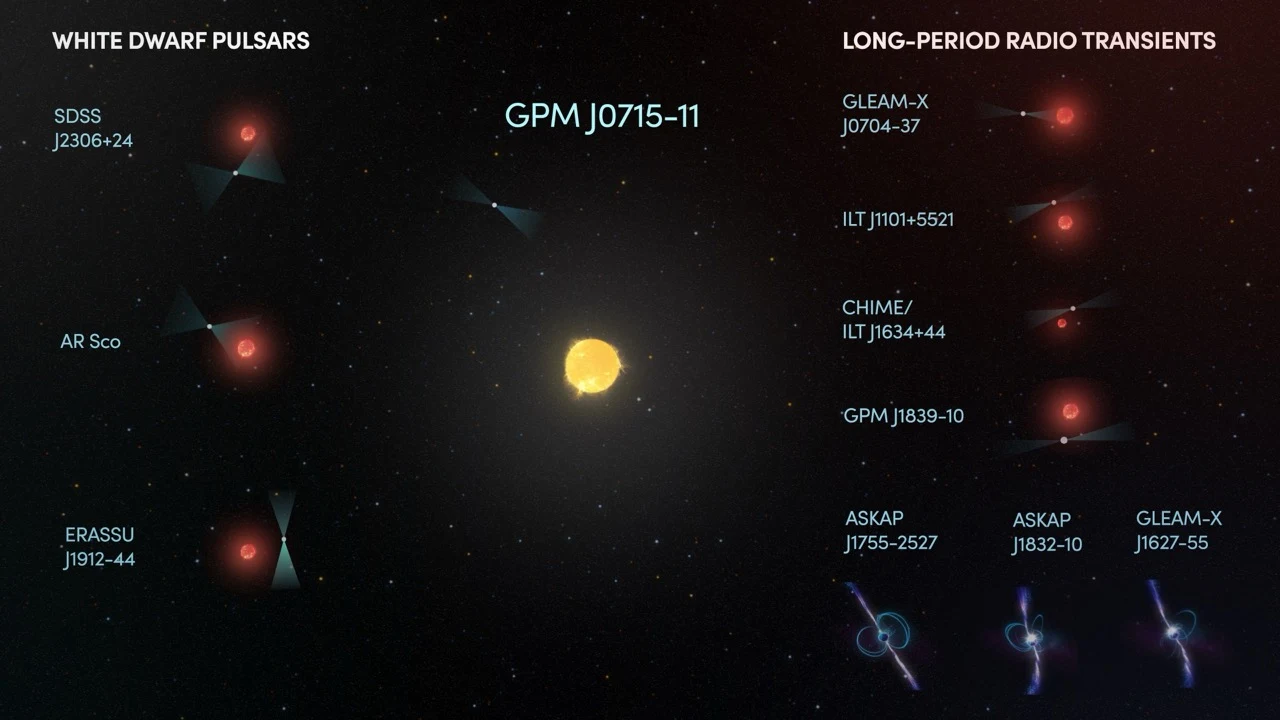
Image credit
Explanatory illustration of the white-dwarf binary
N. Hurley-Walker / ICRAR · ICRAR factual editorial useResized and encoded as WebP; no semantic alteration.
N. Hurley-Walker / ICRAR: comparative explanatory diagram, not an image of the night sky.
A Better Answer, Not the End of the Mystery
The finding helps connect long-period transients with known white-dwarf pulsar systems. It does not establish that every slowly repeating radio source has the same cause.
That is a more interesting outcome than declaring the entire category solved. The growing sample may contain related systems with different companion stars, magnetic environments and emission behavior. A well-characterized example gives astronomers a way to compare those possibilities.
There is no need to invoke an artificial transmitter to make this compelling. A compact dead star and a Sun-like companion are already producing a signal that lets scientists reconstruct motion and investigate stellar weather across thousands of light-years. The natural explanation is not the disappointing ending. It is the remarkable part.
Which would you most like to see explained next: the source of the pulses or the stellar magnetic structures they reveal? Discuss it in the comments below.
Comments
Member comments are temporarily unavailable.
Log in to join the discussion.