
X-Hinges Prints Motion Sensing Into the Parts That Bend
Published October 25, 2026
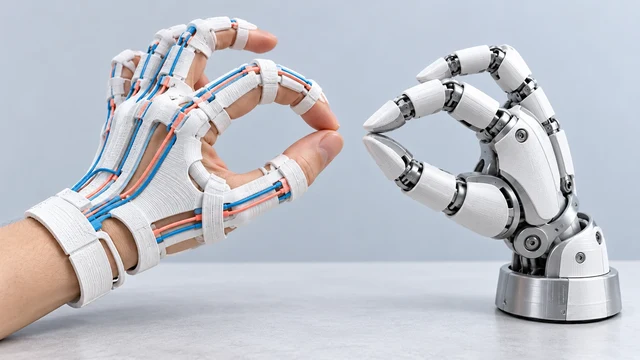
Concept illustration, not the actual X-Hinges prototype or a photograph of the researchers' demonstration. Watch their original video below.
A glove, a responsive lamp and a flexible controller show how printed conductive materials can turn moving structures into sensors. Calibration is still part of the job.
A printed glove bends a finger, and a robotic hand follows. The appealing part is not the imitation by itself. It is where the measurement comes from: flexible structures that have their sensing elements printed into them, rather than a finished glove covered with separately attached sensors.
That is the idea behind X-Hinges, developed by Xiang Chang, Haiyang Yan, Stefanie Mueller and Jiaji Li. The team combines compliant mechanisms, conductive printing materials and a motion-decoding system. Its September 10 research manuscript describes the method; MIT revisited the project in an October 22 feature.
The Hinge Is Also Part of the Sensor
A compliant mechanism moves by flexing its material. Think of a deliberately bendy region doing the job that a pin joint might otherwise perform. X-Hinges gives that flexible region another job: producing an electrical reading as it changes shape.
The important distinction is between the material doing the sensing and the material carrying the signal. If both have similar resistance, a change in the connecting path can get mixed up with the change you actually wanted to measure. The researchers instead co-print conductive materials with different electrical properties inside a flexible body.
That does not mean an entire robot, including its computer, comes out of the printer. Readout electronics and data processing still turn resistance measurements into estimates of motion. The fabrication method integrates the sensing structures; it does not abolish the rest of the sensing system.
The design supports two bending directions and axial deformation, such as compression. Separate sensing configurations help distinguish those motions. That is more useful for an expressive controller than a single switch that merely reports whether something has bent far enough.
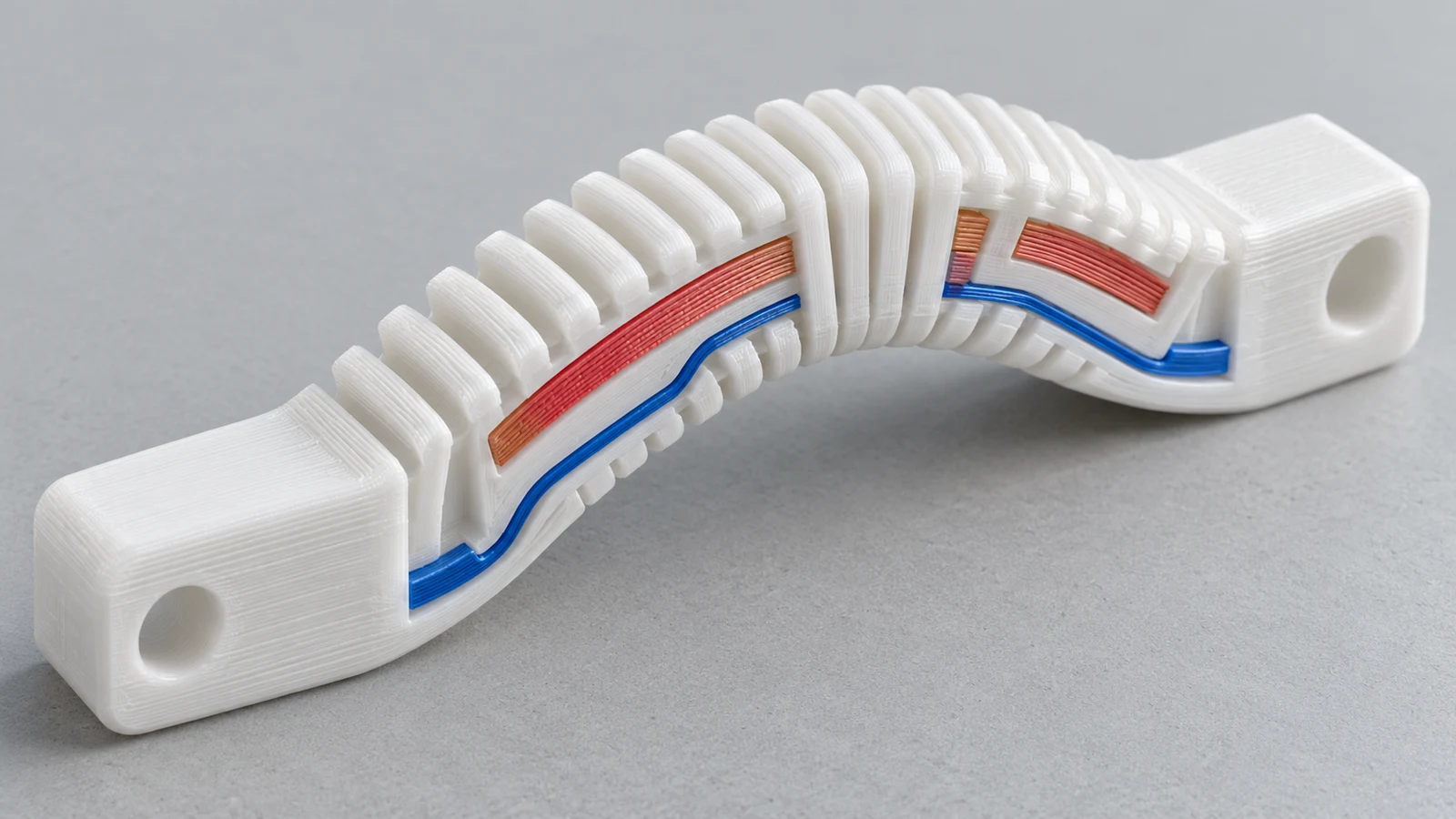
Explanatory illustration only; not the researchers' geometry, a wiring diagram or a validated fabrication cross-section.
A Lamp, a Glove and a Controller
The researchers' demonstration is worth watching because the interfaces do different things with the same basic idea. A glove relays finger movements to a robotic hand. A folded lamp responds to being pinched. A small animal-shaped controller turns movement of its flexible parts into input. A sensing surface provides tactile information about objects placed on it.
These are research demonstrations, not evidence that the surface can recognize any object or that the glove can teach any robot an arbitrary task. Their value is more concrete: they show that the printed joint can become a reusable interaction component, instead of a custom sensor installation for every object.
The accompanying design tool lets a user choose geometry, permitted motion and sensing arrangements. That changes the design question. Instead of finding somewhere to mount a sensor after the object is finished, the designer can decide where measurement belongs while deciding how the object should move.
X-Hinges: printed motion-sensing mechanisms
The researchers' actual demonstration, embedded from the upload linked by MIT. The preview is a separate concept illustration; it is not a frame from the experiment.
The Awkward Part Is Making Two Prints Agree
An identical-looking pair of printed objects need not produce identical electrical readings. Small fabrication differences affect the conductive layout, making calibration part of the actual workflow rather than a final cosmetic adjustment.
The team uses a computer-vision approach to recalibrate outputs. Its longer-term ambition is to build sensing and actuation into the same fabrication process. That remains an ambition; the present work should not be mistaken for a self-calibrating, fully autonomous printed machine.
For makers, the promising takeaway is a design direction: put sensing where deformation already happens. The practical questions remain familiar. How repeatable is the print? How does its response drift? What calibration must travel with the object when someone else builds it?
Would you use a self-sensing joint for a controller, a tool or a wearable? Bring your ideas to the comments below.
Comments
Member comments are temporarily unavailable.
Log in to join the discussion.