
Asteroid 2026 TS Is Due to Pass Earth Beyond the Moon on October 18
Published October 17, 2026
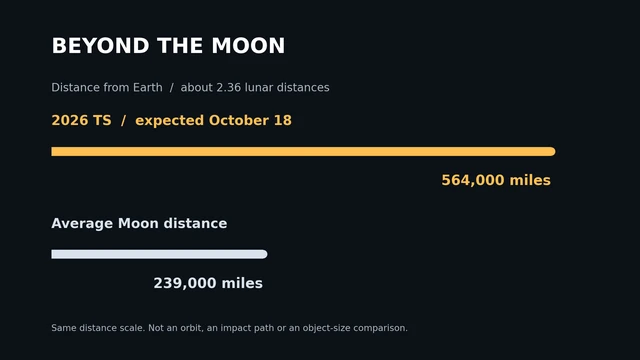
Predicted distance comparison checked October 17. This is not an orbit, an impact path or a size comparison.
JPL predicts a roughly 564,000-mile miss distance for 2026 TS. The upcoming encounter is about 2.36 average lunar distances, not an impact warning.
The next asteroid on this week's watch list is not following the same inside-the-Moon-distance story as 2026 TL6. Asteroid 2026 TS is expected to pass Earth at roughly 564,000 miles, about 2.36 times the Moon's average distance.
JPL's Close Approach Data record, checked on October 17, places the nominal encounter at 06:16 UTC on October 18. That is 2:16 a.m. Eastern Daylight Time on October 18. At this article's publication, the passage is still upcoming. JPL encounter record.
The predicted distance describes a pass, not an announced impact threat. A close-approach listing is useful observational information without being an emergency notice.
The distinction is worth preserving in a shared headline, where the table's qualifications can easily disappear.
Read the Distance Before the Adjective
The underlying JPL value is approximately 0.006062 astronomical units. Converted into everyday units, that is about 907,000 kilometers, or 564,000 miles. Rounded values in different unit systems can look slightly different without describing different encounters.
The JPL record includes minimum and maximum distance estimates alongside the nominal value. These describe the current orbital solution, which can be refined as observations accumulate. A rounded headline number is a readable summary of that solution, not a claim of unlimited precision.
For comparison, NASA's Asteroid Watch explanation gives an average Earth-Moon distance of approximately 239,000 miles. The lead chart uses the same scale for the asteroid's predicted miss distance and that lunar reference. NASA's dashboard and distance explanation.
Nothing in the chart says the asteroid, Earth and Moon line up. The Moon is a distance reference here, not a plotted location at the moment of the flyby. The bars also do not compare the bodies' physical sizes.
That is a better starting point than an illustration with an enormous asteroid looming over a tiny Earth. The latter might look dramatic while concealing almost everything that makes the actual encounter understandable.
The Diameter Is Approximate
NASA/JPL's research listing puts the approximate size at 170 feet, or about 52 meters. The supplied MPC information gives a broader estimated range of roughly 29 to 92 meters. Those should not be turned into a claim that someone measured a perfectly spherical, 52-meter object up close.
The estimate and the miss distance answer different questions. One concerns the physical body; the other concerns the geometry of the encounter. A precise-looking time beside an estimated size does not give all the numbers identical certainty.
Not a New Version of the TL6 Story
We already covered 2026 TL6's October 10 passage. That smaller object's reported miss distance was inside the Moon's average distance. TS is a different asteroid, with a different encounter and a substantially larger predicted miss distance.
Putting the two stories next to each other is useful precisely because the catchy phrase "close to Earth" does not tell you which geometry applies. Names, dates and units do the real work.
After the encounter, the meaningful update would be a confirmed passage or a revised orbital solution. This pre-encounter report should not quietly become a claim that observations from October 18 have already been collected.
For readers exploring the public records, preserve the time zone beside the timestamp and the units beside the distance. Those small details prevent much larger misunderstandings when a table becomes a headline.
What comparison makes an asteroid approach clearest to you: miles, kilometers or lunar distances? Share your preference in the comments below.
Comments
Member comments are temporarily unavailable.
Log in to join the discussion.