Nature Turned Terraforming Mars Into a Playable Science Experiment
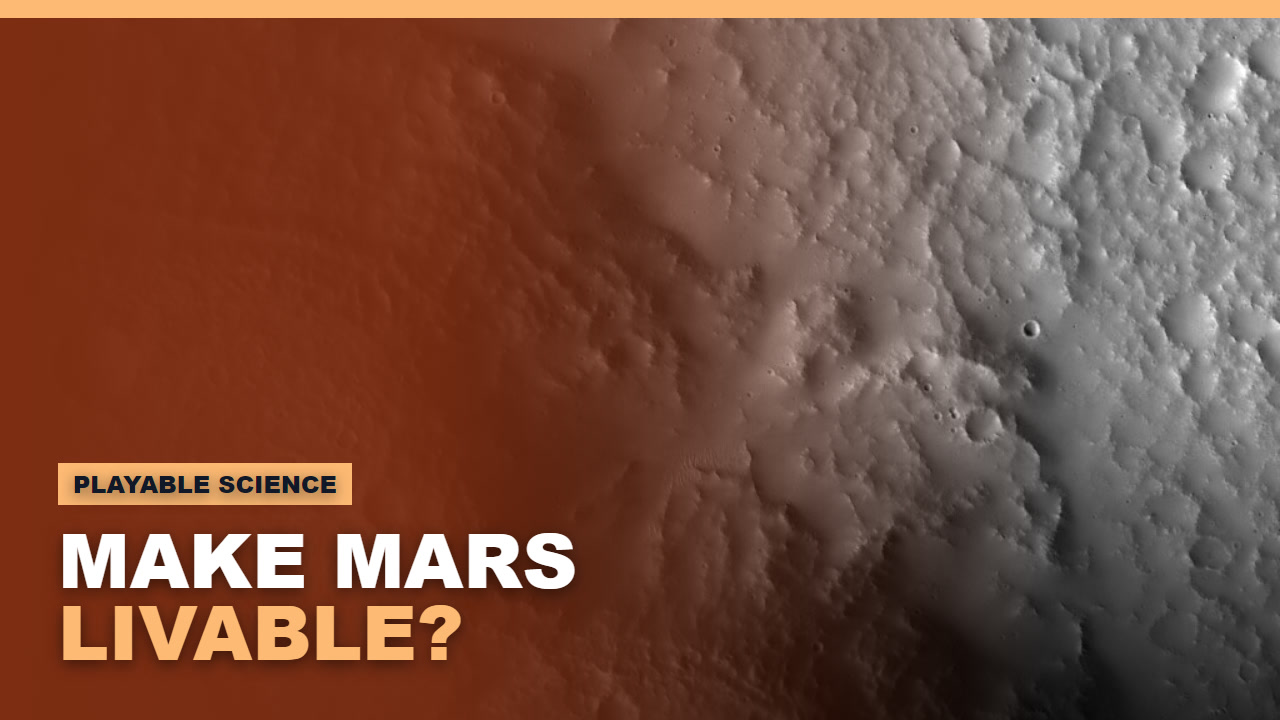
Photo credit
Nature consulted scientists to turn the planetary-scale tradeoffs of making Mars habitable into an experimental interactive adventure.
Terraforming Mars is usually presented as a promise, a warning, or a montage. Nature chose a more demanding format: a game.
Published on June 25, 2026, Can you terraform Mars? is an experimental interactive adventure developed with input from scientists. Its premise moves a planetary-scale idea out of a passive illustration and into a system the reader has to engage with.
That format is especially well suited to terraforming because the subject is made of dependencies. Changing one part of a planet affects others. A useful explanation has to show choices, limits, and consequences rather than only describing a future red world turning green.
Why this subject wants to be played
Articles are good at laying out evidence in sequence. Games are good at showing relationships that push back.
Terraforming is a chain of connected problems: atmosphere, temperature, water, radiation, energy, materials, and time. Any proposal has to operate inside physical conditions that do not care how compelling the vision sounds. An interactive system can make the audience confront that structure by turning scientific constraints into the boundaries of the experience.
This does not make a game a prediction engine. A designed experience simplifies. The important question is whether the simplification preserves the central tradeoffs instead of converting the science into a decorative theme.
Nature's decision to consult scientists is therefore part of the design, not only fact-checking added at the end. Expert input helps determine which relationships deserve to become rules, which uncertainties should remain visible, and where a player should be prevented from treating an impossible action as an easy upgrade.
Agency changes how a reader meets uncertainty
A conventional feature can say that terraforming Mars remains speculative. A game can make uncertainty something the player encounters through incomplete options and constrained outcomes.
That shift matters for science communication. When readers choose an approach, they become more attentive to what the system allows and what it withholds. A failed plan can teach a dependency more memorably than a paragraph listing obstacles, provided the game makes the reason legible.
The form also resists one of the weakest habits in future-tech coverage: treating a distant possibility as though it were an announced product. By placing the premise inside an experimental adventure, Nature can explore the idea while keeping its hypothetical status visible.
The interface is part of the argument
Illustrator Petra Péterffy created the visual work for the feature. That art has to do more than make Mars attractive. In an interactive, visuals guide attention, separate choices from outcomes, and tell the player what kind of world they are manipulating.
This is where editorial design and game design meet. A headline establishes the question. Scientific consultation establishes the boundaries. Illustration establishes the world. Interaction turns the reader from observer into participant.
No one element can carry the piece alone. A beautiful Mars with weak rules becomes spectacle. Accurate rules with an unreadable interface become homework. The experimental format succeeds only when those layers support one another.
A useful model for playable journalism
The strongest lesson is broader than Mars. Some subjects are systems before they are stories: climate, epidemics, ecosystems, infrastructure, and supply chains all involve feedback and delayed consequences.
Playable journalism can let readers explore those relationships without pretending that a small game contains a complete scientific model. The key is honesty about scope and close collaboration between researchers, editors, artists, and interaction designers.
Can you terraform Mars? begins with a famous speculative question. Its more interesting experiment is editorial: can a science publication explain a future by giving the audience meaningful agency inside it?
Comments
Member comments are temporarily unavailable.
Log in to join the discussion.