
A Sahara Meteorite Preserves a Water-Altered Piece of Ancient Mars
Published November 3, 2026
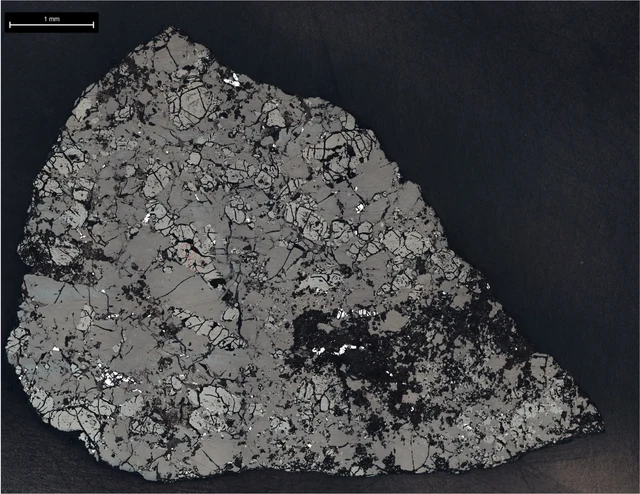
Reflected-light image of the actual Teghaza 001 specimen, PIA26801, released October 29. Courtesy NASA/JPL-Caltech.
Image credit
Reflected-light slice of Martian meteorite Teghaza 001
NASA/JPL-Caltech · NASA factual editorial useResized and encoded as WebP; no semantic alteration.
Teghaza 001 records ancient Martian crust and water alteration around 4.1 billion years ago. Its dates, mineral clues and 13 possible source regions tell different stories.
Before it became a specimen in a laboratory, Teghaza 001 was a pinkish stone found in the Sahara. Before that, it was part of Mars. Its minerals preserve a history older than most of the rocks a person is likely to pick up on Earth.
NASA's October 29 report describes a new Science study characterizing the roughly 800-gram meteorite, found in Mali in 2022. The researchers place it among the oldest Martian meteorites known. Their age-dating indicates alteration by water around 4.1 billion years ago, after the rock had already formed.
Those are different events. Finding the meteorite was a 2022 event. The current story is research into its composition and chronology, not a newly observed fall or a fresh discovery of a rock on Mars.
A Record Written in Several Minerals
The value is not simply that the rock is old. A sample containing several kinds of minerals can preserve relationships between them: material that formed from cooling magma, textures left by later changes, and evidence that different processes acted at different times.
NASA describes Teghaza 001 as preserving an unusual mixture of igneous minerals from ancient Martian crust. That gives researchers something different from a sample dominated almost entirely by one mineral. The question becomes how the ingredients fit together, not just what age appears beside the specimen's name.
The NASA Photojournal reflected-light image shows how much information is packed into a thin slice. Brighter iron-titanium oxide grains, medium-gray pyroxene and darker shocked plagioclase help investigators choose places to examine with other instruments. The visible pattern is a map for further measurements, not a photograph of ancient water flowing through Mars.
There is a particularly useful warning in the image notes: the fine-grained material labeled as alteration in the annotated version formed on Earth. A rock can record both an ancient planetary history and later terrestrial weathering. Not every vein or changed patch in a photograph is evidence of the same event.
Dating Without Dissolving the Whole Story
NASA reports that the team identified zircon crystals, which can preserve chronological clues, and used an in-situ rubidium-strontium dating approach developed by Caltech researchers. The technique examined individual mineral grains on a piece smaller than a fingernail.
That small scale matters for more than convenience. With a rare planetary sample, every destructive measurement spends material that another researcher might need. An analysis that preserves much of the specimen leaves more possibilities for later instruments and different questions.
The dates also need to be read with their geological meaning intact. NASA's account says the water-related alteration occurred around 4.1 billion years ago and the original rock formed earlier. It would be misleading to collapse those into one exact date and call it both the rock's birth and the arrival of water.
A separate Science Advances paper had already addressed the meteorite's water content in June. The October characterization adds to that research history; it is not evidence that every result associated with Teghaza was first announced this week.
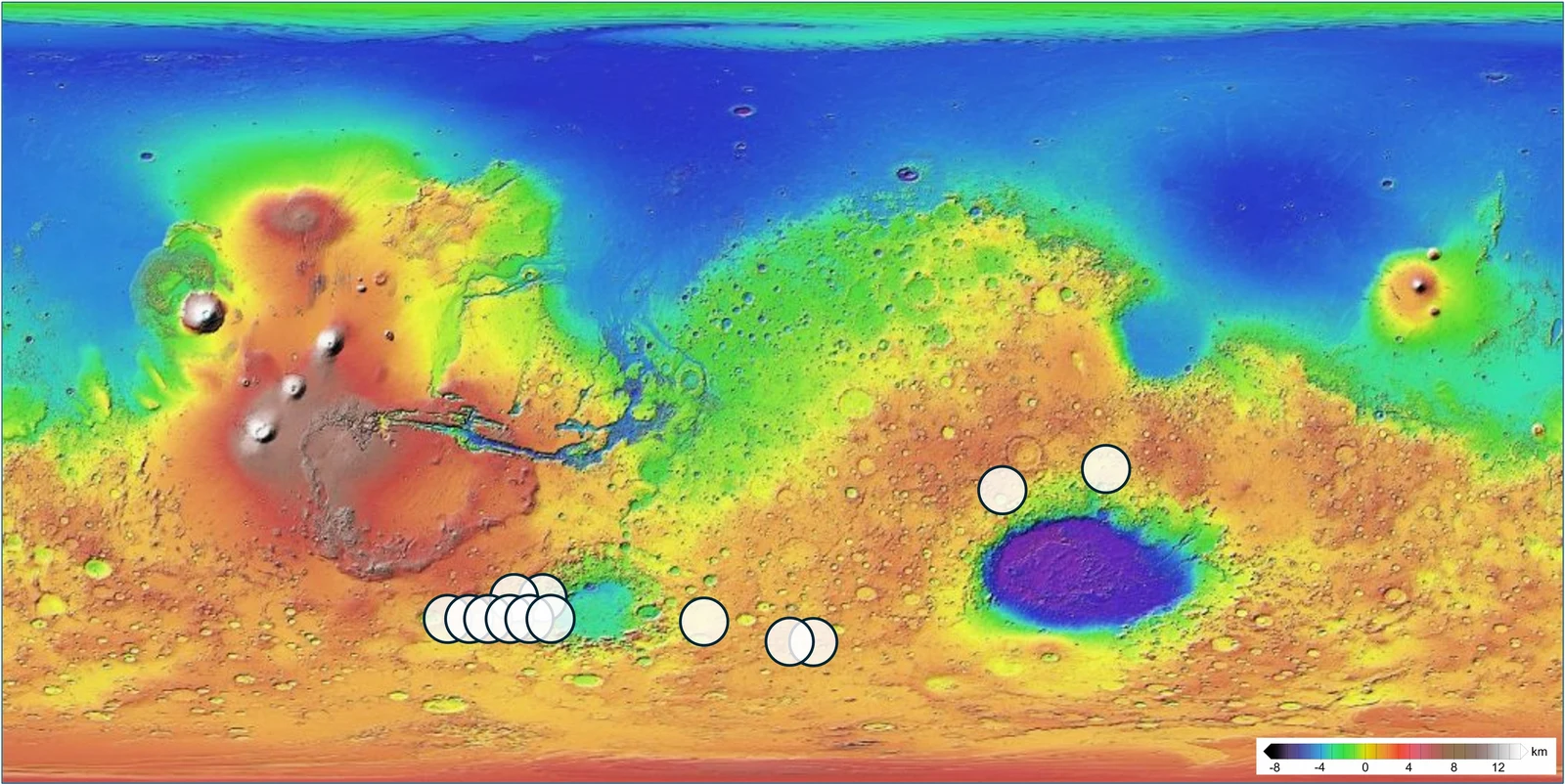
Image credit
Thirteen possible source regions for Teghaza 001
NASA/JPL-Caltech/USGS · NASA factual editorial useResized and encoded as WebP; no semantic alteration.
Thirteen candidate source regions, not confirmed origins. Colors show elevation; circles mark compositional matches. PIA26802. Courtesy NASA/JPL-Caltech/USGS.
Thirteen Possible Homes, No Exact Address
Laboratory chemistry can be compared with measurements from spacecraft. NASA says the meteorite's distinctive mineral mixture resembles material observed in Mars' cratered southern highlands.
The researchers identified 13 candidate source locations, using Mars Reconnaissance Orbiter observations. The published map places those candidates over elevation data from Mars Global Surveyor. Its colors show terrain height; they are not a map of the meteorite's water content or proof of a single birthplace.
This is a comparison between two very different scales of evidence: a specimen that can be interrogated grain by grain, and a planet surveyed from orbit. A compositional match helps narrow a geological setting. It does not preserve a shipping label identifying the precise crater that launched the rock.
The transport itself is a separate part of the story. An impact can eject Martian material into space; some eventually reaches Earth. Identifying a meteorite as Martian relies on measurements such as its oxygen-isotope relationships and comparisons with established planetary evidence, not its desert location or pink color alone.
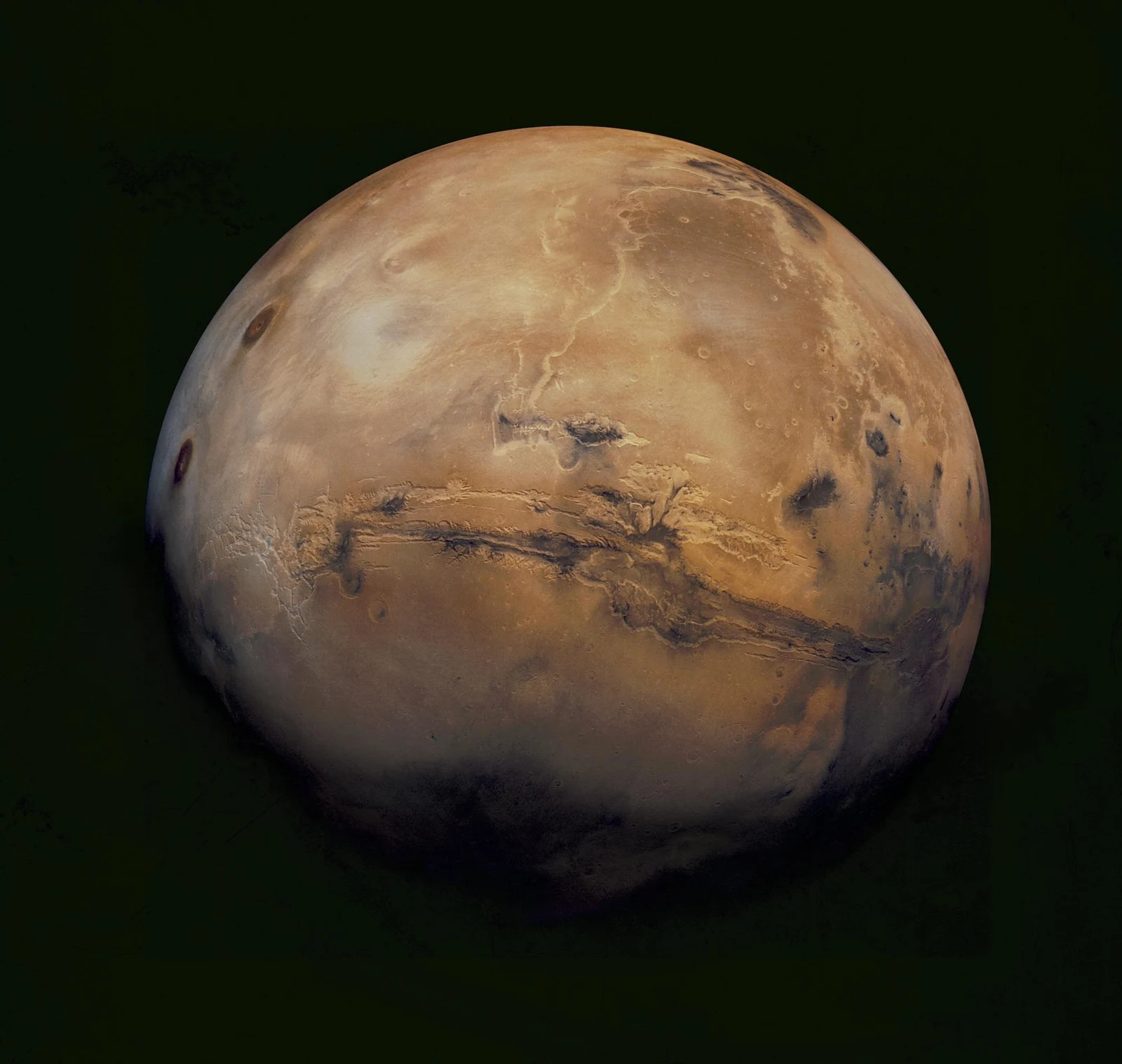
Image credit
Archival Viking Orbiter mosaic of Mars
NASA/USGS · NASA factual editorial useResized and encoded as WebP; no semantic alteration.
Archival Viking Orbiter mosaic, PIA04304, for planetary context; not a newly captured view or an identified Teghaza ejection site. Courtesy NASA/USGS.
Water History Is Not a Life Detection
The appeal of a sample this old is that it gives researchers a tangible piece of early Mars, from a setting not otherwise represented in the same way among known Martian meteorites. Its mineral relationships and dates can inform questions about crust formation and interactions between rock and water.
That is already a substantial scientific opportunity. It does not require a claim that the meteorite contains life, proves an inhabited Mars, or resolves the planet's entire climate history. The current studies are starting points for more investigations, not a complete biography of the Red Planet.
The most interesting thing about this small rock may be how much can still be asked of it. Preserving the specimen, separating its different alterations and comparing it carefully with orbital observations keep those questions open.
Which part of a meteorite's journey would you most like researchers to reconstruct? Share your thoughts in the comments below.
Keep exploring
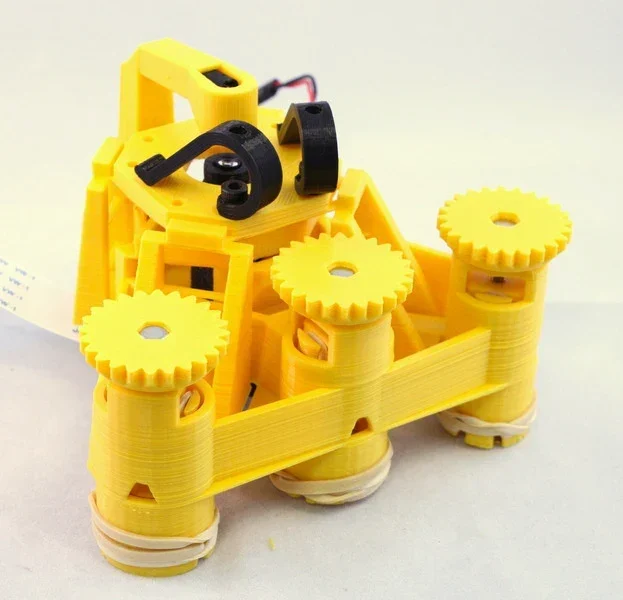
Richard Bowman and contributors' full microscope build instructions: printing, flexure actuators, two optical configurations, illumination, wiring, and motorization.
Image credit
docs/images/microscope_complete_1.jpg
Richard Bowman and OpenFlexure contributors · CERN-OHL-1.2Resized without cropping and converted to WebP for the project card.
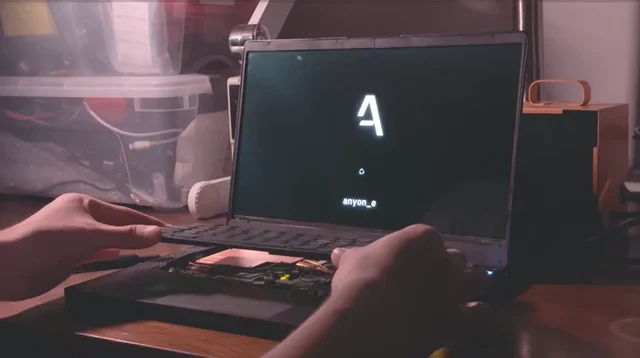
The original anyon_e creation story: a removable mechanical keyboard, custom electronics, a 4K OLED display, power-system work, Linux bring-up, and a machined chassis.
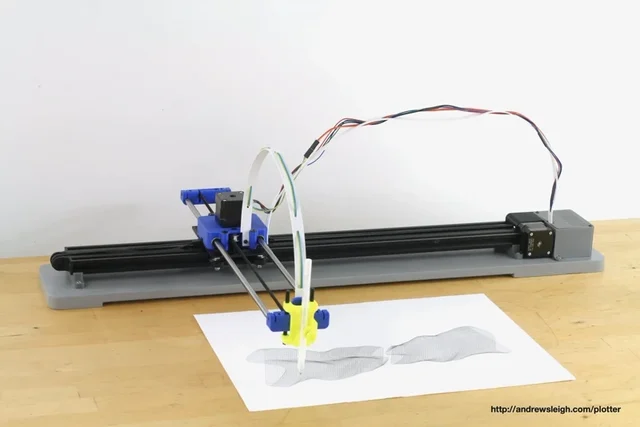
Andrew Sleigh's complete plotter writeup, with three design generations, original machine photos, parts lists and the SVG-to-G-code workflow.
Image credit
photos/v3/IMG_6608.jpg
Andrew Sleigh · MITResized without cropping and converted to WebP for the project card.
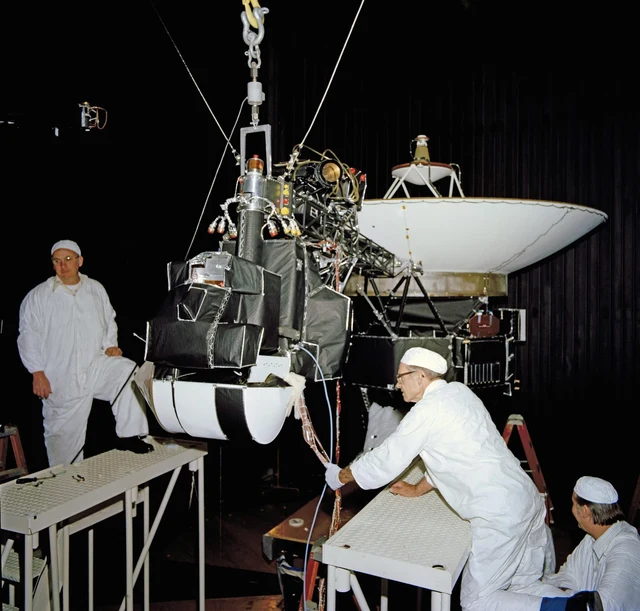
Voyager 1's signal returned before troubleshooting commands were sent. NASA's account separates the October fault response from September's power-saving work.
Image credit
Voyager spacecraft in thermal-vacuum testing in 1977
NASA/JPL-Caltech · NASA factual editorial useResized and encoded as WebP; no semantic alteration.
Comments
Member comments are temporarily unavailable.
Log in to join the discussion.