
Voyager 1 Went Quiet, Then Reconnected Before NASA Sent Help
Published November 3, 2026
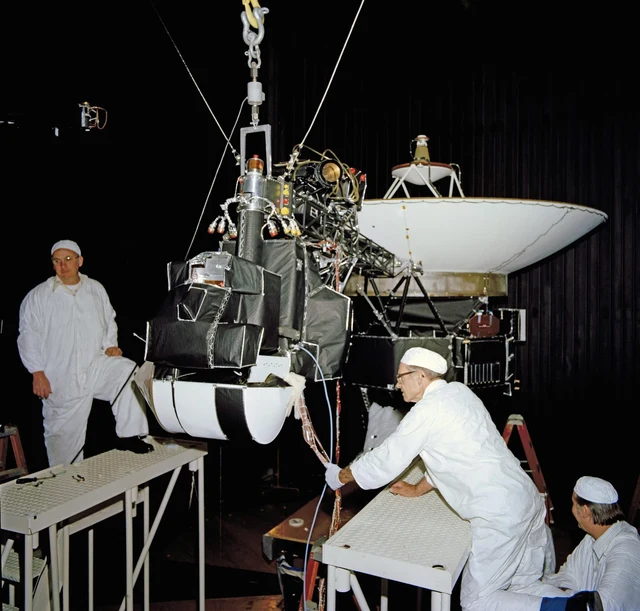
Archival ground-test photograph, April 27, 1977; not the October 2026 recovery. Courtesy NASA/JPL-Caltech.
Image credit
Voyager spacecraft in thermal-vacuum testing in 1977
NASA/JPL-Caltech · NASA factual editorial useResized and encoded as WebP; no semantic alteration.
Voyager 1's signal returned before troubleshooting commands were sent. NASA's account separates the October fault response from September's power-saving work.
For two scheduled calls, Earth heard nothing from Voyager 1. Then the signal returned before NASA had sent the troubleshooting commands.
That is the striking detail in NASA's October 29 account of a communications interruption on October 18-20. The spacecraft's backup thrusters had switched on automatically. Engineers were still investigating what caused the original problem; the report does not establish that a particular failed part was identified and repaired.
At roughly 16 billion miles away, even finding out what went wrong is a slow conversation.
Two Missed Calls, Not a Live Troubleshooting Session
NASA's Deep Space Network could not detect Voyager 1 during contact attempts on October 18 and 19, spaced 24 hours apart. A signal appeared at the next attempt, on October 20. NASA described the interruption as lasting about 48 hours and said contact had continued since the return.
Those scheduled observations matter. They are not a second-by-second recording of everything the spacecraft did while Earth could not hear it. The safe conclusion is that the signal was absent at the failed contacts and present again on October 20, not that engineers watched a precise two-day repair unfold remotely.
The diagnostic information revealed a thruster-group shutdown and activation of its backups. Voyager's fault-protection programming can make that swap when it detects a problem, then put the spacecraft into a stable configuration and pause normal activity. That buys the ground team time. It is not the same as the spacecraft independently diagnosing every possible failure.
The Other Repair Was About Heat
The communications incident was separate from a power-saving change completed in September. Engineers switched off three devices and substituted three lower-power alternatives, all as one coordinated operation. NASA nicknamed that change the Big Bang.
Why change them together? These devices also help keep the spacecraft warm. Saving electrical power while distributing too little heat to the wrong place would create another problem. The useful change had to satisfy both requirements at once.
Both Voyagers lose about four watts of available electrical power each year as their radioisotope power systems age. That makes small savings consequential. NASA said the September work should extend operation of Voyager 1's remaining science instruments; without it, another instrument might have needed to be switched off as early as summer 2027. It did not promise an unlimited extension.
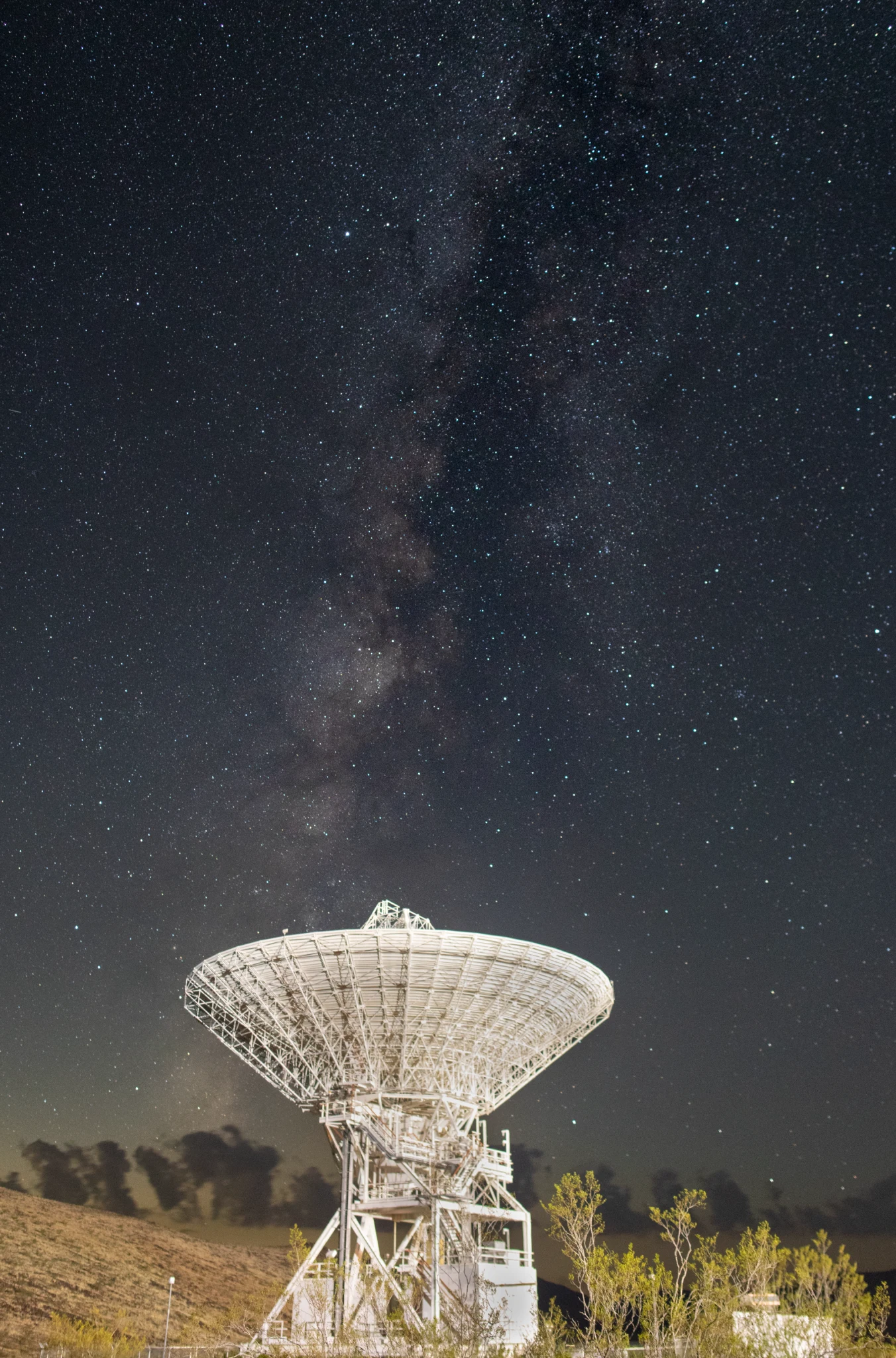
Image credit
Goldstone DSS-15 under the Milky Way in September 2025
NASA/JPL-Caltech · NASA factual editorial useResized and encoded as WebP; no semantic alteration.
Goldstone's DSS-15 in September 2025, shown for Deep Space Network context, not as a record of this Voyager contact. Courtesy NASA/JPL-Caltech.
A Day Each Way
NASA's report also looked ahead to November 18, when Voyager 1 was expected to reach a distance from Earth equivalent to one light-day. That milestone was still upcoming in the October account, not something the communications recovery had already achieved.
At that distance, a radio command takes approximately 24 hours to arrive. Its reply needs another 24 hours to come back. Even an immediate onboard response becomes a roughly two-day exchange from the ground team's perspective.
That is what makes dependable fault protection so important here. Backup hardware is only useful if the spacecraft can reach a stable state while its human operators wait for information. The returned signal is good news. Understanding why it vanished remains a different engineering job.
Which old spacecraft system would you most like to see explained? Tell us in the comments below.
Keep exploring
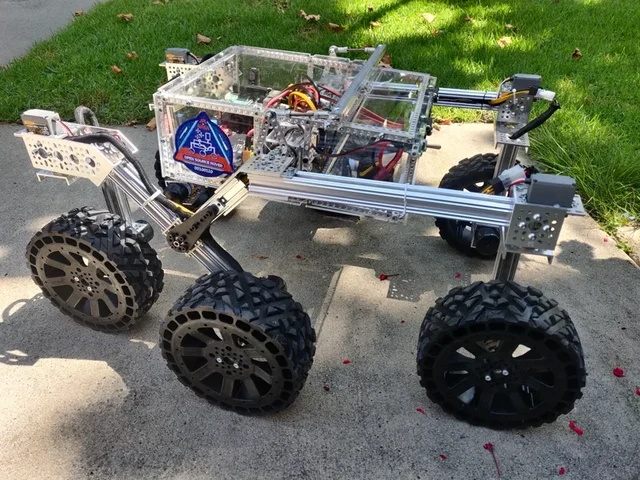
The complete reviewed JPL rover hardware manual: parts lists, wiring, PCB assembly, mechanical chapters, original build photographs and diagrams, optional mast, and downloadable schematics.
Image credit
images/osr-side-outside.jpg
JPL / California Institute of Technology and Open Source Rover contributors · Apache-2.0Resized without cropping and converted to WebP for the project card.

Teghaza 001 records ancient Martian crust and water alteration around 4.1 billion years ago. Its dates, mineral clues and 13 possible source regions tell different stories.
Image credit
Reflected-light slice of Martian meteorite Teghaza 001
NASA/JPL-Caltech · NASA factual editorial useResized and encoded as WebP; no semantic alteration.
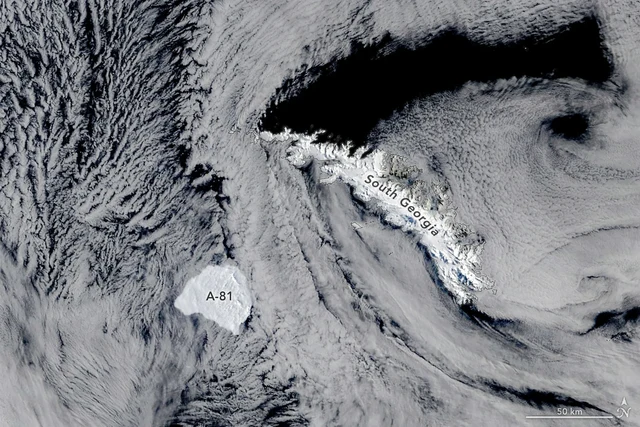
NASA's new view follows A-81 to the edge of South Georgia's underwater shelf. The iceberg is slowing after a journey that began at Antarctica's Brunt Ice Shelf.
Image credit
A-81 near South Georgia on October 20, 2026
NASA Earth Observatory/Michala Garrison; MODIS data from NASA EOSDIS LANCE and GIBS/Worldview · NASA factual editorial useResized and encoded as WebP; no semantic alteration.
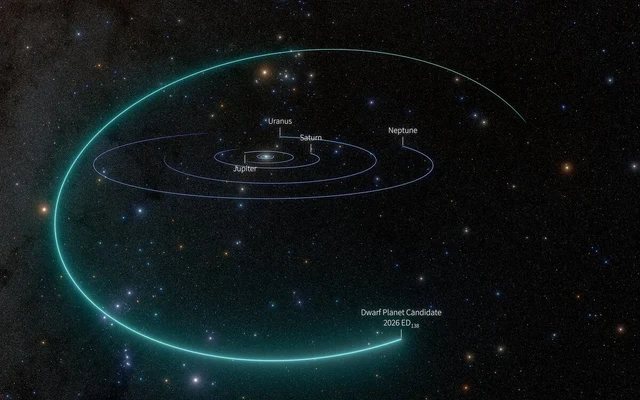
Repeated Rubin images and a decade of recovered observations revealed 2026 ED138 beyond Pluto. Its estimated size is impressive, but dwarf-planet status remains unconfirmed.
Image credit
2026 ED138 orbital model
NSF-DOE Vera C. Rubin Observatory/NOIRLab/SLAC/AURA/R. Proctor; image processing M. Zamani (NSF NOIRLab); orbit data IAU Minor Planet Center (MPCorb), funded by NASA PDCO and Tamkin Foundation; star map NASA/Goddard SVS; Gaia DR2 ESA/Gaia/DPAC · CC BY 4.0Cropped orbital model to focus on the labeled candidate and orbit; resized and encoded as WebP. Model shows its May 8, 2026 position, not a resolved photograph.
Comments
Member comments are temporarily unavailable.
Log in to join the discussion.