DARPA Made Small Drones Try to Carry Four Times Their Own Weight
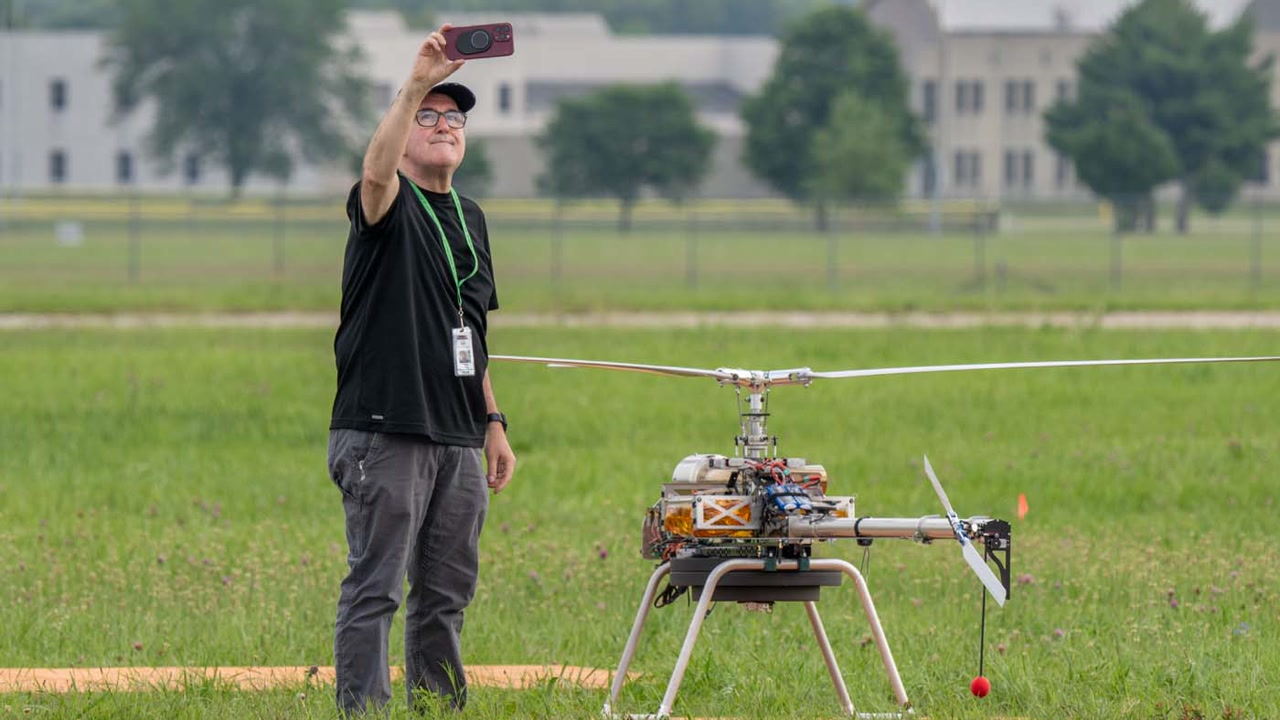
Photo credit
The Lift Challenge put unconventional aircraft through a five-nautical-mile course to test whether small drones can escape a stubborn payload limit.
Most small drones are lucky to carry their own weight. DARPA spent a week in Dayton asking inventors to do something much ruder to physics: build an aircraft weighing no more than 55 pounds, load it with at least 110 pounds, and chase a payload-to-weight ratio above four to one.
The result was the Lift Challenge, a $6.5 million competition that put aerospace companies, university teams, startups, and independent builders on the same field. The machines ranged from recognizable multirotors to exposed mechanical experiments that looked as if the workbench had learned to fly.
The course punished more than raw thrust
The official challenge rules required a scored aircraft to complete a five-nautical-mile circuit. It had to climb with its payload, fly four nautical miles, set the load down, and complete a final unloaded mile. Teams had 90 minutes and two flight windows to post their best result.
That changes the engineering problem. Lifting a heavy object for a few seconds can demonstrate impressive thrust, but it does not prove that a vehicle can control itself, manage heat, survive vibration, conserve energy, and finish a useful trip.
The aircraft weight included its fuel or batteries. Every larger motor, stronger beam, extra sensor, and safety margin could improve reliability while making the scoring ratio worse. Teams were optimizing an entire flying system, not simply attaching the largest possible propellers to a frame.
A maker competition with military stakes
DARPA invited 124 teams representing small businesses, students, entrepreneurs, established firms, and participants from more than 20 countries. The agency's daily media gallery shows the variety clearly: long single rotors, skeletal fixed-wing hybrids, clustered propellers, compact gas engines, battery systems, and teams repairing hardware under event tents.
The final four days were open to the public at the National Museum of the U.S. Air Force. DARPA described teams attempting scoring runs to get above a four-to-one ratio on August 8 and said a payload-to-weight record had been broken earlier in the week.
As of August 11, however, DARPA's main public challenge pages and gallery did not include a final results table with enough detail to independently state the winning team and verified score. The event happened; the designs flew; a precise winner claim should wait for a primary results release.
That caution does not make the contest less interesting. It keeps the story where the evidence is strongest: unusually small aircraft were tested against a demanding heavy-lift mission in public, and DARPA says the week produced a new payload-to-weight record. The exact record and final ranking need a complete primary results release.
Why the ratio matters
Payload fraction determines whether a drone can do more than carry a camera. Better ratios could make small aircraft useful for disaster supplies, infrastructure inspection, equipment delivery, and field logistics without requiring a much larger vehicle for every increase in cargo.
The military interest is direct. DARPA frames the problem around moving useful loads through difficult environments without depending on runways or crewed helicopters. But the physics is shared with civilian aviation. A lighter, more efficient lift system can lower cost and expand where vertical flight makes sense.
There are tradeoffs. A design optimized to win one ratio may be noisy, mechanically exposed, difficult to maintain, or poorly suited to bad weather. Competition performance is a starting point, not proof that a machine is ready for routine service.
The field was part of the experiment
Prize challenges let an agency test more design ideas than it could plausibly commission one by one. Instead of choosing a favored architecture in advance, DARPA defined a measurable bottleneck and let very different teams attack it.
That makes the weird aircraft valuable even when they do not win. A failed gearbox, unstable rotor, overheated controller, or clever frame can reveal which approaches deserve another iteration. The Lift Challenge turned a hard aviation constraint into a maker-scale public experiment, then made the scoreboard answer to physics.
Comments
Member comments are temporarily unavailable.
Log in to join the discussion.