ESA Followed a Dying Satellite to Learn How Spacecraft Break Apart
Published September 10, 2026
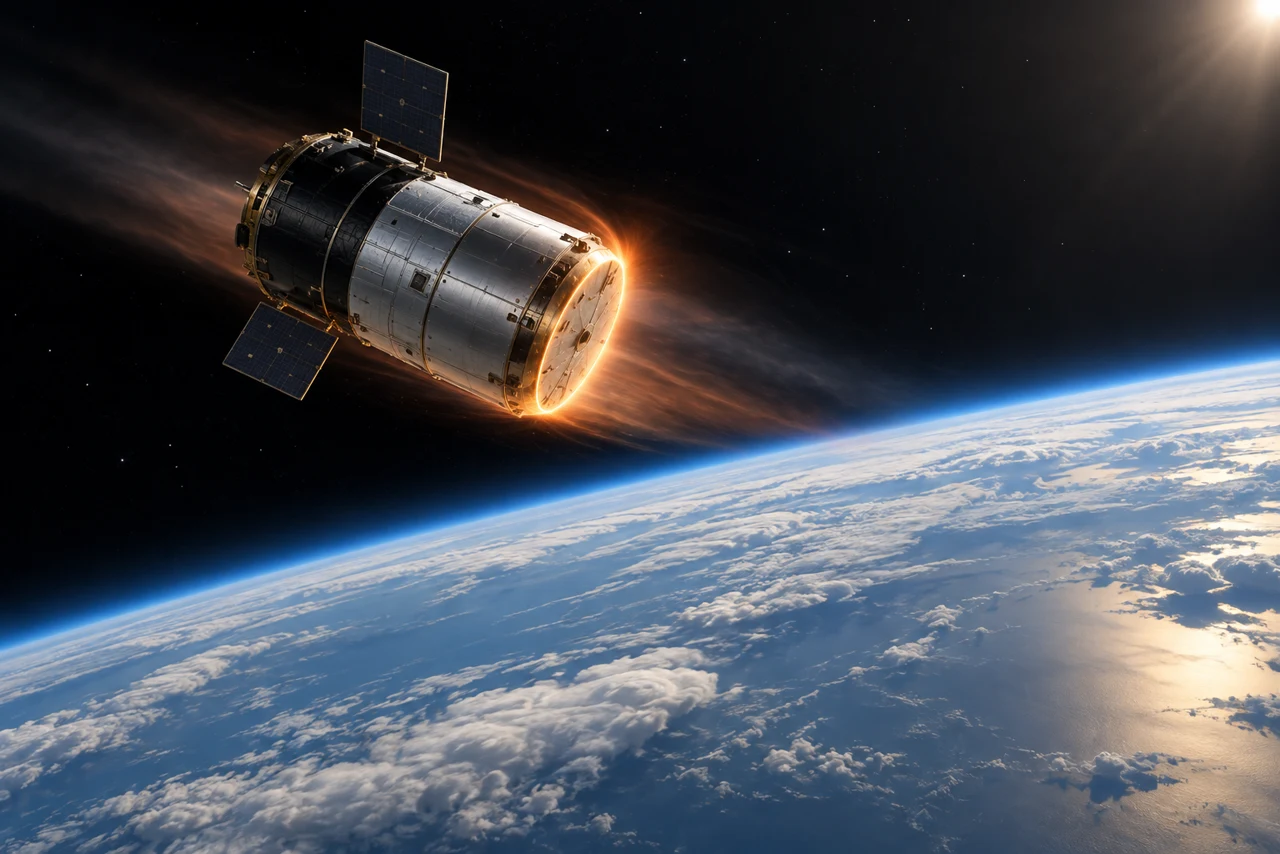
Reentry illustration, not footage of Cluster or a depiction of its exact configuration.
Cluster's final spacecraft reentered on September 1. An aircraft full of instruments watched its last seconds to improve the science of satellite disposal.
For most spacecraft, the last moments of a mission are the part nobody gets to inspect closely. ESA turned the end of Cluster into an experiment, sending an instrumented aircraft to watch satellites break up during atmospheric reentry.
The result is an unusually direct way to study a hard engineering question: when hardware falls back through the atmosphere, what actually happens to it?
A Final Observation Run
ESA's September 2 account reports that Tango, the last of the four Cluster spacecraft, reentered on September 1 at 21:30:31 UTC. Its targeted path over the South Pacific allowed the ROSIE airborne team to observe the event. Samba had reentered the previous day.
The team obtained observations with 29 of the aircraft's 30 instruments, tracking the two reentries for about 50 seconds on average. The lead image is a conceptual illustration. ESA's recorded Tango observation shows the actual, faint event rather than an artist's reconstruction.
ESA plans to use the experience in reentry research, including the proposed Draco mission. Draco's announced concept adds measurements from inside a spacecraft during its destruction, complementing the view from outside.
Destruction Is a Design Condition
A product's operating life is only one part of its behavior. It also has to be assembled, moved, serviced, and eventually taken out of use. Designs become more honest when those stages are treated as engineering requirements rather than awkward events after the interesting work ends.
For spacecraft, disposal brings an especially difficult measurement problem. An external observer sees emissions and fragments, not a neatly labeled sequence of internal failures. A model may describe a plausible sequence, but observations are needed to test whether it is the right one.
Our reading of this campaign is that its value lies in narrowing that uncertainty. More dramatic footage is not automatically better evidence. What matters is whether the timing, trajectory, and instrument records let researchers connect what they see with a physical explanation.
What a Workshop Can Borrow
You do not need to destroy a prototype to learn from its end-of-life design. Try walking through disassembly instead. Which fasteners become inaccessible? Which materials have been permanently joined? Can a failed component be removed without damaging the parts around it?
Those questions often reveal assumptions hidden by a successful first demonstration. A device can work exactly as intended while still being difficult to repair, recover, or retire responsibly.
The useful habit is to document transitions as carefully as steady operation. Startup, shutdown, overload recovery, and disassembly can expose behavior that a normal test run never reaches. Choose safe, controlled tests appropriate to your equipment; a spectacular failure is not a requirement for an informative one.
Cluster's final act makes that principle visible at an extraordinary scale. A mission can stop operating and still leave behind a new measurement.
Which part of a build's eventual disassembly do you plan before construction? Tell us in the comments below.
Comments
Member comments are temporarily unavailable.
Log in to join the discussion.