
Rubin's New Dwarf-Planet Candidate Was Hiding in a Crowd of Stars
Published October 29, 2026
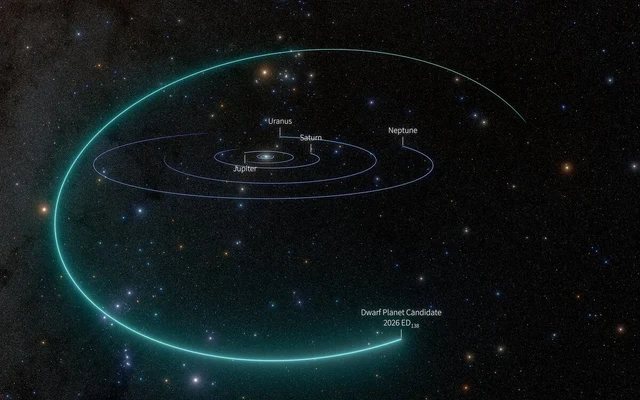
Cropped orbital model showing ED138's May 8, 2026 position, not a resolved photograph. Credit: NSF-DOE Vera C. Rubin Observatory/NOIRLab/SLAC/AURA/R. Proctor; processing M. Zamani (NSF NOIRLab). Orbit data: IAU Minor Planet Center, NASA PDCO and Tamkin Foundation. Star map: NASA/Goddard SVS; Gaia DR2: ESA/Gaia/DPAC.
Image credit
2026 ED138 orbital model
NSF-DOE Vera C. Rubin Observatory/NOIRLab/SLAC/AURA/R. Proctor; image processing M. Zamani (NSF NOIRLab); orbit data IAU Minor Planet Center (MPCorb), funded by NASA PDCO and Tamkin Foundation; star map NASA/Goddard SVS; Gaia DR2 ESA/Gaia/DPAC · CC BY 4.0Cropped orbital model to focus on the labeled candidate and orbit; resized and encoded as WebP. Model shows its May 8, 2026 position, not a resolved photograph.
Repeated Rubin images and a decade of recovered observations revealed 2026 ED138 beyond Pluto. Its estimated size is impressive, but dwarf-planet status remains unconfirmed.
A large world can be difficult to find without being especially faint. Sometimes the problem is everything behind it.
That is the appeal of 2026 ED138, the dwarf-planet candidate announced by Rubin Observatory on October 27. It was hiding in a busy part of the sky near the Milky Way's plane. The discovery combines a new telescope's repeated observations with a second search through photographs that had already been taken.
This is an addition to our coverage of that announcement, not a discovery dated October 29. It is also not Planet Nine, a newly photographed planetary surface or a confirmed addition to the International Astronomical Union's list of dwarf planets.
First Find the Motion
Matthew Holman of the Center for Astrophysics | Harvard & Smithsonian identified the object on October 13 while running earlier Rubin data through search software developed with Kevin Napier. The software's job was to connect detections belonging to the same moving object among billions of detections.
One appearance would be a weak starting point. A bright spot in a crowded astronomical image does not arrive with an identification label attached. The useful question is whether several detections fit the same moving body.
Rubin reports that Mario Juric's subsequent search found 20 additional observations. In total, its telescope had observed ED138 30 times on 20 nights between March and July 2026. The published discovery mosaic makes the distinction visible: the important evidence is a small point changing position among background sources, not an image that resolves a globe.
This is why the observing pattern matters. Repeated coverage gives a search algorithm opportunities to connect what would otherwise be isolated points. The telescope and the software are parts of the same discovery process.
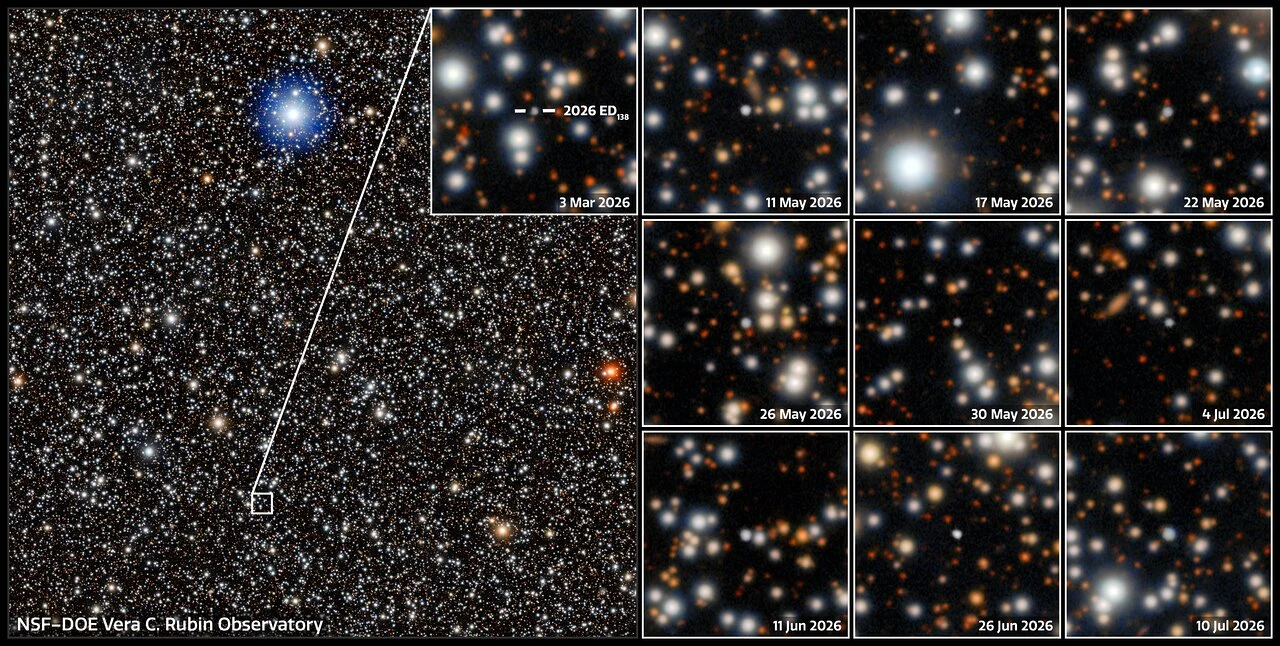
Image credit
2026 ED138 discovery mosaic
NSF-DOE Vera C. Rubin Observatory/NOIRLab/SLAC/AURA; image processing M. Jurić (UW), D. de Martin and M. Zamani (NSF NOIRLab) · CC BY 4.0Resized and encoded as WebP; no semantic alteration.
Actual discovery images with their original annotations, not a resolved planetary surface. Credit: NSF-DOE Vera C. Rubin Observatory/NOIRLab/SLAC/AURA; processing M. Juric (UW), D. de Martin and M. Zamani (NSF NOIRLab).
Then Look Backward
Once an object has been identified, older photographs become more useful. Instead of asking a broad question about everything in the image, researchers can ask whether a particular body should have been present at a particular location.
Archival images from the Dark Energy Camera, found through the Asteroid Institute's ADAM Precovery service, extended the record back to 2016. Rubin says the combined data let the team trace more than ten years of the orbit.
That is a valuable change in the evidence, not time travel in the discovery date. The object was present in those older images without having been recognized as this object. Its identity gives the archive a new question to answer.
An orbital visualization can explain the resulting geometry, but it should not be mistaken for direct footage of a spacecraft flying around ED138. The orbit graphic reproduced here is a model; the discovery images show what the telescope actually recorded.
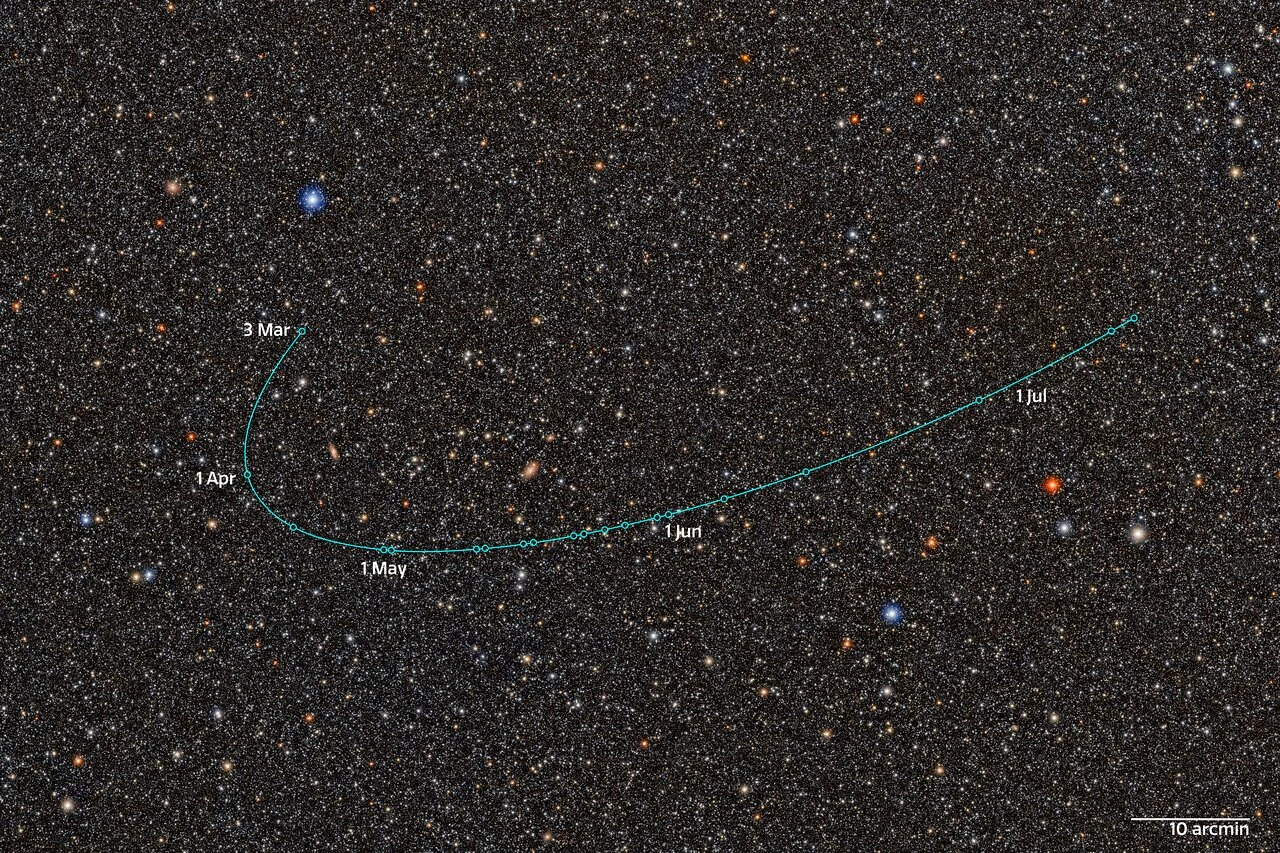
Image credit
2026 ED138 annotated observational composite
NSF-DOE Vera C. Rubin Observatory/NOIRLab/SLAC/AURA; image processing M. Jurić (UW), D. de Martin and M. Zamani (NSF NOIRLab) · CC BY 4.0Resized and encoded as WebP; no semantic alteration.
Composite of Rubin observations from March-July 2026, not a single exposure. Credit: NSF-DOE Vera C. Rubin Observatory/NOIRLab/SLAC/AURA; processing M. Juric (UW), D. de Martin and M. Zamani (NSF NOIRLab).
Why the Diameter Is a Range
The preliminary diameter estimate is wide: about 600 to 1,500 kilometres. The distance is approximately 46 astronomical units from the Sun, with one astronomical unit equal to the average Earth-Sun distance. Rubin compares this with Pluto's average distance of about 40 astronomical units, not Pluto's position on the same day.
The size estimate uses distance, brightness and an assumed range of surface reflectivity. A more reflective body can produce the same observed brightness as a larger, darker one. An image that establishes a moving point's existence therefore need not establish its diameter precisely.
That distinction is easy to lose in a headline about a hidden world. The uncertainty is not whether every possible point of light is a planet. It concerns the physical properties of a tracked, newly identified trans-Neptunian object.
Rubin says infrared observations are needed to constrain the size and clarify its nature. Until those follow-ups, the diameter should remain a range, rather than being rounded into a single impressive number for comparison with a familiar world.
A Candidate, Not a New Census Entry
Being beyond Neptune is not enough to make something a dwarf planet. The researchers identify ED138 as a candidate because an icy body in the estimated size range is expected to be massive enough for gravity to make it round. That expectation is not the same as having directly measured its shape.
The orbit is also inclined by almost 25 degrees relative to the Solar System's plane. Rubin describes it as a hot-classical trans-Neptunian object, with its orbital history potentially involving gravitational disturbance by Neptune. The classification concerns orbital behavior; it does not mean the distant object has a hot surface.
There is plenty to be interested in without upgrading a candidate to a confirmed dwarf planet. Its brightness, the crowded discovery field and the decade-long recovered orbit each tell a different part of the story.
What Makes This Worth Following
The strongest result is not a speculative drawing of unexplored terrain. It is a demonstration of how repeated observations and searchable archives can make a familiar sky yield something previously unrecognized.
The next steps should reduce physical uncertainty: better constraints on size, reflectivity and the object's place among other distant bodies. Meanwhile, the existing record already makes ED138 more than a single unexplained spot in a photograph.
Would you rather see the next update focus on the size measurement or the search algorithm that found it? Tell us in the comments below.
Keep exploring
The complete reviewed JPL rover hardware manual: parts lists, wiring, PCB assembly, mechanical chapters, original build photographs and diagrams, optional mast, and downloadable schematics.
Image credit
images/osr-side-outside.jpg
JPL / California Institute of Technology and Open Source Rover contributors · Apache-2.0Resized without cropping and converted to WebP for the project card.
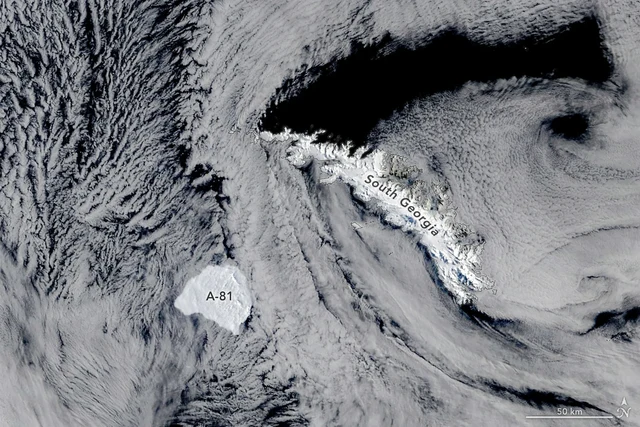
NASA's new view follows A-81 to the edge of South Georgia's underwater shelf. The iceberg is slowing after a journey that began at Antarctica's Brunt Ice Shelf.
Image credit
A-81 near South Georgia on October 20, 2026
NASA Earth Observatory/Michala Garrison; MODIS data from NASA EOSDIS LANCE and GIBS/Worldview · NASA factual editorial useResized and encoded as WebP; no semantic alteration.
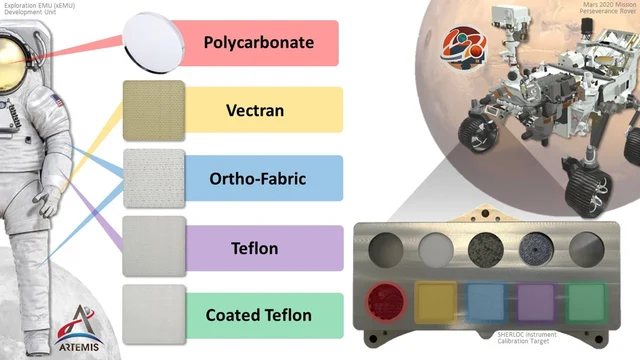
Dust down to roughly 100-300 nanometres clings to Perseverance's calibration materials. The new measurements could help engineers design cleaner suits and habitats.
Image credit
Spacesuit materials on the SHERLOC calibration target
NASA · NASA factual editorial useResized and encoded as WebP; no semantic alteration.

Four spectral peaks reveal two gas rings around white dwarf J1328-1450. Surviving bodies could help maintain the structure, but those bodies have not been directly seen.
Image credit
J1328-1450 proposed system artist impression
ESO/L. Calçada · CC BY 4.0Resized and encoded as WebP; no semantic alteration.
Comments
Member comments are temporarily unavailable.
Log in to join the discussion.