
A Giant Antarctic Iceberg Has Reached South Georgia's Hidden Obstacle
Published October 27, 2026
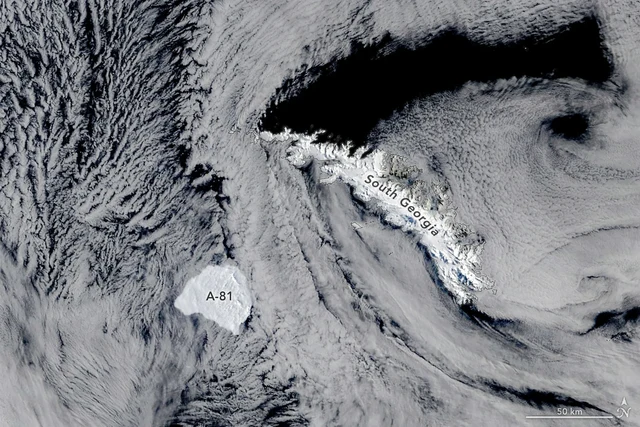
Terra MODIS view acquired October 20, 2026, featured in NASA's October 27 report. Credit: NASA Earth Observatory/Michala Garrison; NASA EOSDIS LANCE and GIBS/Worldview data.
Image credit
A-81 near South Georgia on October 20, 2026
NASA Earth Observatory/Michala Garrison; MODIS data from NASA EOSDIS LANCE and GIBS/Worldview · NASA factual editorial useResized and encoded as WebP; no semantic alteration.
NASA's new view follows A-81 to the edge of South Georgia's underwater shelf. The iceberg is slowing after a journey that began at Antarctica's Brunt Ice Shelf.
A slab of Antarctic ice has reached an obstacle that is mostly invisible from above. Iceberg A-81 is approaching South Georgia, and its northward progress has slowed near the island's underwater shelf.
NASA's October 27 Earth Observatory report brings the journey into view with a Terra satellite image acquired on October 20. The white block and the long, mountainous island share the frame. What the picture cannot show directly is the seabed that may now be interrupting the iceberg's drift.
An Island Extends Beyond Its Shore
A-81 left Antarctica's Brunt Ice Shelf in January 2023. It spent more than three years in the Weddell Sea before reaching the Antarctic Peninsula's tip in May 2026 and moving into the Scotia Sea. By late October, it had travelled about 2,300 kilometres north-northwest of its starting point.
NASA's account describes the berg appearing to bump along South Georgia's shelf edge. That is an interpretation of its slowing progress, not a declaration that it has become permanently grounded. A satellite photograph gives the surface position; establishing what happens beneath it requires more than the bright outline of the ice.
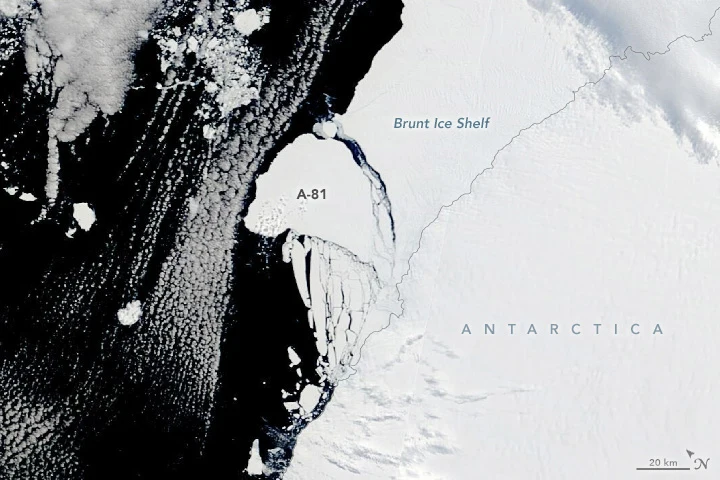
Image credit
A-81 after separation from the Brunt Ice Shelf
NASA Earth Observatory/Lauren Dauphin; MODIS data from NASA EOSDIS LANCE and GIBS/Worldview · NASA factual editorial useResized and encoded as WebP; no semantic alteration.
Archival Terra MODIS image, January 24, 2023, after A-81's separation. Credit: NASA Earth Observatory/Lauren Dauphin; NASA EOSDIS LANCE and GIBS/Worldview data.
The Break Happened Years Ago
The origin image is worth keeping beside the new one. Earth Observatory's January 2023 account dates the break to late January 22 and puts the newly calved iceberg's area at about 1,550 square kilometres. That is its size at calving, not a fresh measurement of its present area.
The fracture followed Chasm 1, a rift that had resumed growing in 2012 after a long quiet period. This was not an overnight crack appearing without warning. The eventual separation was one step in a process watched for years.
That earlier report also records why the location matters beyond the shape of the ice. The Brunt shelf is home to the British Antarctic Survey's Halley Research Station. BAS had moved the station farther inland in 2016 as the chasm widened; it reported the station unaffected by the 2023 break.
A Journey Still in Progress
The visual contrast is striking: an abrupt separation at the shelf, then years of drifting, then a slowdown near another landmass. A map of coastlines alone would miss part of the story. Icebergs have depth, and an island's surrounding shallow water can matter before its shore does.
There is no need to turn this image into a prediction of an imminent collision or breakup. The new report establishes a location and a change in progress, not A-81's final destination. The next useful observation will be whether it continues along the shelf edge, moves away or stops for longer.
What would you most like to see beside the next satellite image: a drift track or a seabed-depth map? Tell us in the comments below.
Keep exploring

The complete reviewed JPL rover hardware manual: parts lists, wiring, PCB assembly, mechanical chapters, original build photographs and diagrams, optional mast, and downloadable schematics.
Image credit
images/osr-side-outside.jpg
JPL / California Institute of Technology and Open Source Rover contributors · Apache-2.0Resized without cropping and converted to WebP for the project card.
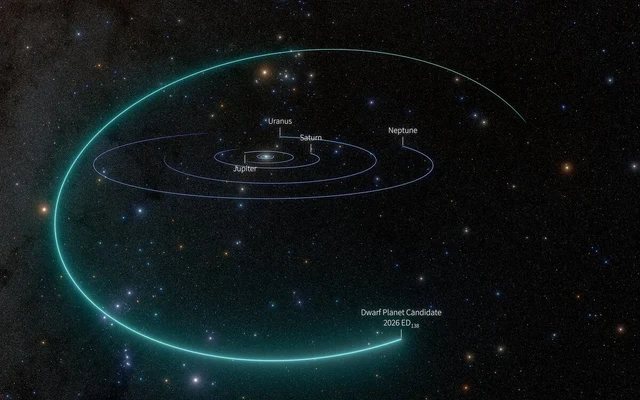
Repeated Rubin images and a decade of recovered observations revealed 2026 ED138 beyond Pluto. Its estimated size is impressive, but dwarf-planet status remains unconfirmed.
Image credit
2026 ED138 orbital model
NSF-DOE Vera C. Rubin Observatory/NOIRLab/SLAC/AURA/R. Proctor; image processing M. Zamani (NSF NOIRLab); orbit data IAU Minor Planet Center (MPCorb), funded by NASA PDCO and Tamkin Foundation; star map NASA/Goddard SVS; Gaia DR2 ESA/Gaia/DPAC · CC BY 4.0Cropped orbital model to focus on the labeled candidate and orbit; resized and encoded as WebP. Model shows its May 8, 2026 position, not a resolved photograph.
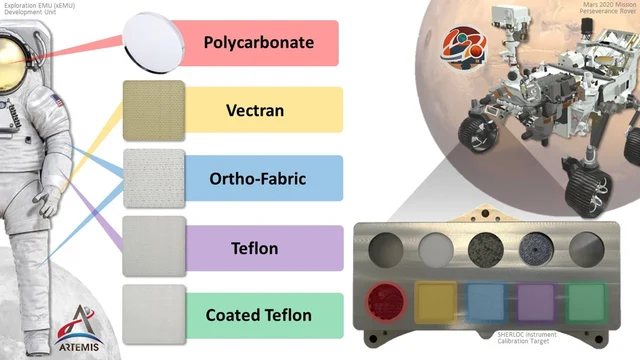
Dust down to roughly 100-300 nanometres clings to Perseverance's calibration materials. The new measurements could help engineers design cleaner suits and habitats.
Image credit
Spacesuit materials on the SHERLOC calibration target
NASA · NASA factual editorial useResized and encoded as WebP; no semantic alteration.
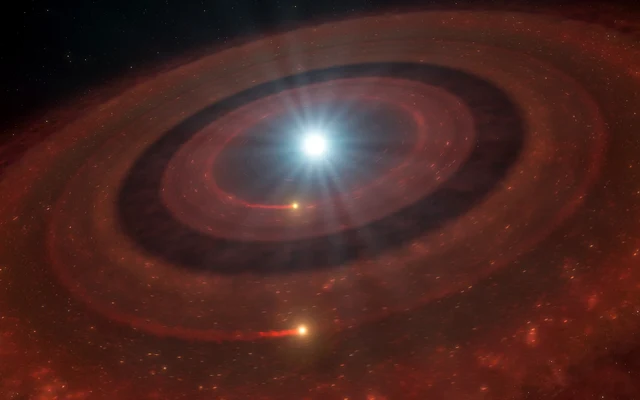
Four spectral peaks reveal two gas rings around white dwarf J1328-1450. Surviving bodies could help maintain the structure, but those bodies have not been directly seen.
Image credit
J1328-1450 proposed system artist impression
ESO/L. Calçada · CC BY 4.0Resized and encoded as WebP; no semantic alteration.
Comments
Member comments are temporarily unavailable.
Log in to join the discussion.