Scientists Found the First True Sugar in Interstellar Space
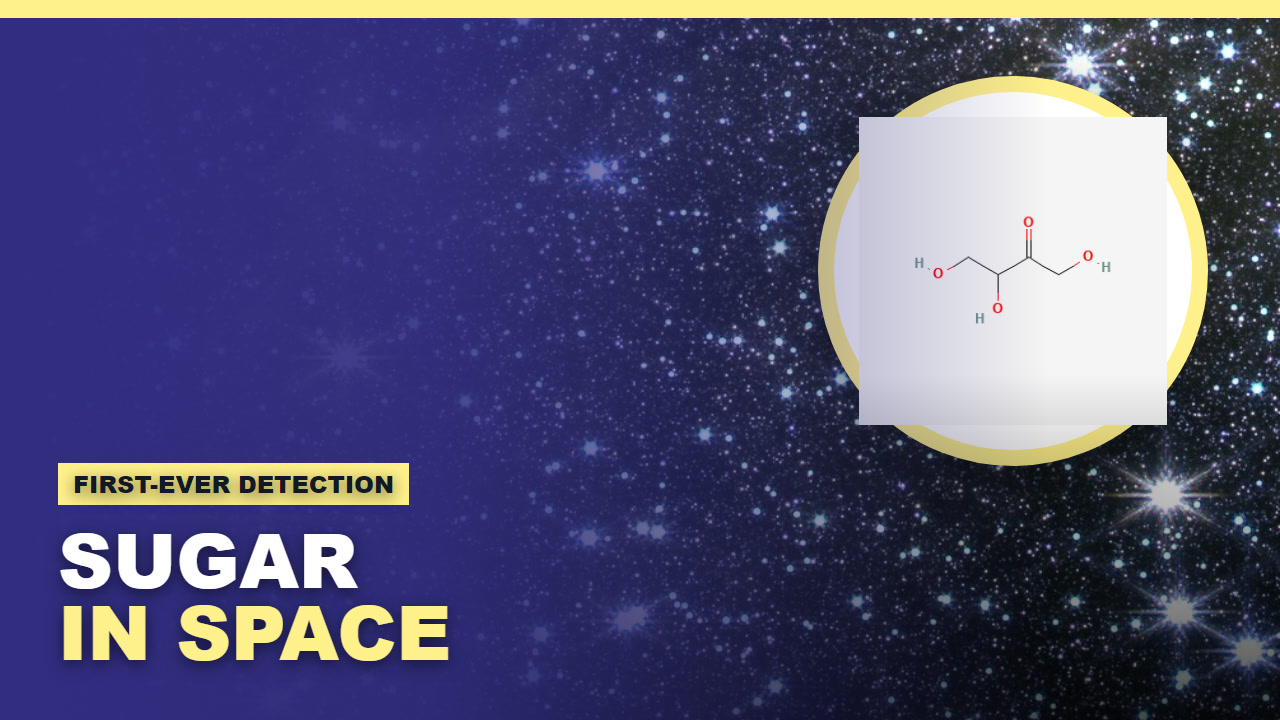
Astronomers detected erythrulose, a four-carbon sugar, in a Galactic Center molecular cloud - the first true sugar identified in interstellar space.
Space has delivered plenty of strange chemistry, but until July 2026 it had never yielded a confirmed true sugar. A team reporting in Nature Astronomy has now detected erythrulose, a four-carbon sugar, inside a molecular cloud near the center of the Milky Way.
The finding is not evidence of life. It is evidence that one of life's important classes of molecules can form before planets do, in the cold chemical environment between stars. That moves a piece of prebiotic chemistry farther upstream than scientists had been able to observe directly.
Why this counts as the first
Astronomers had previously found glycolaldehyde in interstellar space, and it is often described informally as a simple sugar. Chemically, however, glycolaldehyde is a hydroxyaldehyde rather than a true saccharide.
Erythrulose crosses that line. It is a chiral, four-carbon ketose. On Earth, sugars perform several jobs essential to biology: they provide energy, form structural materials, and help build the backbones of nucleic acids. The exact molecule detected is not a claim that RNA or life is floating in the cloud, but it expands the inventory of biologically relevant chemistry known to exist in space.
The team searched the Galactic Center molecular cloud G+0.693-0.027 using the Yebes 40-meter telescope in Spain and the IRAM 30-meter telescope in Spain. Rather than photographing molecules, radio telescopes identify the distinctive rotational frequencies molecules emit or absorb. Matching those spectral fingerprints requires accurate laboratory measurements and extremely sensitive surveys.
The signal hidden in a crowded spectrum
Sugar molecules are difficult targets. They are thermally fragile, absorb water readily, and are difficult to vaporize for conventional gas-phase laboratory measurements. Without accurate reference frequencies, astronomers cannot confidently pick their signatures out of a molecular cloud packed with signals from other compounds.
The researchers combined broadband astronomical surveys with laboratory spectroscopy, quantum chemistry, and astrochemical modeling. They reported multiple transitions consistent with erythrulose rather than relying on one isolated spectral bump.
Their analysis indicates that erythrulose is at least eight times more abundant in the cloud than comparable three-carbon sugars, which remained undetected even in the sensitive data. The models suggest the molecule can form efficiently on interstellar dust grains from simpler two-carbon aldehydes and alcohols.
A possible delivery route to young planets
Scientists have found ribose, glucose, and other sugars in meteorites and in samples returned from asteroid Bennu. Those discoveries raised a basic question: did some of that material form inside asteroids, or did the chemical ingredients begin assembling earlier in the interstellar medium?
The erythrulose detection supports the earlier route. Dust grains coated with molecules can become part of larger bodies as a star system forms. Asteroids and comets can then preserve and deliver some of that chemistry to young planets.
There is another useful property. Ketoses such as erythrulose can rearrange into aldoses when water is present. The researchers argue that interstellar erythrulose could therefore have contributed to a broader sugar inventory available to early metabolic and replication chemistry.
What the discovery does and does not mean
No one found alien dessert, a living organism, or direct proof that life began with ingredients from space. The result is more precise and more useful: a true sugar can form in an interstellar environment, and astronomers now know how to recognize it.
That makes erythrulose both a discovery and a search template. With better laboratory spectra and more sensitive surveys, scientists can look for related sugars in other clouds and test whether this chemistry is common. The first detection changes the question from whether true sugars can exist between stars to how much of them the galaxy is making.
Comments
Member comments are temporarily unavailable.
Log in to join the discussion.