
Two Rings Around a Dead Star Hint at Planetary Survivors
Published October 29, 2026

Artist's impression of the proposed J1328-1450 system, not a direct observation of rings or surviving bodies. Credit: ESO/L. Calçada.
Image credit
J1328-1450 proposed system artist impression
ESO/L. Calçada · CC BY 4.0Resized and encoded as WebP; no semantic alteration.
Four spectral peaks reveal two gas rings around white dwarf J1328-1450. Surviving bodies could help maintain the structure, but those bodies have not been directly seen.
The evidence for two rings around a dead star arrived as four peaks in a spectrum. It was not a photograph with two planets neatly picked out.
A Nature Astronomy paper published October 26 describes an unusual debris system around the white dwarf J1328-1450. ESO's October 27 explanation makes the puzzle clear: two separated gas rings appear to persist where a simpler disc signature would normally be expected. We are adding this earlier finding to our coverage with its original paper date.
Four Peaks, Two Speeds
Gas emits light at particular wavelengths. Motion shifts those wavelengths: material moving toward us contributes a blueshift, while receding material contributes a redshift. A rotating disc can therefore produce two peaks, representing its approaching and receding sides.
The X-shooter instrument on ESO's Very Large Telescope found a different pattern at J1328-1450. Its emission lines have four peaks. The team explains that signature with two gas rings rotating at different speeds, each contributing a pair.
The diagram below shows that reasoning in simplified form. It is an explanatory illustration, not the raw spectrum and not a resolved image of the rings. The distinction keeps the observation separate from the picture used to explain it.
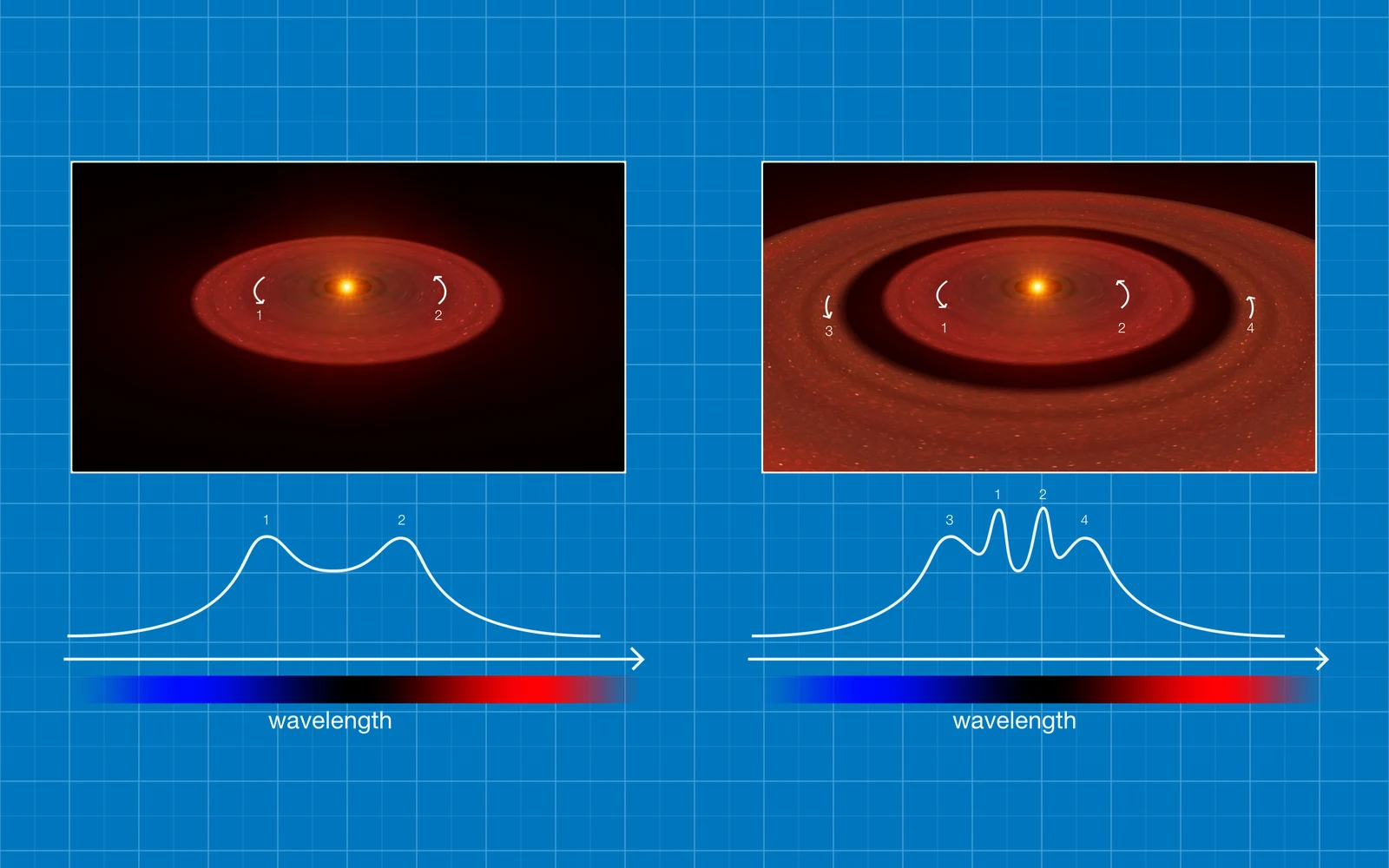
Image credit
Two versus four spectral peaks illustration
ESO/L. Calçada · CC BY 4.0Resized and encoded as WebP; no semantic alteration.
Explanatory illustration of the spectral interpretation, not the raw measured spectrum. Credit: ESO/L. Calçada.
Survivors Are the Proposed Explanation
The researchers suggest that two surviving planetary bodies help maintain the structure. Their proposed bodies range from a few kilometres across to potentially Pluto-sized. Neither has been directly photographed in these observations.
That proposal is intriguing because the central star has already passed through a destructive transformation. A white dwarf is the compact remnant of a star that exhausted its fuel and shed its outer layers. Planetary material can survive, be disrupted and contribute debris around that remnant.
The paper's important observation is the unusual spectral structure. The interpretation involving surviving bodies should stay attached to that evidence, rather than quietly become a confirmed inventory of planets. An artist's impression can show what the proposed system might look like; it cannot supply a detection the instrument did not make.
A Future to Study, Not a Forecast
ESO presents this system as a glimpse of the possible futures of planetary systems, including our own. That does not make it a detailed prediction of what the Solar System will look like after the Sun's later evolution.
Different histories can leave different survivors and debris. This system is valuable because its unexpected double-ring structure gives researchers another arrangement to explain and compare against models. The gap and the stability of the two rings make it more than a generic picture of destruction.
There is enough strangeness in the measurement itself: four peaks where a familiar single-disc signature would give two. The possible survivors make that measurement a question worth following, not a conclusion to skip ahead to.
Would you like a closer look at the spectroscopy or at how the proposed bodies could maintain the rings? Let us know in the comments below.
Keep exploring

The complete reviewed JPL rover hardware manual: parts lists, wiring, PCB assembly, mechanical chapters, original build photographs and diagrams, optional mast, and downloadable schematics.
Image credit
images/osr-side-outside.jpg
JPL / California Institute of Technology and Open Source Rover contributors · Apache-2.0Resized without cropping and converted to WebP for the project card.
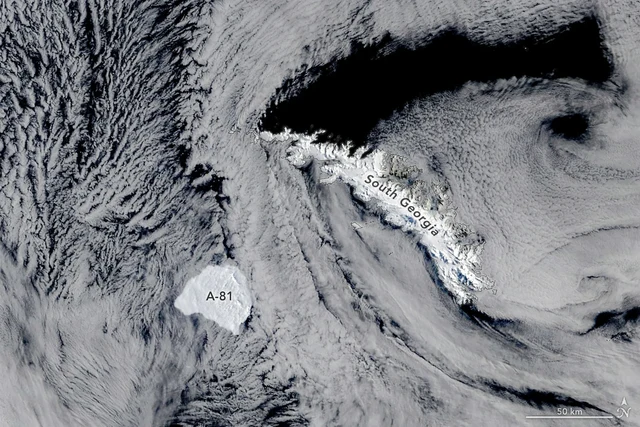
NASA's new view follows A-81 to the edge of South Georgia's underwater shelf. The iceberg is slowing after a journey that began at Antarctica's Brunt Ice Shelf.
Image credit
A-81 near South Georgia on October 20, 2026
NASA Earth Observatory/Michala Garrison; MODIS data from NASA EOSDIS LANCE and GIBS/Worldview · NASA factual editorial useResized and encoded as WebP; no semantic alteration.
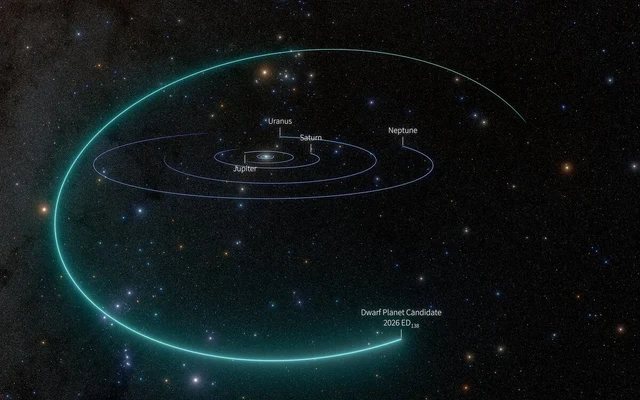
Repeated Rubin images and a decade of recovered observations revealed 2026 ED138 beyond Pluto. Its estimated size is impressive, but dwarf-planet status remains unconfirmed.
Image credit
2026 ED138 orbital model
NSF-DOE Vera C. Rubin Observatory/NOIRLab/SLAC/AURA/R. Proctor; image processing M. Zamani (NSF NOIRLab); orbit data IAU Minor Planet Center (MPCorb), funded by NASA PDCO and Tamkin Foundation; star map NASA/Goddard SVS; Gaia DR2 ESA/Gaia/DPAC · CC BY 4.0Cropped orbital model to focus on the labeled candidate and orbit; resized and encoded as WebP. Model shows its May 8, 2026 position, not a resolved photograph.
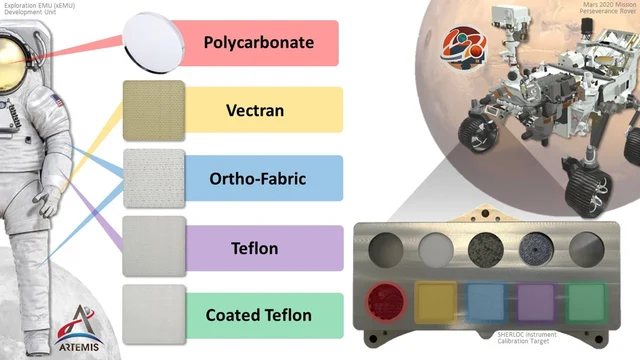
Dust down to roughly 100-300 nanometres clings to Perseverance's calibration materials. The new measurements could help engineers design cleaner suits and habitats.
Image credit
Spacesuit materials on the SHERLOC calibration target
NASA · NASA factual editorial useResized and encoded as WebP; no semantic alteration.
Comments
Member comments are temporarily unavailable.
Log in to join the discussion.