How Many Meteorites Reach Earth? Cameras Are Chasing the Answer
Published October 3, 2026
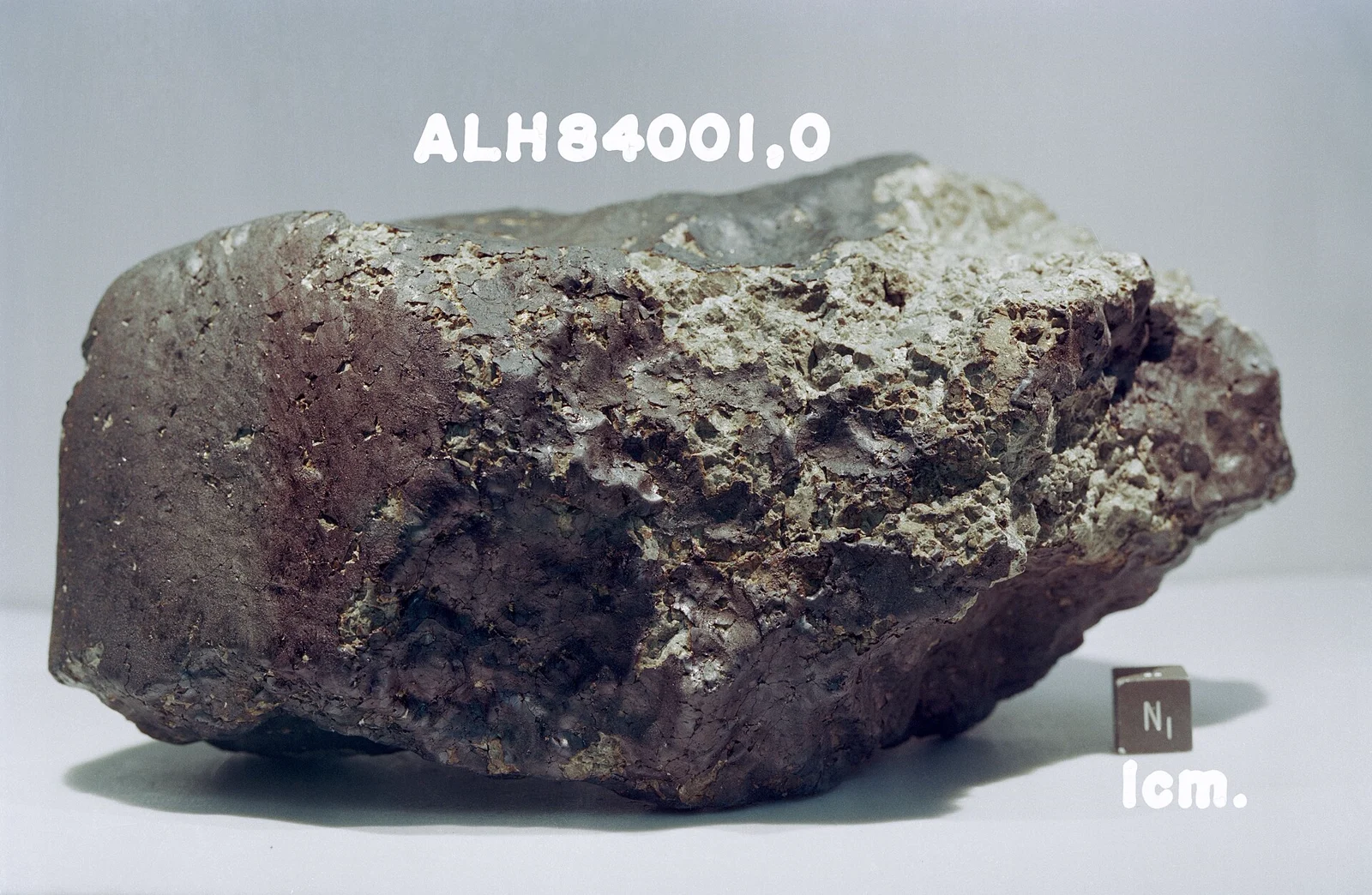
ALH84001, a Martian meteorite, in an archival laboratory photograph. This is a reference specimen, not a recovery from the new GMN study.
An October 1 research update uses Global Meteor Network fireballs to estimate surviving rocks. The hard part is turning bright streaks into a reliable rate.
A fireball can light up a sky full of witnesses and still leave a remarkably difficult question behind: did any of the rock reach the ground? Counting the flashes is one job. Counting the surviving material is another.
A new research update is tackling the second problem using a network built around inexpensive cameras and Raspberry Pi computers. The ambition is not simply a larger collection of spectacular videos. It is a defensible estimate of meteorite arrivals, including events whose surviving pieces nobody ever picks up.
What Changed on October 1
The Meteoritical Society's October 1 report describes work by Chloe Kadir, a University of Manchester researcher, with Denis Vida and collaborators at Western University in Canada. During a May-August visit, they re-measured Global Meteor Network fireballs, reconstructed their paths and orbits, and used the last observed portions of their trajectories to estimate surviving masses.
The report describes a network of more than 1,600 cameras in 45 countries. Those are the report's figures, not a live census of working stations.
There is a limit to the announcement: it does not provide a new numerical annual meteorite rate. Results were presented at September's Europlanet Science Congress, and a manuscript is being prepared. October 1 is the date of this public progress update, not the date the research first existed or a finished journal paper appeared.
A Flash, a Survivor, a Specimen
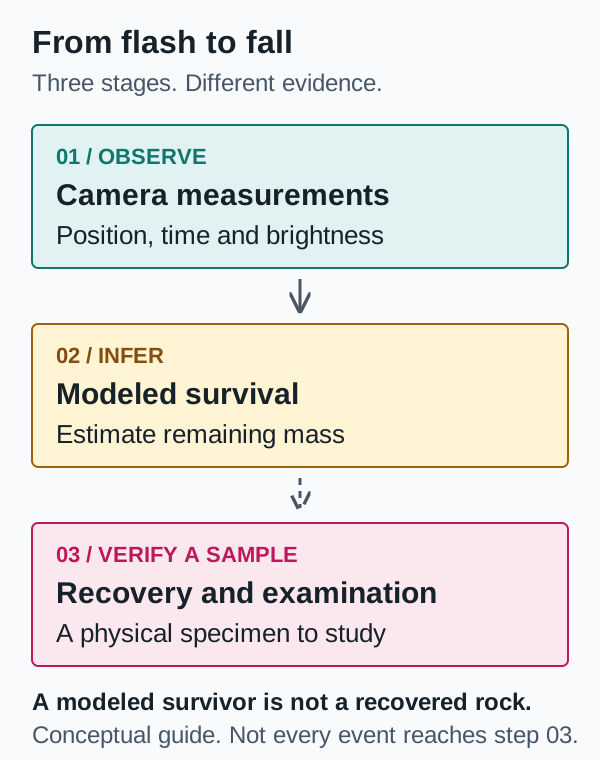
Start with the objects being counted. NASA's meteor and meteorite primer distinguishes a meteoroid in space, the meteor phenomenon during atmospheric entry, and a meteorite that survives to the ground. Those words are not interchangeable milestones in a guaranteed delivery service.
A camera records light and position. It does not weigh a stone sitting on the ground. A model can use the observations to estimate whether material survived, but an estimated survivor is not a recovered, examined specimen.
| Evidence | What it supports | What it does not establish alone |
|---|---|---|
| Recorded fireball | An observed luminous atmospheric event | A meteorite on the ground |
| Estimated terminal mass | A modeled amount remaining at the end of the observed path | Recovery or laboratory classification |
| Recovered specimen | A physical sample that can be examined | A complete count of all arrivals |
This distinction matters because a recovery catalogue and a flux estimate answer different questions. One records what was found. The other tries to account for a population, including material that escaped recovery. Treating them as the same count would build the search effort into the answer.
Pixels First, Mass Later
The team's conference abstract, updated July 2, describes uniformly reprocessing multi-station observations. Astrometry concerns where the object appears; photometry concerns its brightness. Combining those measurements helps reconstruct velocity, trajectory and fragmentation behavior before physical modeling estimates terminal mass.
That ordering is important. A survival estimate depends on the observations and the model, rather than being an extra fact directly visible in a bright photograph. The abstract describes deriving a calibrated flux and comparing it with earlier estimates, but publishes no numerical rate or uncertainty interval. The October report's wording is more provisional: work towards an updated measurement, with publication still ahead.
Keeping the measurement procedure consistent across events is also useful. Otherwise, differences between processing methods could be mistaken for differences between incoming rocks. That is our reading of why the uniform re-measurement matters, not a claim that every uncertainty has been eliminated.
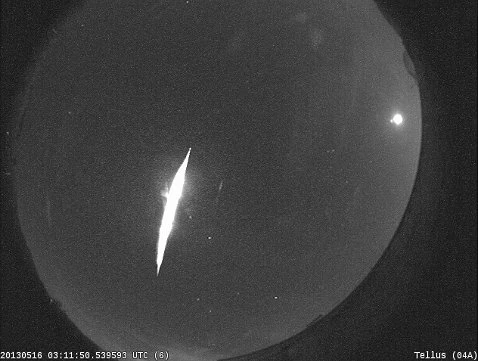
The historical account of that frame describes observations from six cameras and substantial deceleration before the object disintegrated. Brightness made it conspicuous. It was not, by itself, a certificate of a recoverable stone.
The Quiet Nights Belong in the Calculation
A flux is a rate with a denominator. The GMN team's 2022 optical-flux methods paper defines atmospheric meteor flux using counts above a mass limit divided by effective collecting area and observing time. It also explains how stellar detections help identify usable observing periods, with corrections for sensitivity and obstructions.
That paper concerns meteor-shower measurements, not a published answer to the new meteorite-survival study. It nevertheless illustrates the bookkeeping problem: a camera's presence on a map is not proof of a full night's useful coverage.
Consider two otherwise equivalent observing setups. If one collects twice as much usable area-time, the same count implies a different rate. This is an illustrative comparison, not GMN survey data. Cloudy hours, blocked views and detection thresholds therefore matter alongside the exciting detections. An impressive camera total cannot replace an exposure calculation.
What Would Make the Answer Useful?
When the manuscript appears, the things to look for are concrete: the mass threshold, usable coverage, survival-model assumptions, uncertainty, and how the estimate compares with historical measurements. Those details determine whether two quoted rates are genuinely comparable.
For makers, there is a practical way into the subject without pretending to run a meteorite census alone. The Global Meteor Network links its camera participation guide, public trajectory tools and data explorer. Its stations use open-source detection software on Raspberry Pis. A well-calibrated observation that overlaps another station's view can contribute more than an isolated beautiful streak.
The interesting next result is not merely a bigger number. It is a number whose route from camera pixels to possible ground arrivals can be inspected.
Would you rather build a sky camera or work on the data behind the detections? Tell us in the comments below.
Comments
Member comments are temporarily unavailable.
Log in to join the discussion.